

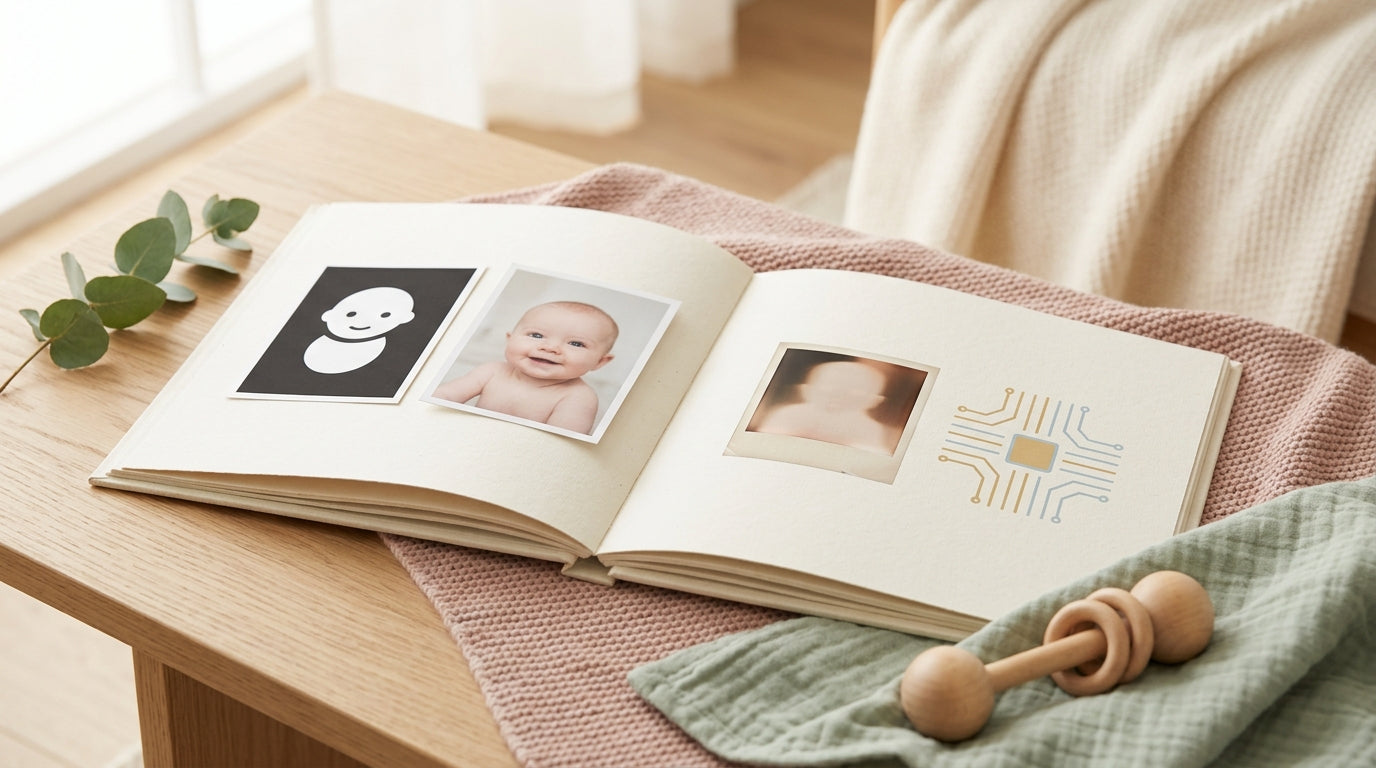
The phone on my nightstand vibrates at 4:12 in the morning. The screen lights up the dark room with another WhatsApp message from my mom, reading simply, "send more babi images." She always mistypes baby as babi, mostly because her thumbs are too fast for the tiny keyboard and she refuses to wear her reading glasses. I stare at the ceiling, covered in dried milk, trying to decide if I've the energy to scroll through my camera roll and find a picture where my son doesn't look like a grumpy old man who just got handed a bad tax return. I've seen a thousand of these newborn faces in the hospital nursery, and let me tell you, none of them are naturally photogenic.
When you've a child, your relationship with photography completely fractures into three distinct, exhausting jobs. First, you've the visual development tools, those stark black-and-white graphics you shove in their face to make their brains work. Second, you've the grueling monthly milestone photo shoots that society demands you execute. Third, you've the sheer terror of managing their digital footprint every time an extended relative demands a photo. Deciding how to handle this triad of visual chaos is exactly like triaging a crowded pediatric ER waiting room on a full moon, where you just have to prioritize the bleeding issues and ignore the rest until morning.
The contrast card hustle
Listen, before they're old enough to smile for a camera, they've to learn how to actually see the camera. When I was in nursing school, we spent maybe half a day on infant visual development, and from what I vaguely remember, their retinas are basically mush at birth. They see the world in blurry gray blobs, mostly because the neural pathways connecting their eyes to their brains haven't bothered to finish construction yet.
My pediatrician said giving them high-contrast black and white graphics is like sending their optic nerves to the gym. Apparently, looking at stark, simple patterns forces the eyes to focus and helps build up those visual motor skills. I used to think the whole monochrome nursery trend was just sad beige moms taking all the joy out of childhood, but it turns out there's actually a biological reason babies stare at bold stripes like they owe them money.
We do tummy time twice a day, and I just prop up these rigid black and white flashcards right by his head. Because the high contrast is the only thing he can clearly detect, it holds his attention long enough to distract him from the fact that he hates being on his stomach, which eventually tricks him into lifting his heavy head and building his neck muscles.
You can also just use a very simple play setup instead of buying specialized cards. We use the Rainbow Play Gym Set because it has a few basic wooden shapes and a muted elephant that gives him something distinct to track with his eyes as he lies there. It's mostly wood and doesn't play aggressive electronic music that makes me want to throw things out the window, which is a massive win for my own sensory regulation.
The pressure of the perfect monthly shot
Every single month, I drag the same blanket into the living room, lay down the little wooden numbers, and attempt to document his growth while he actively tries to ruin my life. You see these perfect milestone shots on social media where the infant is peacefully resting next to a beautifully lettered sign, but in my house, it's a sweaty, desperate wrestling match.

I've learned that if you actually want to see how much they've grown, you've to ruthlessly control the variables. You need to take the picture in the exact same spot with the exact same background item every single month, otherwise, you just have a disjointed collection of pictures that show nothing about their physical development. My son just spits up on the milestone blocks and tries to eat the blanket.
To keep the pictures consistent, I put him in the Organic Cotton Baby Bodysuit for every single monthly photo. It's my absolute favorite thing he owns because it's completely plain, doesn't have any ridiculous cartoon slogans distracting from his actual face, and the elastane means it stretches over his giant head without a meltdown. The organic cotton also doesn't cast weird synthetic shines under the camera lens, so the photos really look somewhat professional even though I'm sweating through my shirt behind the iPhone.
Sometimes you need a prop to get them to look toward the lens instead of staring at the ceiling fan. I bought the Bear Teething Rattle thinking it would look adorable as a little visual anchor in the pictures. It's honestly just okay. The wooden ring is fine for his gums, but the crochet bear part gets soggy the literal second he puts it in his mouth, which means half of my supposedly aesthetic photos look like he's chewing on a wet dish sponge.
Turn them away from direct overhead lights and just use the soft natural light bleeding in through a window so their skin doesn't look jaundiced.
Explore our organic baby clothes collection if you want clothing that seriously photographs well without screaming for attention.
What happens when you text the family chat
Now we get to the part of sharing pictures that really keeps me up at night. The moment you text a cute bath time photo to the family group chat, you lose control of where that image goes. My mother-in-law thinks Facebook is a private diary, and I've had to have some very tense conversations over lukewarm chai about why we don't post identifiable pictures of an infant on a public platform.

The tech landscape right now is basically a digital wild west, and companies are aggressively scraping public and semi-private images to train their AI models. My understanding is that once a photo of your kid is ingested by a machine learning algorithm, you can never truly delete it from the internet's collective brain. It's terrifying, yaar.
We've implemented a very strict digital privacy policy in our house that makes me incredibly unpopular with extended family. If we share photos on social media, we either photograph him from behind so you can only see the back of his head, or we cover his face entirely. And even that comes with a massive caveat.
Listen, if you're going to cover your kid's face with a smiley face emoji, you've to do it right. If you just slap a sticker over their face inside the Instagram app, the app's software still retains the original metadata and the hidden layers of the underlying image. I'm pretty sure clever algorithms can just strip the sticker away later. To seriously protect them, you've to open the photo in your phone's native editor, put the emoji over their face, save it, and then take a screenshot of that edited photo. Posting the screenshot flattens the image into one single layer, destroying the original face data underneath.
It sounds paranoid until you realize how many strangers are quietly archiving content from public profiles. I also refuse to send pictures via standard text messages anymore. We force the grandparents to use end-to-end encrypted apps like Signal or WhatsApp, which is why I get those 4 AM "send babi images" requests in a slightly more secure digital environment.
Accepting the blurry reality
You can buy all the contrast cards in the world to stimulate their optic nerves, and you can curate the most perfectly neutral outfits for their monthly photos, but the reality of photographing a baby is just profoundly messy. They grow so fast that half the time you're just capturing a blur of a hand or a double chin.
I delete about ninety percent of the pictures I take because they're objectively terrible. The ones I keep aren't usually the perfectly posed milestone shots, but the candid ones where he's looking at me with that specific, slightly confused expression he gets right after a nap. Protect their privacy, give their eyes something interesting to look at, and accept that your camera roll is going to be a disaster for the next three years.
Check out our baby toys collection to find simple, beautiful objects that look great in photos and seriously help your little one's development.
Questions you probably have at 3 AM
Are high contrast images seriously required for babies to see normally?
Required is a strong word. Your baby will figure out how to see eventually even if you just let them stare at a blank wall. But my pediatrician explained that the black and white cards just make the process easier for them. It gives their underdeveloped retinas something obvious to lock onto, which keeps them engaged longer during terrible activities like tummy time.
How do I get my baby to look at the camera for a milestone photo?
You basically have to make a complete fool of yourself. I hold my phone with one hand and frantically wave a silicone spatula with the other because for some reason kitchen utensils are more fascinating than actual toys. Don't stress about eye contact, just snap twenty photos in a row and pray one of them captures a half-smile instead of a grimace.
Why shouldn't I just use Instagram to put an emoji over my baby's face?
Because social media apps are sneaky. When you edit a photo natively inside an app, the platform often saves the original unedited file on their servers in case you want to revert the changes later. That means they still have your kid's face on file. Using the screenshot method forces the image to flatten completely, so there's no hidden face data floating around in Mark Zuckerberg's basement.
Is it okay to send photos through regular text messages?
I mean, people do it all the time, but regular SMS texts are completely unencrypted. They just bounce around cell towers in plain text, meaning your carrier or anyone with decent interception software could theoretically see them. I make my family use encrypted apps because it just adds one extra layer of friction between my son's face and the weird parts of the internet.
My mom gets mad that I won't let her post pictures of the baby. What do I say?
Blame the pediatrician, that's what I do. I just tell my relatives that our doctor strongly advised against creating a digital footprint before the child can consent. It shifts the blame off you and makes it a medical safety issue. If they still push back, just send them a blurry photo of the baby's elbow and tell them their Wi-Fi must be broken.




Share:
The Midnight Babi Meltdowns: Surviving Drool and Sleeplessness
The brutal truth about your babies vaccine schedule and tears