

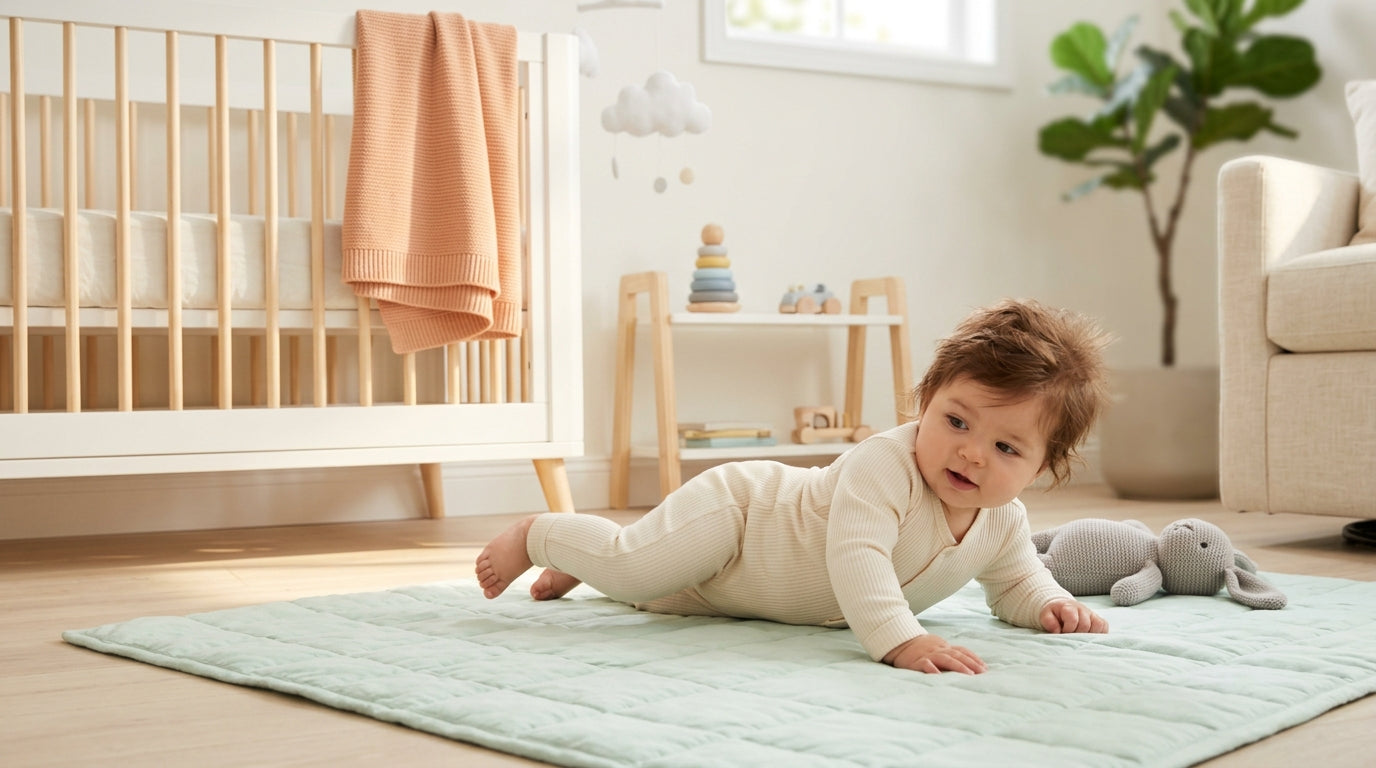
2:14 AM. The baby monitor is glowing like a radioactive brick on my nightstand. I'm staring at a grayscale pixel blob that's supposed to be my four-month-old daughter, except instead of lying flat on her back like a compliant little system process, she's completely face down in the mattress. Panic spikes into my chest. I scramble out of bed, trip hard over the humidifier cord, barge into the nursery, and aggressively flip her back over like a frantic diner cook trying to save a burning pancake.

She instantly wakes up, absolutely terrified, and starts screaming at the top of her lungs. My wife, Sarah, appears in the doorway a minute later, blinking slowly in the dark, wrapped in her robe. "Did you just wake the sleeping baby because she rolled?" she whispers.
Yes. Yes, I did. Don't do this. If I could go back in time and tell my previous self how to handle the gross motor milestone phase, step one would be: don't manually override the baby in the middle of the night just because she learned a new physics trick.
Before this specific incident, my search history was an embarrassing mess of frantic, sleep-deprived queries: is my babi broken, why is babie sleeping weird, and the classic when do babies roll. I honestly thought she would just stay exactly where we placed her until she was like, two years old and ready to walk. Apparently, babies are not static objects, and their mobility firmware updates hit you when you least expect it.
The timeline I Googled versus reality
If you look at the charts, they tell you rolling isn't a single event but a two-part release schedule. Our pediatrician, Dr. Lin, told us that V1.0 is usually tummy-to-back, which happens somewhere around 3 to 5 months. I logged this in my mental spreadsheet. From my highly unscientific observation, this first direction seems to happen mostly because their heads are basically giant bowling balls and gravity just takes over when they push up too far.
But V2.0 is the main question keeping parents up at night: when do babies roll from back to belly?
This is the tricky one. Moving from back to belly requires actual core strength, hip rotation, and intention. They can't just flop; they've to actively fight gravity. Dr. Lin mentioned this usually drops between 5 and 7 months, but babies are chaotic systems and run on their own timelines. We spent weeks watching her try to heave her little legs over her body, rocking side to side like a turtle stuck on its shell.
Beta testing the great flip
Before the actual flip happens, they do all these weird micro-movements. I'd watch her on the monitor just grabbing her own feet across her body or arching her back like she was trying to bridge out of a professional wrestling hold. To get them ready for this, everyone tells you to do tummy time.
I need to talk about tummy time for a second because it's honestly the most stressful activity I've ever been subjected to in my own living room. My pediatrician told us we should aim for an hour a day total by the time she was four months old. An hour! Do you know how long an hour is when a tiny human is just mashing her face into a rug and screaming at the floor? It feels like an eternity. We started tracking her tummy time in a spreadsheet just to prove to ourselves we were doing it, and most sessions lasted exactly 94 seconds before I had to scoop her up and apologize to her.
It feels unnatural to force your kid to do something they clearly despise with every fiber of their being, but apparently, building that neck and shoulder strength is the only way they eventually learn to lift their chest and initiate a roll.
Also, sometimes they do this thing called the Landau reflex where they arch their back and fly like a skydiver, which looks alarming but is totally fine.
We realized we needed serious motivation to get through the tummy time requirement. Enter the Panda Teether Silicone Baby Bamboo Chew Toy. I've very strong feelings about this panda. It's basically the sole reason my daughter ever figured out how to shift her weight. I'd put her on the floor and place this specific teether just out of her reach. I don't know what it's about the bamboo texture on the handle, but she became obsessed with it. She would grunt and flail and twist her hips trying to get her mouth on it, and honestly, seeing her finally rotate her shoulder to snag it was like watching the moon landing. I love this thing because it actually fits in her uncoordinated little claws.
We also tried the Squirrel Teether, which is fine and definitely food-grade silicone and very green, but my kid just stared at it like it owed her money and refused to reach for it. Your mileage may vary depending on your baby's arbitrary animal preferences, but the panda was our golden ticket.
If you're currently in the trenches of trying to distract a baby who hates being on their stomach, Kianao has a whole collection of sensory toys that might actually buy you three consecutive minutes of peace.
Sleep protocols get a massive patch update
Once you see them successfully execute a roll, or even aggressively attempt one, your entire safety protocol has to change overnight.

The hardest part for me was the swaddle transition. When do babies roll over? Usually, it happens the exact week you've finally gotten them sleeping through the night perfectly wrapped like a little burrito. Dr. Lin told us that the second she shows signs of rolling, the swaddle has to go into storage forever. Apparently, if a swaddled baby rolls face down, they don't have their arms free to push up, which is a massive safety hazard.
Taking away the swaddle ruined our sleep for two solid weeks. She would flail her arms, smack herself in the face, wake up crying, and repeat. Figuring out this transition means ditching the swaddle while simultaneously upgrading to a safe wearable sleep sack and praying they learn how to control their wildly unpredictable arm movements before you literally die of exhaustion.
We also had to completely strip the crib. Nothing but a tight-fitting sheet. Because we had to remove all blankets from her sleep space, we repurposed our favorite Bamboo Baby Blanket in the Universe Pattern for floor play instead. Since it's 70% organic bamboo, it's insanely soft, so I just spread it out on the living room rug for her to practice her back-to-belly rolls. The little high-contrast orange planets give her something to try and scratch at while she's down there, and it absorbs the inevitable massive spit-up that happens the exact second she successfully rolls onto a full stomach.
The alligator death roll on the changing table
Here's a piece of data they don't emphasize enough: once they know how to roll, they'll try to do it everywhere, all the time, regardless of the context.

Diaper changes went from a peaceful two-minute routine to a high-stakes wrestling match. Dr. Lin warned us never to step away from the changing table, not even for a second, because sudden, unexpected rolls are the leading cause of babies falling off furniture. I now change diapers with one forearm firmly pinned across her chest while my other hand frantically tries to secure the diaper tabs, sweating profusely while she attempts an alligator death roll.
To keep her slightly distracted from trying to launch herself off the dresser, I usually hand her the Llama Teether. The little heart cutout in the middle makes it super easy for her to grip with both hands while lying on her back, which occupies her arms just long enough for me to finish the job and get her safely onto the floor.
The trapped arm dilemma
The final stage of the rolling journey is the "stuck arm" phase. When they first figure out how to get from their back to their belly, they almost always pin their own arm underneath their chest. They don't understand the physics of pulling it out, so they just lay there, trapped by their own limb, screaming into the mattress.
I spent days watching her do this. I tried to physically maneuver her arm for her, demonstrating the motion of pulling it backward, and Sarah told me I looked like I was trying to teach a confused cat how to do tai chi. Dr. Lin assured us she would figure it out eventually, and we just had to let her struggle a little bit during playtime so she could learn the mechanics.
Eventually, the data normalized. She stopped getting stuck. She figured out how to sleep on her tummy without me barging in to flip her. I still stare at the monitor way too much, watching the pixels shift as she breathes, but I've stopped trying to debug her sleep positions. She's just doing exactly what her system was programmed to do.
Ready to upgrade your floor time setup? Explore our teething toys collection and organic baby essentials to survive the next gross motor firmware update.
FAQ: Troubleshooting the Flip
Is it normal that my baby only rolls over one shoulder?
Apparently yes. My daughter aggressively favored her left side for a solid month and refused to roll right, which made me worry she had some weird asymmetry bug in her code. Dr. Lin told us it's totally normal for them to have a dominant side early on, and they eventually figure out the other direction when they get bored enough.
My baby learned to roll and now they won't stop doing it in their crib at night. Help?
Welcome to the club. When they learn a new skill, their little brains want to practice it 24/7, even at 3 AM. It wrecks their sleep for a few weeks. You kind of just have to ride it out, give them tons of floor time during the day to practice, and eventually, the novelty wears off and they go back to actually sleeping.
Should I flip my baby back over if they roll onto their tummy while sleeping?
According to my pediatrician, if you put them down on their back to start with, and they're strong enough to roll themselves onto their stomach entirely on their own, you can generally just leave them there. If you try to flip them back every time like I did, nobody is going to get any sleep and your wife will be very annoyed with you.
How do I get them to stop hating tummy time so they can learn to roll?
You probably can't make them love it, but you can distract them. I had to get down on the floor face-to-face with her, make weird noises, and use a very specific silicone panda teether to keep her from melting down. Short bursts of a few minutes throughout the day worked way better for us than trying to force a marathon session.




Share:
When Do Babies Roll From Back to Belly
When Do Babies Finally Learn To Hold Their Own Bottle?