

My mother-in-law was standing in my Chicago kitchen holding a cardboard box of rice cereal like it was some sort of ancient religious artifact. She kept telling me my four-month-old needed a heavy scoop of it mixed into his nighttime bottle so he'd finally sleep through the night. She meant well. She really did. But my eye was twitching.
Listen, I spent years working as a pediatric nurse before trading my scrubs for yoga pants and a toddler who currently thinks sleep is a punishment. I've seen a thousand of these aspirated rice cereal cases in the ER. A panicked parent brings in a coughing infant who choked on beige sludge because their tiny digestive system and airway weren't ready for a thick milkshake of grains.
The transition to solid meals is probably the most anxiety-inducing milestone for new parents. You're constantly second-guessing the timing, the texture, the temperature. You just want someone to give you a definitive date on the calendar, but human biology doesn't care about your planner.
The big rice cereal lie
There's this pervasive myth that four months is the magic starting line for solids, mostly pushed by older generations who survived the nineties and think we're all being overly dramatic. My own pediatrician gently suggested we ignore the noise and aim for roughly six months.
Why six months. Because around that time, the iron and zinc reserves they happily stole from your body during pregnancy start running on empty. Breast milk and formula are amazing, but they eventually stop cutting it for those specific minerals. The medical community basically assumes their little kidneys and guts are robust enough by half a year to handle something other than liquid gold.
But the science on timing is honestly pretty squishy. You can't just flip a switch on their half-birthday and expect them to suddenly digest a carrot. You have to look at the actual kid in front of you.
Physical clues that actually matter
In the hospital, we use triage to assess a patient's status at a glance. You don't just read the chart, you look at how they're breathing, their color, their posture. I applied that exact same visual triage to my son when we were debating his first meal.
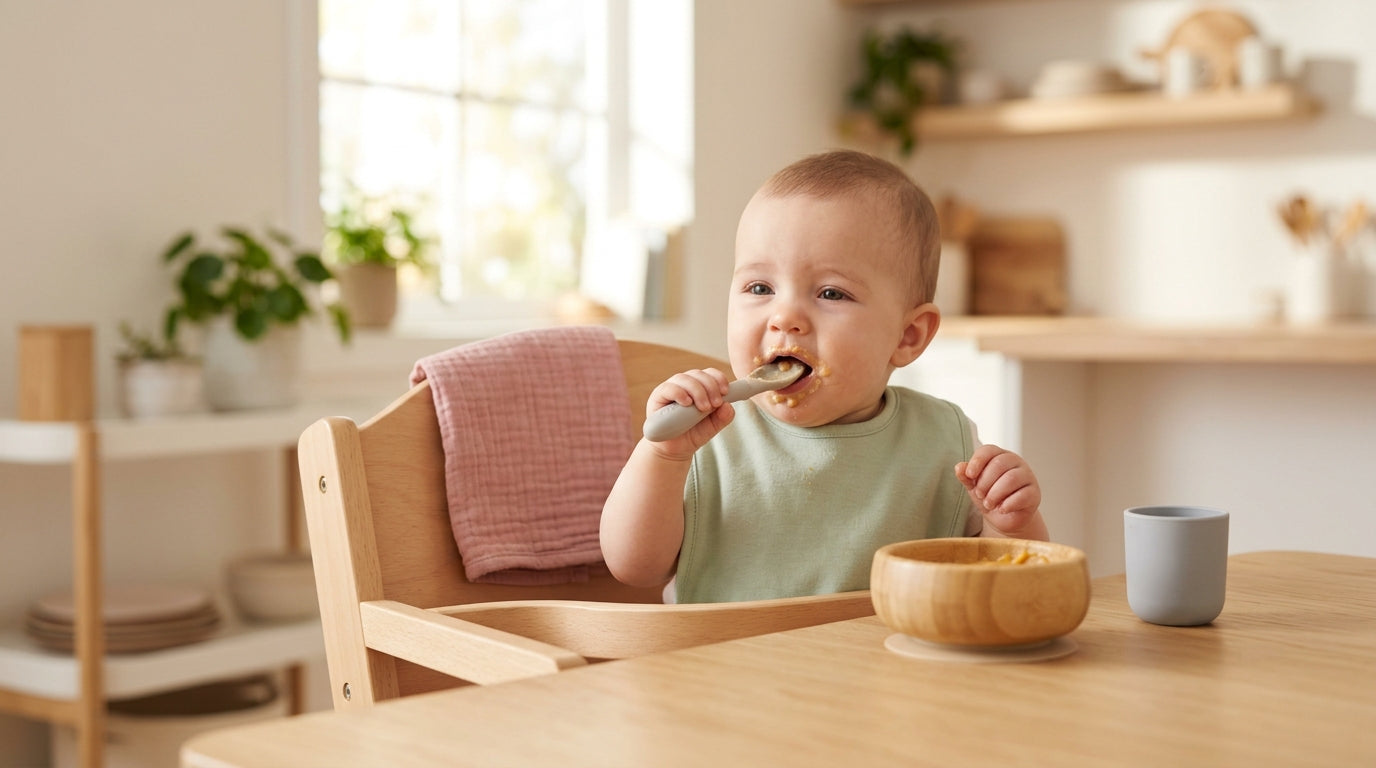
You're basically waiting until they can sit upright like a tiny, demanding dictator without slumping over, lose that weird reflex where they spit everything out like a human Pez dispenser, and weigh roughly double what they did at birth. If you try to feed a floppy baby who keeps thrusting their tongue out, you're just going to end up wearing the sweet potatoes.
They also need to show some actual interest. My nani used to call him her little babi, and this little babi would literally track my fork with his eyes and drool whenever I ate pizza. That was my first clue. The mouth preparation phase usually starts way before the actual food does. They start gnawing on their own fists, your shoulder, the dog's ear.
Before we even attempted a spoon, we relied heavily on the Handmade Wood & Silicone Teether to satisfy that oral fixation. I actually loved this thing. The untreated beechwood gave him a firm, natural surface to mash his sore gums against, and I didn't have to stress about him swallowing cheap plastic splinters. The silicone beads had this squeaky resistance he was obsessed with. It lived at the bottom of my diaper bag for six solid months, covered in lint, but it washed off easily in the sink.
We also tried the Llama Teether around the same time. It's cute enough. It does the job. But the little heart cutout in the middle got incredibly slick with spit after five minutes, and he'd just drop it on the floor repeatedly. It's fine for keeping them occupied while you figure out how to steam a zucchini, but it wasn't our daily driver.
The puree police and the meatbone crowd
Listen, the internet will have you believe that if you feed your child a mashed pea from a spoon, you're stifling their independence and raising someone who won't ever learn to chew properly. The baby-led weaning police are everywhere, lurking in Facebook groups, demanding you hand your six-month-old a massive, unseasoned lamb chop to gnaw on.

I tried it once because the peer pressure got to me. I roasted a perfect strip of bell pepper. My kid looked at it, picked it up with two fingers, wiped it across his forehead, and threw it at the cat. It was a complete disaster. He wasn't eating, he was just conducting a messy physics experiment.
Then you've the puree purists on the other side. These moms are buying four-hundred-dollar baby food makers to steam organic parsnips into a fine, flavorless foam. They boast about their freezer stashes of color-coded silicone cubes. It's exhausting just watching their Instagram stories. The truth is, it really doesn't matter what method you choose because they'll eventually just eat stale french fries off the floor of your minivan anyway. Purees, toast strips, a chaotic mix of both, whatever keeps you from crying in the pantry is the right choice.
Oh, and don't give them fruit juice under a year old since it's basically just sugar water with a good PR team.
Peanut butter roulette
This is where the medical advice flipped completely and gave every millennial parent whiplash. A decade ago, we told parents to treat peanuts like radioactive material until the kid was in kindergarten. Now, we're essentially telling you to rub peanut butter on their gums the second they hit six months.
The studies vaguely suggest that if you introduce the highly allergenic stuff early and often, their immune system might not freak out as much later, though honestly immunology sometimes feels like educated guessing. Eggs, dairy, soy, wheat, fish, peanuts. You're supposed to get it all in there.
My strategy was simple cowardice. I mixed a tiny bit of smooth peanut butter with some breastmilk to thin it out. I only gave it to him in the morning. Why the morning. Because if they blow up with hives, you want it to happen at nine in the morning when the pediatrician's office is fully staffed, not at two in the morning when you're panicking in an ER waiting room sitting next to someone with a weird rash.
If you're already feeling the blood pressure rise just thinking about this transition, take a breath and maybe browse some of the gear on Kianao to feel a bit more prepared before the chaos begins.
The terror of the gag reflex
Feeding an infant is basically a hostage situation. You're trapped in a chair, covered in sticky residue, negotiating with a tiny terrorist who can't speak but has strong opinions on texture.

You're going to see them gag. It's going to happen. I've worked in trauma, and watching my own kid gag on a piece of banana still made my heart stop. Their face turns red, they make this horrific seal noise, and their eyes water. But they're breathing. Gagging is just their body's dramatic way of moving food around a mouth that doesn't know how to chew yet.
Choking is completely different. Choking is silent. Choking is when you need to act. That's why you don't give them hot dogs, whole grapes, popcorn, or raw carrots. You keep those babie-doll sized spoons moving with soft, manageable things.
To survive the mess, you need to lock things down. We started using Wood & Silicone Pacifier Clips to tether his chew toys directly to his bib while he sat in the high chair. When you're trying to coax a spoonful of mush into a moving target, the absolute last thing you want is to be bending over to pick a dropped toy off the dog-hair-covered floor every thirty seconds. These clips grabbed the fabric tightly, and since they're just wood and silicone, I didn't care when he inevitably sucked on the clip instead of the food.
The waiting game
The most annoying part of this whole phase is the waiting. You're supposed to introduce one new single-ingredient food at a time and then wait three to five days. It's incredibly boring.
But if you give them a smorgasbord of sweet potato, egg, and yogurt on Monday, and they wake up Tuesday covered in a rash, good luck figuring out which food betrayed you. You have to move slow. And you've to expect rejection.
It takes a ridiculous number of tries for them to realize broccoli won't kill them. They'll spit it out. They'll smear it in their hair. Don't take it personally. Just wipe their face, throw the bib in the wash, and try again tomorrow. They won't go to college drinking formula, I promise.
Before you dive into the pureed peas and the inevitable mess, grab some reliable pacifier clips and safe teethers from Kianao to help you survive the transition.
Unfiltered FAQ
How do I know if they're actually hungry for real food
Listen, they won't politely ask for a menu. They'll just start staring at your dinner like they want to fight you for it. If they're grabbing at your plate, mimicking your chewing motions, and acting like their milk isn't cutting it anymore, they're probably ready to experiment with some mush.
Is it bad if my kid refuses everything but fruit
No, it's just human nature to prefer things that taste good over things that taste like wet dirt. Keep offering the green beans alongside the apples. Don't make a huge deal out of it. If you act stressed, they'll sense the weakness and dig their heels in. Just keep putting it on the tray and look away.
What should I do if they gag on a puree
You sit on your hands and wait a second. Your instinct is to jam your finger in their mouth, which is the worst thing you can do because you might push the food further back. If they're coughing and making noise, let them work it out. They have a hyperactive gag reflex designed exactly for this learning curve.
Do I really have to skip the salt and sugar
Yeah, you kind of do. Their kidneys are tiny and still figuring out how to filter trash out of their blood. They don't need a salted rim on their mashed peas. Their taste buds are a blank slate, so they don't even know what they're missing yet. Save the seasoning for your own plate.
How much food are they supposed to eat at first
Hardly any. Like, a tablespoon. We're talking about a stomach the size of a small fist. The first few months are just target practice and sensory play anyway. Their main nutrition still comes from breastmilk or formula until they're a year old, so don't stress if most of the puree ends up in their eyebrows.




Share:
When Can Babies Eat Solid Food Without Ruining My Life
Why I Am Spiraling About Sibling Rivalry and the Baby Jane Cast