

It was 7:13 AM on a Tuesday, raining sideways against the kitchen window, and Evie was actively trying to consume a stray piece of dog kibble while her twin sister, Maisy, methodically unrolled an entire two-pound pack of toilet paper. I hadn’t slept properly since roughly 2021. The kettle had just boiled. I needed three minutes—just three consecutive minutes—to pour water over a tea bag and stare blankly at the wall.
So, I did what any desperate modern parent does: I reached for the remote. I clicked over to a streaming service and noticed they’d made a prequel spin-off. Baby SpongeBob. It seemed harmless enough, right? I watched the original in the 90s, and I turned out reasonably fine (minus the mild caffeine dependency and the fact that I’m currently taking orders from two toddlers). How much damage could a miniature, high-pitched yellow sponge do in the time it takes to brew an Earl Grey?
The answer, as I discovered exactly nine minutes later, is a catastrophic amount.
The moment I turned off the television to hand them their toast, the living room descended into a state of anarchy that would make a football hooligan blush. Toast was thrown. Tears were shed. Evie lay face-down on the rug, emitting a low, continuous drone like a malfunctioning fridge, while Maisy forgot how to put on her own slippers, a skill she had proudly mastered just the day before. The withdrawal was instantaneous, violent, and entirely my fault.
The nine-minute brain fry
I mentioned this spectacular parenting fail to our GP during a routine check-up, half-expecting him to tell me I’d ruined them for life. He just sighed—a deep, medical sigh—and muttered something about hyper-stimulation and developing synapses that I barely caught because Maisy was trying to dismantle his stethoscope.
Curiosity (and parental guilt) drove me to Google it at 3 AM. As it turns out, I’d stumbled backward into what actual researchers have known for a while. I read some vague summary of a study suggesting that fast-paced cartoons temporarily break a toddler's brain. Apparently, in these frantic, neon-soaked shows, the scene changes on average every 11 seconds. Think about that. Every eleven seconds, it's a new angle, a loud noise, a flash of surreal animation. It's like being trapped in a nightclub run by feral hamsters.
By the time my tea was brewed, the twins had been subjected to so many rapid-fire visual edits that their tiny frontal lobes were absolutely exhausted. The internet called it a drop in "executive function," which is a very polite, clinical way of saying they had lost all ability to control their emotions, remember multi-step instructions, or tolerate the soul-crushing disappointment of being handed a piece of toast that was cut into rectangles instead of triangles.
I suddenly understood why the sudden proliferation of baby SpongeBob merchandise—from branded nappies to loud, flashing plastic toys—made me so twitchy; it’s all tied to an aesthetic that’s basically adrenaline in visual form.
We had to completely rethink our mornings. If you ever find yourself desperately tempted to rely on a manic animated sea creature to buy yourself three minutes of peace while you desperately try to assemble a sandwich, I highly suggest throwing a pile of delightfully boring, analog shapes at your children instead and walking away.
Gloriously boring objects to the rescue
The antidote to the hyper-stimulated screen meltdown, as we discovered through sheer trial and error, is absolute, glorious boredom. Not actual boredom, but things that require the child's brain to do the heavy lifting rather than having a screen scream at them.

After the television incident, I needed something to decompress them. I pulled out the Gentle Baby Building Block Set. These are, hands down, the best thing we own, mostly because they do absolutely nothing on their own. They don't beep. They don't flash. They don't switch scenes every eleven seconds.
They're just squishy, macaron-colored blocks made of soft rubber. But to a two-year-old recovering from a digital hangover, they're magical. Maisy spent a solid twenty minutes just figuring out how to stack three of them on top of each other, while Evie took on the role of Godzilla, knocking them down the second Maisy succeeded. They’re BPA-free, which is great because Evie still tries to eat them on occasion, and they've these little animal symbols and numbers on the sides.
It forced their brains to slow down. They had to use their hands, feel the textures, and actually think about physics (or whatever the toddler equivalent of physics is—mostly just gravity and spite). When they play with these, the house goes quiet in a way that feels productive, not ominous.
Looking for ways to keep little hands busy without the flashing lights? Browse the Kianao sustainable toy collection for screen-free sanity savers.
The teething loophole
Of course, there are times when you resort to screens because there's an underlying medical crisis happening in their mouth. Teething is the universe's way of punishing parents for finally getting their babies onto a sleep schedule.
When those molars start moving, the twins become inconsolable little strangers. You'll try anything. We were gifted a Violet Bubble Tea Teether during a particularly brutal week of drool and screaming. I’ll be honest, it’s a bit trendy for my liking—I barely know what a boba pearl is, let alone why a baby needs a silicone representation of one—but I can't argue with the results.
It has this textured "cream" area at the top that Evie gnawed on like a feral badger for three days straight. It’s 100% food-grade silicone, and you can chuck it in the fridge (which I highly think, as the cold seemed to numb her gums enough that she stopped trying to bite the sofa cushions). It kept her occupied and out of pain long enough for me to cook dinner without needing to turn on the telly to distract her. Sometimes, a slightly absurd-looking teething toy is all that stands between you and another desperate foray into digital babysitting.
Looking backward (and down at the rug)
It made me nostalgic for the days when they were immobile blobs. Before they could walk over to the TV stand and demand entertainment. When they were about six months old, keeping them stimulated without overwhelming them was so much simpler.

We used to just lay them under a Rainbow Play Gym Set. It was brilliant. It's just a wooden A-frame with a few natural, animal-themed toys hanging from it. No batteries, no synthetic noises. Just a wooden elephant and some rings that make a gentle clacking sound when a baby accidentally swats them.
I look back on those days fondly. They’d lie there, staring at the gentle earthy tones, trying to figure out depth perception, totally at peace. It was Montessori-ish before I even knew what that meant, and it certainly didn't leave them with the emotional regulation of a tired honey badger.
Someone at a playgroup recently suggested I try swapping the cartoons for an "interactive toddler phonics app" on a tablet instead, which took exactly four seconds for me to completely disregard.
Embracing the slow play
We haven't banned the TV entirely—I'm a parent, not a martyr. But we’ve completely changed what we watch. If I absolutely need twenty minutes to prevent dinner from catching fire, I put on slow-paced documentaries about trains, or cartoons that feature real-time pauses and realistic situations.
The manic, scene-splicing, hyper-colored world of baby SpongeBob and its chaotic cousins is permanently off the menu in our flat. I’d rather deal with the mess of a hundred wooden blocks scattered across the lounge floor than deal with the psychological fallout of a nine-minute cartoon binge.
Parenting is hard enough without actively sabotaging their tiny, fragile attention spans. Keep it boring. Keep it analog. Let them chew on fake bubble tea and stack rubber squares. Your future self, standing in the kitchen drinking a lukewarm cup of tea in relative peace, will thank you.
Ready to swap the screen time for toys that actually help their brains grow? Explore Kianao's full range of sustainable baby essentials today.
Frequently Asked Questions (Because we're all just guessing here)
Did I permanently break my kid by letting them watch fast cartoons?
I highly doubt it, though my Google spirals at 2 AM would tell you otherwise. My health visitor basically said the effects are temporary. Their brains just get incredibly tired from trying to process a scene change every eleven seconds. They bounce back once you turn it off and let them play with something physical, though you do have to survive the immediate, apocalyptic meltdown first.
How do I deal with the post-screen tantrums?
I usually just sit on the floor with them and wait it out, honestly. The worst thing I can do is try to rationally explain to a two-year-old why they can't watch more TV when their brain is buzzing with artificial adrenaline. I just offer a hug, let them scream it out, and subtly slide some wooden blocks into their line of sight. Eventually, the urge to build a tower overrides the urge to scream.
What kind of toys actually replace the TV?
The boring ones. I used to think toys needed to light up and play Beethoven to be "educational," but it's the opposite. Stuff that just sits there—blocks, wooden rings, sensory toys—forces them to create the action. It takes a few days for them to get used to entertaining themselves, but once they do, it's brilliant.
Can I use a tablet instead of the television?
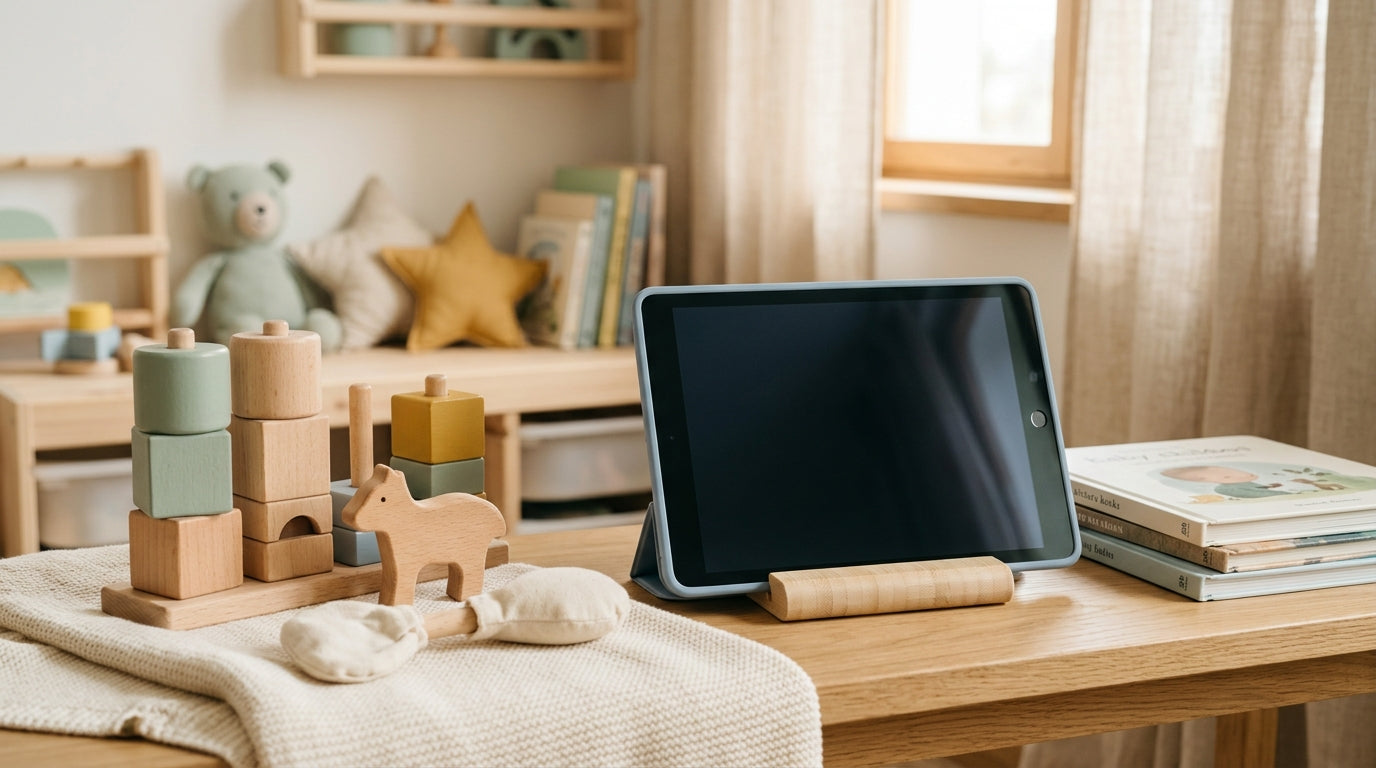
I mean, you can do whatever you want, but from my exhausted perspective, a tablet is often worse. It’s right in their face, and the apps are designed to be addictive. Whenever we tried an "educational" app, the twins ended up fighting over who got to tap the screen, and taking it away was like disarming a bomb. I'll stick to physical toys, thanks.
What if I just need 10 minutes to shower?
We've all been there. If you've to use a screen, look for shows that move at the pace of real life. Things where the characters speak slowly, pause for answers, and don't feature explosions of color every five seconds. Or, if they're young enough, stick them in a safe space with a wooden play gym. Sometimes, just letting them roll around with a safe silicone teether on the floor of the bathroom while you wash your hair is the greatest victory of the day.




Share:
Dear past me: when your baby spitting up a lot feels like too much
The Truth About Baby Squid: Seafood Purées and Screen Time Bugs