

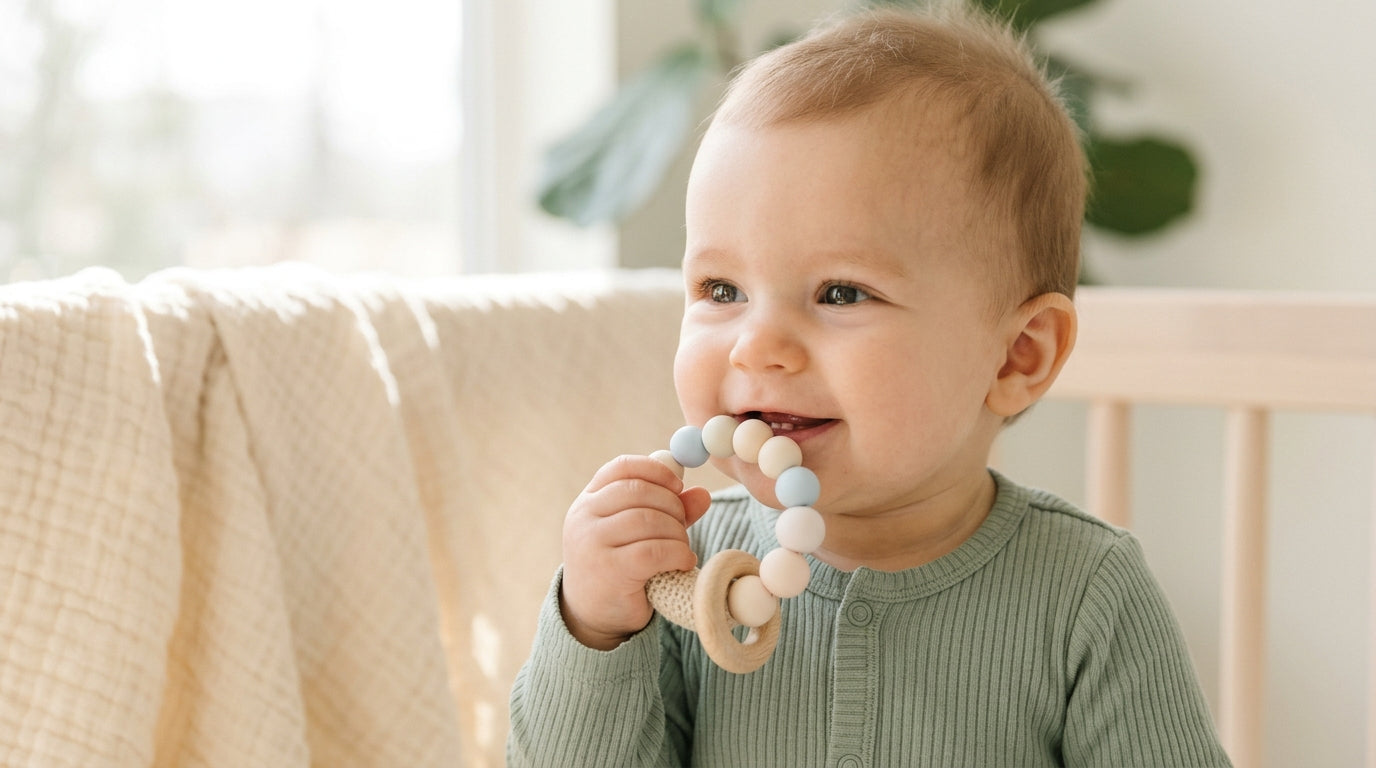
It was 3:14 AM on a Tuesday, and the Portland rain was actively mocking my sanity by drumming a steady, chaotic beat against the bedroom window. The baby, who usually just gives a polite little squawk when he wants milk, was emitting a sound that I can only describe as a system-level hardware failure alarm. I picked him up, and my hand immediately slipped. His entire chin, neck, and the collar of his fleece pajamas were coated in a thick, viscous layer of drool. I wiped my hand on my pants, grabbed the digital thermometer with my other hand, and waited for the beep. 99.4°F. I stood there in the dark, furiously thumbing typos into my phone like babie temperature and why is my babi leaking fluid, until my wife Sarah gently took the phone out of my hand. "He's just teething, Marcus," she sighed, already pulling a fresh onesie from the drawer.
I had entirely missed the memo on this. As a software engineer, I kind of assumed human development ran on a strict release schedule. You hit a certain age, a biological cron job executes, and boom—teeth deploy. Apparently, biological firmware is way messier than that, and nobody warned me that the installation process involves quite so much localized flooding.
The deployment schedule makes zero sense
The next morning, armed with an espresso and a wildly inaccurate sense of confidence, I decided to map out the exact timeline. I wanted data. I wanted a spreadsheet. I wanted to know precisely when do babies transition from gummy little blobs to creatures capable of destroying a saltine cracker.
What I found was a statistical nightmare. The literature essentially says teeth might show up whenever they feel like it. I asked my pediatrician at our next checkup, hoping for a firm deadline. She just laughed and told me her own daughter didn't get a single tooth until she was 14 months old, while another kid in her practice was born with one already poking through. That completely broke my mental model. How do they process solid food? Do their gums just harden into little anvils? Apparently, yes, they do.
My pediatrician did map out a "standard" progression for me, though she prefaced it by saying our kid would probably ignore it entirely. Supposedly, it rolls out in symmetrical batches, which at least appeals to my need for order:
- The bottom front units: Apparently these lower central incisors show up between 6 and 10 months. These are the ones that turn your sweet child into a tiny, drooling vampire.
- The top front units: Upper central incisors arrive around 8 to 12 months, completing the classic "I'm going to bite your shoulder" look.
- The side pieces: Lateral incisors follow up top and bottom somewhere between 9 and 16 months.
- The heavy chewers: First molars allegedly drop in between 13 and 19 months, which I'm actively dreading because those sound massive.
- The pointy ones: Canines fill the gaps around 16 to 23 months.
- The back hardware: Second molars finish the set right around the time they hit terrible twos, just to make sure maximum chaos.
Our guy was right around seven months when the first white nub breached the surface. I only noticed because he bit my knuckle while I was trying to extract a piece of rogue lint from his mouth, and it felt like I'd been tagged by a tiny shard of glass.
The error codes are mostly fluid
Let's talk about the drool. I feel like nobody adequately prepared me for the sheer physics of teething saliva. I thought I understood fluid dynamics, but this kid defied the laws of conservation of mass.

For about three weeks straight, he was a localized biohazard zone. We'd put a dry bib on him at 8:00 AM, and by 8:12 AM, it looked like he'd been caught in a monsoon. I started tracking our laundry loads just out of morbid curiosity. We went from doing a load of baby clothes every three days to running the machine daily. I bought a stack of thick, organic cotton bibs thinking they would serve as an impenetrable moisture barrier, but he just chewed on the bibs until they functioned like a wet sponge resting directly against his chest.
The worst part was the rash. Because his chin was perpetually submerged in a shallow pool of his own making, his skin got bright red and angry. I tried gently dabbing his face with a tissue every ten minutes, which just annoyed him and made him thrash around, smearing the drool into my eyes. My wife finally showed me how to apply a thick layer of healing ointment to act as a hydrophobic shield, which worked great until he wiped his greasy little chin all over the couch cushions.
My mom kept warning me that the teething would destroy his sleep architecture entirely, but honestly, his sleep was already such a fractured mess of random wakings and bizarre sleep regressions that we barely noticed a difference.
Hardware that actually worked
Because I can't fix his biological code, I threw myself into acquiring hardware patches. I researched teethers like I was speccing out a new server rack. I learned that you're supposed to avoid liquid-filled rings because they can burst, and you definitely shouldn't put things in the actual freezer because the ice can damage their already sensitive gum tissue.

My absolute favorite, the one that saved us from total midnight meltdowns, is the Silicone Sloth Teether. I don't know what kind of ergonomic wizardry went into designing this thing, but it's perfect. The silicone is squishy but resilient, and the little sloth arms are shaped exactly right to reach the back corners of his mouth where my fingers couldn't safely go. Plus, you can toss it in the fridge for twenty minutes. Whenever he started doing that frantic, open-mouthed head-shaking thing, I'd hand him the cold sloth, and the localized cooling seemed to reboot his whole nervous system. I actually caught myself holding it once, just admiring the structural integrity of the silicone branches.
On the flip side, we also have the Bunny Teething Rattle. Sarah bought this one because it matches the nursery aesthetic, and I'll admit, the untreated beechwood and soft crochet yarn look infinitely better than the neon plastic junk covering our living room floor. It's supposed to offer contrasting textures for sensory development. The problem is that my son's motor control is still in beta testing. He grabbed the wooden ring, got overly excited by the rattling sound, and immediately bashed himself in the forehead with the hard wood. He cried, Sarah glared at me like it was my fault, and the bunny got temporarily relegated to a top shelf. It's a gorgeous piece of craftsmanship, but maybe better suited for a kid who understands basic tool safety.
We did have better luck using the Zebra Rattle Tooth Ring strictly as a visual distraction while he was in his high chair, mostly because the high-contrast black and white stripes would temporarily mesmerize him into forgetting his mouth hurt long enough for me to spoon-feed him some cold applesauce.
The toothbrush patch
Once that first jagged little tooth actually cut through, the rules of the game changed immediately. I was perfectly happy just letting him gum his toys to death, but my pediatrician politely informed me that oral hygiene starts the second you see enamel.
We had to start brushing a single, microscopic tooth twice a day. I bought a tiny toothbrush with bristles so soft they felt like a cloud, and I dabbed an amount of fluoride toothpaste onto it that was roughly the size of a single pixel. Trying to brush an angry, squirming 8-month-old's mouth is an exercise in futility. I usually just end up shoving the brush in there and letting him chew on the bristles for thirty seconds while I make exaggerated brushing noises. I'm pretty sure he thinks it's a game, but the pediatrician said any friction is better than no friction, so I'm logging it as a win.
If you're currently deep in the drool trenches and frantically searching forums at 3 AM to find out exactly when do babies teeth decide to stop ruining your life, just know there's no exact science here. They show up when they show up. Get yourself a thick stack of washcloths, order a few solid silicone teethers to keep in the fridge rotation, and accept that your left shoulder will be slightly damp for the next six months.
If you need some reliable hardware to help troubleshoot the biting phase, you can dig through Kianao's teething toys collection for options that won't leak toxic goo or break apart in your kid's mouth.
Now, if you'll excuse me, I need to go pry the TV remote out of my son's mouth before he drools directly onto the battery compartment.
Midnight troubleshooting FAQ
Does teething seriously cause a fever?
I was fully convinced it did, because the night before his first tooth popped, his forehead felt like a laptop running a heavy compile job. But my pediatrician firmly told me that teething doesn't cause true fevers over 100.4°F. She said the swelling might make them run a tiny bit warm (which explained his 99.4°F reading), but if they're honestly burning up, there's a virus in the system, not just a tooth.
What about those amber teething necklaces?
My aunt sent us one in the mail with a long, handwritten note about ancient holistic energy. I spent ten minutes researching it online, read three different warnings from the FDA about severe choking and strangulation hazards, threw the necklace directly into the garbage, and just gave him a wet washcloth to chew on instead. I don't mess around with neck jewelry on a creature that routinely tries to eat dirt.
Can I use numbing gel on their gums?
Apparently not anymore. I remember my parents using that stuff on my younger brother, but doctors now say gels with benzocaine are a massive safety risk for infants. I guess it can lower the oxygen in their blood, which sounds terrifying. I asked about homeopathic tablets too, and the doctor basically rolled her eyes and said they're unregulated and sometimes contain belladonna. So we stuck strictly to mechanical cooling—chilled silicone and cold cloths.
How do I stop him from biting my fingers?
If you figure it out, please let me know. I tried firmly saying "no," which he thought was hilarious. Now, the second I see his jaw lock onto my hand, I quickly break the seal and shove his cold sloth teether into his mouth instead. It's basically an endless game of redirecting the damage to an approved target.




Share:
The Absolute Chaos of When Do Baby Teeth Fall Out (And What to Do)
When Will My Baby Actually Roll Over? A Dad's Data Log