

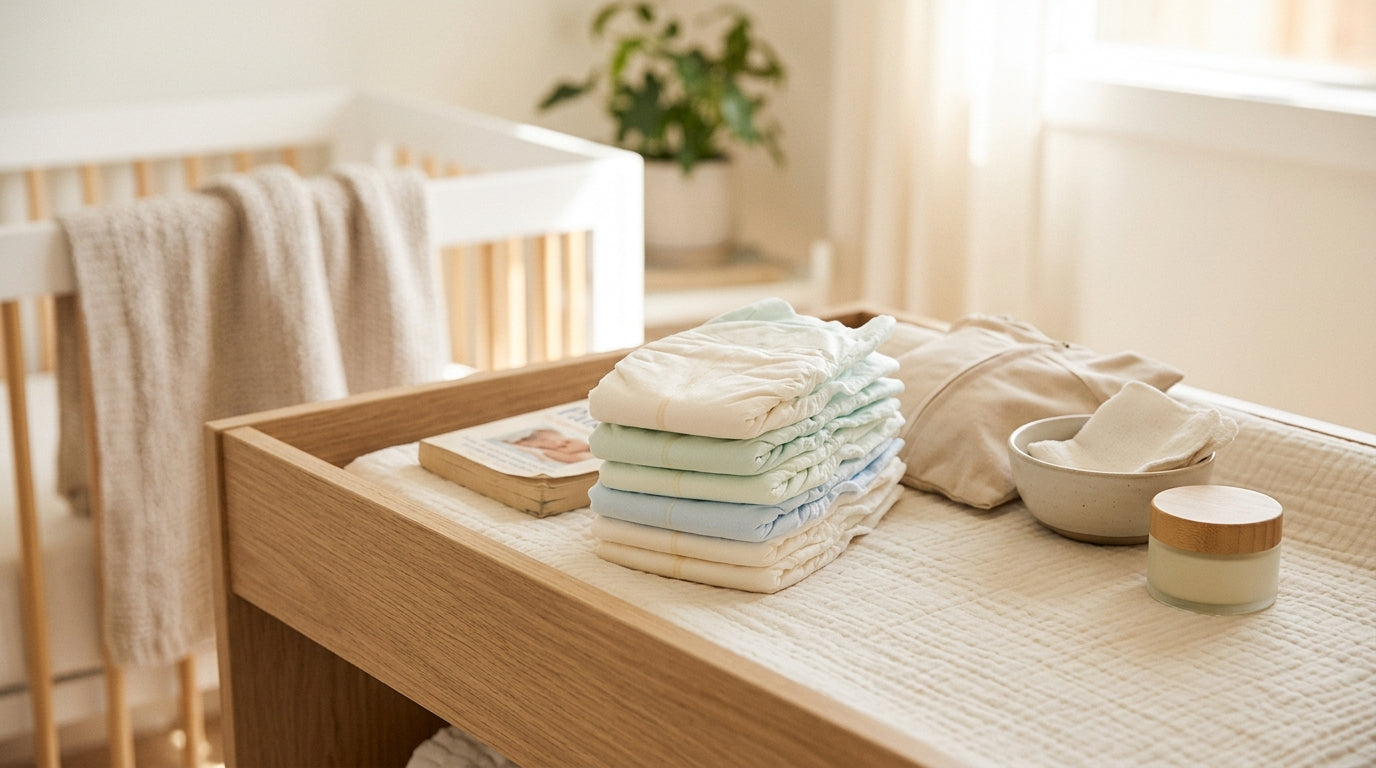
Dear Marcus from eleven months ago. You're currently standing in the Target diaper aisle, holding your phone open to a highly formatted Google Sheet. You have calculated that based on an average output of 8.4 voids per day, you need to acquire exactly 252 Newborn-sized diapers to clear the first month of your son's life. Put the boxes down, man. Walk away before you make a massive logistical error.
You think you understand what's about to happen to your house, your wallet, and your hands. You don't. Right now, you approach the concept of a newborn baby like a new software project—figure out the inputs, estimate the outputs, secure the necessary server capacity. But a baby is not a predictable system. A baby is a tiny, screaming random number generator, and you're about to spend the next year of your life covered in the resulting data.
I'm writing this from the future to save you money, time, and the big humiliation of having your wife Elena explain how baby clothes actually work while you panic over a biological containment breach at three in the morning.
Your sizing math is completely wrong
Here's the reality of the volume you're dealing with: a newborn baby will require a diaper change about every two hours, around the clock, with zero respect for weekends or federal holidays. I tracked this in a Notes app for the first two weeks. We hit 11 changes on a Tuesday, 13 on a Thursday, and I think I blacked out entirely on Sunday. The unit economics of baby diapers are staggering when you realize you'll go through roughly 3,000 of them before the kid's first birthday.
But here's your critical error in the diaper aisle: "Newborn" size is a trap. Diaper sizes are based on weight, not age, which seems completely counterintuitive. The "N" size usually taps out around 10 pounds. Your son is going to be born at eight pounds and some change, and he's going to gain weight like a memory leak filling up RAM. He will outgrow that newborn size in roughly three weeks.
I know this because I'm currently staring at three unopened boxes of newborn baby diapers in the garage that we can't use. We kept cramming him into them because the spreadsheet said we should, right up until the point where the velcro tabs were barely touching and the diapers were leaving deep red compression marks on his thighs. Elena finally staged an intervention and bumped him up to Size 1. Just buy a single small pack of the tiny ones and keep a stash of the next size up so you aren't panic-buying at a gas station at midnight.
Hardware features you actually need
When you're evaluating diaper tech, there are only a few features that actually matter. Ignore the branding and look for the umbilical cord notch. Apparently, for the first couple of weeks, the baby has this drying stump of an umbilical cord attached to their belly, and if you rub a regular waistband against it, things get irritated. If you buy a diaper without this little U-shaped cutout, you've to manually fold the front of the diaper down like you're cuffing a pair of tiny, highly absorbent jeans.

You also need a blowout barrier. A blowout is a physics-defying event where liquid newborn stool escapes the confines of the diaper and shoots directly up the baby's back, often reaching the shoulder blades. It defies gravity. It makes zero sense.
Let me tell you about the night I truly understood the value of good baby gear. It was 3 AM, and our son had just executed a catastrophic blowout. It was everywhere. I was holding him at arm's length like a ticking bomb, realizing I was going to have to pull a poop-covered shirt over his face to get it off. Elena walked in, sighed, and calmly showed me how the Long Sleeve Organic Cotton Baby Bodysuit he was wearing is honestly engineered for this exact scenario. It has these envelope-style lap shoulders. You don't pull it up over their head; you pull it down over their shoulders and legs. It's a literal hardware feature I had no idea existed. That bodysuit saved us from smearing toxic waste into his eyes. Also, the organic cotton washed perfectly clean the next day, which is wild considering I was ready to burn it in the backyard.
The last feature is the wetness indicator line. It's just a strip of chemicals on the outside that turns from yellow to blue when it detects moisture. It's a simple boolean value—yellow equals false, blue equals true—and it'll save you from constantly unzipping his pajamas in the cold just to check his status.
The great diaper rash debugging process
I assumed diaper rash was a sign of bad parenting, like we had somehow failed to keep the system clean. But our doctor, Dr. Miller, told us that about half of all babies get it no matter what you do. I guess the digestive enzymes in their output basically eat away at their fragile beta-version skin if it sits there for more than a few minutes.
Dr. Miller told us the secret is applying barrier cream like you're "frosting a cake." You don't rub it in. You spackle it on. You want a thick, opaque layer of zinc oxide that prevents anything from really touching the epidermis. It gets everywhere. It stains your clothes, it ruins your towels, and it requires industrial solvents to get off your hands, but it protects the baby.
She also gave me a very stern warning about wiping protocol. You always wipe front to back. Apparently, wiping back to front just drags bowel bacteria into the wrong port and causes urinary tract infections. It's one of those hard biological rules you just can't mess around with.
The sustainability guilt trip
Eventually, you're going to look at the trash can in the nursery, see it overflowing with plastic, and feel a deep, crushing guilt about the planet you're leaving your kid. You will briefly consider cloth diapering.

Look, I researched this heavily. I read that the environmental impact is supposedly a "wash" because while disposables clog up landfills for 500 years, traditional cloth diapers require massive amounts of water, heavy-duty detergents, and constant electricity to clean. I'm sure there are better eco-friendly systems out there now, but honestly? In the fourth trimester, I was operating on 45 minutes of sleep. I simply didn't have the bandwidth to boil cotton prefolds on the stove at 2 AM.
We found a middle ground. We use eco-friendly disposables made from unbleached bamboo that at least break down a little faster, and we give him plenty of "diaper-free time" so we aren't burning through paper products every single hour. For diaper-free time, we just lay down the Organic Cotton Baby Blanket with Squirrel Print on the floor. It's ridiculously soft, and when he inevitably pees on the smiling woodland creatures, it takes exactly three seconds to throw in the washing machine. It doesn't hold onto weird smells like the synthetic blankets do, and the organic cotton means I'm not stressing about whatever chemicals are rubbing against his bare skin.
We also bought the Panda Play Gym Set to put over him while he aired out. I'll be honest with you—at three weeks old, his vision was basically rendering at 144p resolution. He couldn't really see the wooden teepee or the crocheted panda. He just kind of stared blankly into the void while laying naked on his blanket. It’s aesthetically very nice and the wood feels premium, but early on it was essentially just expensive room decor. He really started interacting with it around month four, but for the newborn phase, don't expect it to magically entertain them while you deal with the laundry.
If you're looking to build out your nursery with stuff that seriously works and doesn't poison the earth or your baby's skin, browse Kianao's organic collections to find gear that survives the chaotic first few months.
Just accept the mess
Past Marcus, you can't optimize a baby. You can't write a script to make a newborn baby diaper hold more liquid, and you can't predict when the system is going to crash. Throw away the spreadsheet. Buy the bamboo disposables, learn how lap shoulders work, and accept that your error logs are going to be full of poop for the foreseeable future. You'll figure it out.
Before you get back to frantically Googling how to install a car seat, check out our collection of organic baby clothes that are seriously designed to survive the inevitable blowouts.
Frequently Asked Questions From Tired Parents
How many newborn baby diapers do you seriously go through in a day?
Way more than you think is biologically possible. In our experience, it was usually between 8 and 12 a day for the first month. My data tracker hit 13 once. Just budget for a staggering amount of throughput.
When are you supposed to size up to the next diaper?
When you've to stretch the velcro tabs to the absolute limit just to get them to touch, or when you take the diaper off and see angry red compression marks on their thighs. Also, if they start having blowouts every single day, the diaper isn't absorbing fast enough, and a larger size will give you more capacity.
Do I really need to buy a wipe warmer?
Elena bought one, we used it for a week, and then I realized it was basically just a humid, heated incubator for bacteria. Cold wipes startle them for a second, but they get over it, and you won't have to worry about unplugging a heating element every time you leave the house.
What's the best way to prevent diaper rash?
Dr. Miller told us it's all about limiting moisture contact and creating a physical barrier. Change them the second the wetness indicator turns blue, give them diaper-free time on a cotton blanket every day so the skin can breathe, and apply a thick layer of zinc oxide cream like you're aggressively frosting a cake.
Are organic cotton clothes really necessary for the newborn phase?
I thought it was marketing nonsense until we noticed synthetic fabrics were giving him these weird little red bumps on his back. Their skin is basically a fresh install and reacts to everything. Switching to undyed organic cotton genuinely made a difference in his skin texture, plus the lap shoulders saved me from multiple blowout disasters.




Share:
Newborn Baby Eyesight: When Do Their Optical Sensors Boot Up?
A Desperate Letter to Myself About Surviving Newborn Babies