

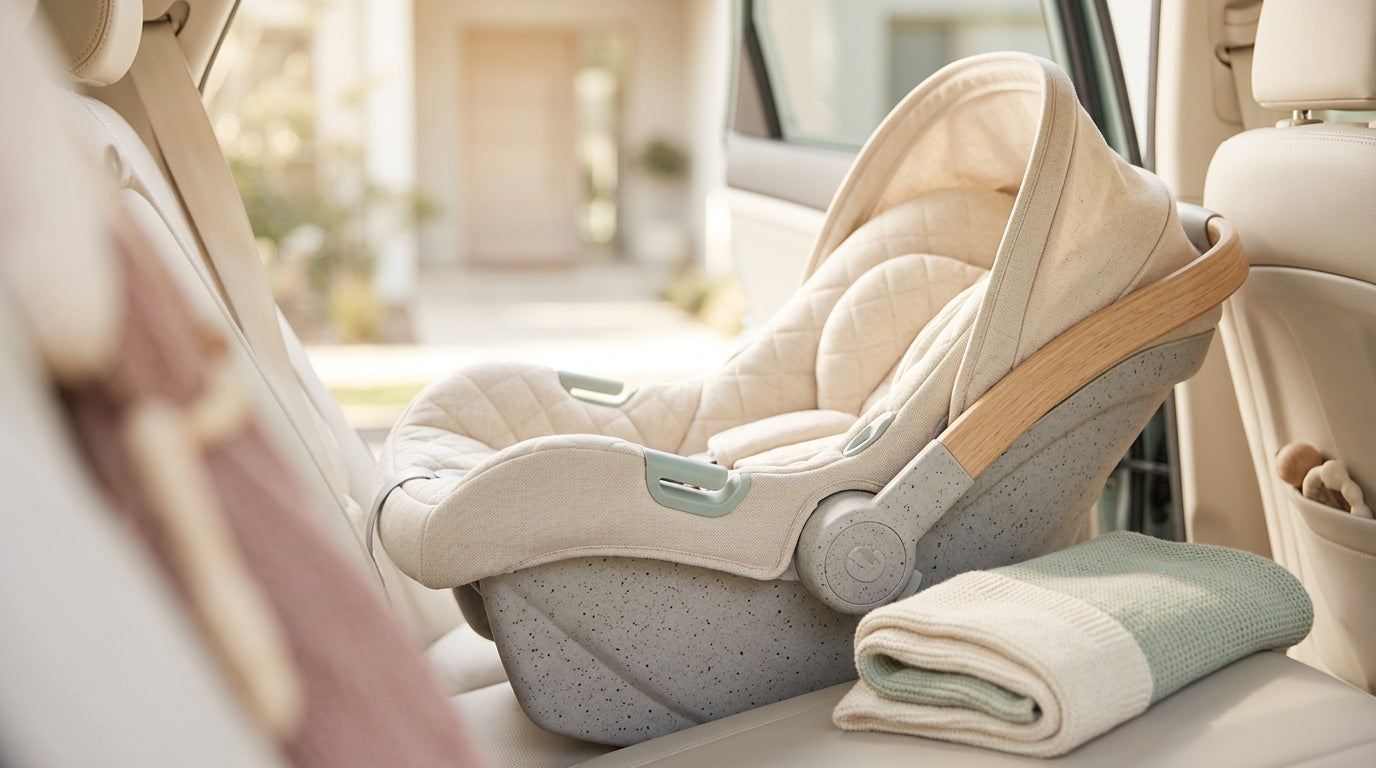
You're currently sitting on the garage floor in your maternity leggings. There's a half-eaten granola bar on the bumper of the Honda, the manual for the convertible seat is open to page forty-two, and you're quietly crying because the little plastic bubble refuses to cross the green line. Breathe, yaar.
I know exactly what your browser history looks like right now. It's a tragic string of 3 AM panic searches typed with one thumb while nursing in the dark. I know you typed the words car seats for babi and then frantically searched babie head slump, staring blankly at the red squiggly spellcheck lines because you were too sleep-deprived to remember how to spell basic nouns. I see you. I was you six months ago, convinced that one wrong pull of a nylon strap would ruin everything.
Listen. I spent four years in pediatric triage pulling beads out of toddlers' noses and dealing with actual emergencies, but putting my own flesh and blood into a Chicco KeyFit made me sweat through my shirt. We treat car safety like an advanced physics exam we're perpetually failing instead of just a basic mechanical task. The truth is much more boring than your anxiety wants you to believe.
The illusion of the perfect installation
You think if you just spend six hundred dollars on the newest European rotating model, the seat will magically install itself. It won't. My dad bought a seat that cost more than my first car, but beta, it doesn't matter how much aerospace-grade aluminum is in the frame if you attach it to the vehicle with the structural integrity of a wet paper towel.
The hospital discharge nurses watched me fumble with the LATCH clips like I was trying to defuse a bomb. In triage, I used to be the one silently judging the parents who couldn't thread a harness, but karma is real. It took me forty minutes to figure out the chest clip on my own child while standing in the loading zone. The LATCH system was supposed to make our lives easier, but mostly it's just a nightmare of twisted webbing and broken thumbnails.
Stop watching those highly produced installation videos, throw away the aftermarket head support pillow that didn't come in the box, and just pull the tightening strap until the base stops sliding around the backseat. Grab it at the belt path. If it moves more than one inch in any direction, you've to push your knee into the base and pull harder. That's the whole secret. There's no magic trick, just body weight and stubbornness.
The coat situation is out of control
Let's talk about the winter coat delusion. We live in Chicago. The wind hurts your face from November to April. Naturally, your instinct is to stuff him into a miniature down parka that makes him look like a marshmallow, and then wedge him into the car seat. Don't do this.

Dr. Lin, our doctor, took one look at my son's puffy coat at his two-month checkup and handed me a harsh dose of reality. Crash forces compress all that fluff in a millisecond. You think the harness is tight, but if you hit the brakes, all those goose down feathers flatten out, and suddenly there are four inches of slack in the straps. He will fly right out of the harness.
It's incredibly annoying to take a coat off a screaming infant in a freezing parking lot. You're going to hate doing it. But you've to peel the coat off, buckle him tightly into the harness, and then lay a blanket over his lap like he's an elderly man sitting on a porch. It's the only way.
I usually just keep the Organic Cotton Baby Blanket Ultra-Soft Monochrome Zebra Design in the back seat for this exact purpose. It's fine. It's just a blanket, but it's thick enough to block the wind, and the black and white pattern gives him something to stare at so he stops screaming at red lights. Plus, it doesn't leave fuzzy lint all over my black leggings, which is really all I ask of any baby product at this point.
Physics is mostly guesswork
You're going to fall down a rabbit hole reading about load legs and anti-rebound bars. The manual will use a lot of big words about kinetic energy dispersion and rotational forces. My understanding of the science is fuzzy at best, but the gist is that these extra metal bars brace against the floor or the back of the car seat to stop the whole contraption from violently flipping upward if you get rear-ended.
I think it helps absorb the shock, or maybe it just makes us feel better because it looks like a roll cage. Either way, the American Academy of Pediatrics seems to think these features reduce head injuries, so if your seat has a load leg, drop it to the floorboards. Just know it'll take up exactly the amount of legroom your passenger needs to sit comfortably.
Then there's the positional asphyxiation panic. Newborns have the muscle tone of a wet noodle. If the car seat is installed too upright, his heavy little head flops forward onto his chest and compresses his airway. To verify the angle is safe, just look at the leveling line on the sticker on the side of the base. If that line is parallel to the ground, he can breathe. It really is that simple.
And yes, the plastic technically expires after ten years because the materials degrade in the sun, so just throw the thing away when he goes to middle school.
Toys are basically shrapnel
You're going to be tempted to buy those rigid plastic steering wheels and heavy mirrors that strap to the headrest so you can look at him in the rearview mirror. Stop.

In a collision, anything that's not bolted down becomes a projectile. A hard plastic toy traveling at forty miles an hour is a weapon. I asked Dr. Gupta about the mirrors, and she just sighed and rubbed her temples. Instead of hanging a mobile over his face, just give him something soft to hold.
I rely heavily on the Llama Teether Silicone Soothing Gum Soother. I actually genuinely like this thing. The main reason is that I can loop a pacifier clip through the little heart cutout, attach it to his sweater, and when he inevitably throws it in a fit of rage somewhere around Lake Shore Drive, it doesn't shatter a window. It just bounces softly against the door. It's food-grade silicone, so it can't hurt him if he falls asleep with it against his face.
We also have the Squirrel Teether Silicone Baby Gum Soother floating around the floorboards somewhere as a backup for when the llama falls into the dark abyss between the seats. It's cute enough, and he aggressively gnaws on the acorn part when his gums are pulsing.
Before you lose your mind entirely analyzing crash test ratings on YouTube, maybe just step away and browse a teething toys collection for things that actually stay safely inside your house.
The pinch test reality
Eventually, you'll move from the infant carrier to the convertible seat, which stays permanently in the car. The infant carrier is a trap anyway. You think it's convenient until your shoulder dislocates trying to carry a twenty-pound baby sitting inside a fifteen-pound chunk of plastic through the grocery store.
Whether you're using the bucket seat or the convertible, the rules for the straps are identical. Parents make this so complicated. They pull the shoulder pads, yank the crotch buckle, adjust the headrest, and somehow the harness is still loose.
Quit tugging at the lap belts, ignore the massive shoulder pads that just get in the way, and simply slide the plastic chest clip up so the top edge is exactly level with his armpits. Then do the pinch test. Pinch the harness webbing right at his collarbone. If your fingers can grab a horizontal fold of the fabric, the straps are too loose. Pull the tail strap at his feet until you can't pinch any slack.
That's it. You survived the math test.
Close the manual. Go inside. Eat the rest of your granola bar and stop worrying about the angle of the chest clip. You're doing fine.
If you want to focus on something you can actually control, explore our organic baby essentials to make the rest of his day a little more comfortable.
How long do we really have to stay rear-facing?
Until his legs are practically folded behind his ears. Seriously, max out the weight and height limits on your specific convertible seat. The pediatricians want them rear-facing until age four or five now, depending on the kid's size. The bones in a toddler's neck are still mostly cartilage. Rear-facing acts like a turtle shell, absorbing the crash forces across the entire back of the seat instead of snapping their heavy head forward. Don't flip them just because they look cramped.
Can he sleep in the car seat once we get inside the house?
No. When the seat clicks into the base in your car, the angle is correct. When you set the carrier flat on your living room floor, the angle changes entirely. His chin can drop to his chest and cut off his oxygen quietly. I know it physically hurts to wake a sleeping baby after a car ride, but you've to unbuckle him and move him to a flat crib. I've seen too many terrifying cases in triage from parents who let them nap in the carrier on the floor.
What do I do if he screams the entire ride?
You turn the radio up and keep driving. It feels like torture, but a crying baby is a breathing baby. Don't pull over on a busy highway shoulder just to put a pacifier back in his mouth. If the harness is tight and the chest clip is at armpit level, he's safe. He is just mad. Let him be mad.
Do I need to buy one of those expensive rotating car seats?
Need is a strong word. You don't need it for safety. A basic ninety-dollar seat passes the exact same federal crash tests as the six-hundred-dollar swivel seat. You're paying for your own convenience. If you've a bad back or a tiny two-door car, the rotating feature will save you a lot of physical pain when loading him in. But the seat itself is not inherently safer just because it spins.
How do I know if my secondhand seat is safe?
Unless you got it directly from your overly cautious sister who swears on her life it was never in an accident, don't use it. You can't see micro-fractures in the plastic under the fabric cover. If a seat has been in any kind of crash, or if it's past the expiration date stamped on the plastic shell, it's garbage. Buy a cheaper new seat rather than a premium used one.




Share:
A Portland Dad's Honest Guide to Picking Gifts for Infants
The Truth About New Baby Gifts (And Why I Burned a Cardigan)