

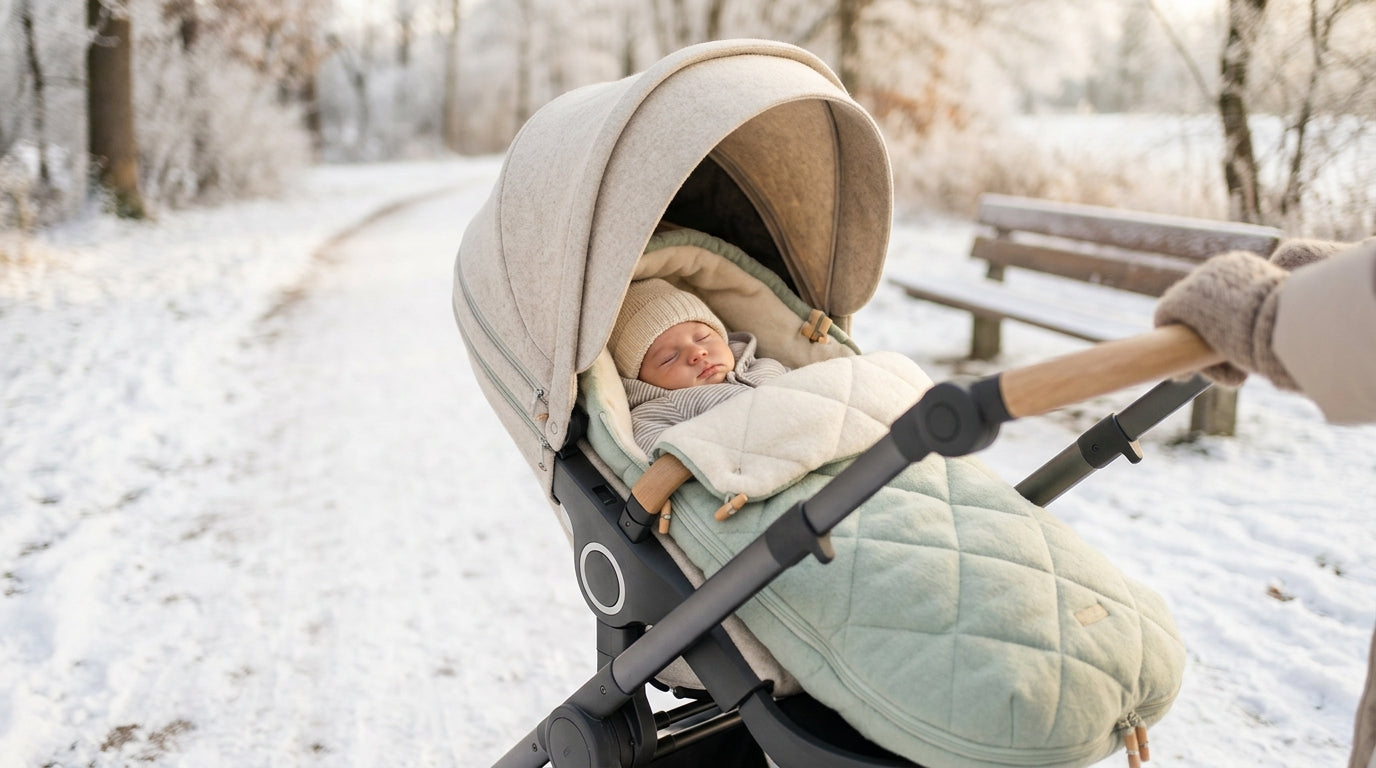
I was standing outside a bakery in the Loop last January when I watched a terrified new dad try to shove his three-week-old into a stroller bassinet. The baby was wearing a fleece onesie, a thick synthetic snowsuit that made him look like a starfish, and a crocheted blanket tucked tightly under his chin. It was barely thirty degrees out, but that infant was a red, screaming tomato. I had to physically restrain myself from walking over and unwrapping the poor kid like a tamale.
There's this pervasive myth in modern parenting that survival in cold weather requires turning your infant into a heavily padded marshmallow. We buy these giant puffy suits thinking we're protecting them from the elements, completely ignoring the fact that we're just trapping their body heat under layers of plastic-based fabric.
Listen, if you want to actually get out of the house between November and March without inducing heatstroke in your child, you need to abandon the snowsuit entirely and invest in a proper stroller footmuff. But buying one is shockingly complicated, mostly because the baby industry loves to sell us garbage we don't need.
The marshmallow suit is a terrible strategy
I spent five years running triage in a pediatric ER, and I've seen a thousand of these overheated, miserable infants. Parents bring them in crying inconsolably, completely missing the fact that the kid is just sweating to death under four inches of polyester batting.
My doctor took one look at my daughter strapped into a puffy coat during her two-month checkup and casually mentioned I was building a portable sauna. The physics of a bulky snowsuit inside a stroller or car seat just don't work in your favor. Thick layers compress under the harness straps, which means the straps are never actually tight enough to keep the baby secure if the stroller tips or you hit a curb too hard.
Even worse, those rigid puffy suits restrict all movement. A newborn in a snowsuit can't bend their arms or settle into a comfortable position. They just lie there, stiff as a board, slowly baking in their own body heat while you leisurely drink your iced coffee.
A footmuff acts entirely differently. It essentially is a sleeping bag customized for the bizarre geometry of baby gear. You strap the child in wearing normal indoor clothes, zip the bag around them, and the ambient heat circulates naturally instead of being suffocated by layers of tight synthetic fluff.
The dark art of infant thermoregulation
Newborns are notoriously terrible at regulating their own body temperature. I vaguely recall from nursing school that their hypothalamus function is pretty immature, but the practical translation is that they don't sweat efficiently when they're hot, and they lose heat rapidly from their giant heads when they're cold.
When you use a high-quality stroller muff, you're relying on convection and insulation rather than direct suffocation by fabric. But this means you've to constantly check if the system is working. If you're browsing our winter walking essentials, just remember that the gear only does half the job. You have to do the rest.
Stop checking your baby's hands and nose to see if they're cold. Their extremities are always going to feel like little ice cubes because their circulatory system is prioritizing their internal organs. My doctor taught me to just shove two fingers down the back of the baby's neck. If the neck feels warm and dry, you're fine, but if it feels damp or sticky, your baby is overheating and you need to unzip the footmuff immediately.
Materials that actually do the job
This is where I get incredibly judgmental about what companies are trying to sell you. You can walk into any big-box store and find a fifty-dollar footmuff made of shiny polyester and stuffed with cheap synthetic fleece. They look incredibly warm. They're essentially plastic bags.

Synthetic fleece builds up an absurd amount of electrostatic charge, and because it doesn't breathe, moisture just pools against the baby's skin. Your kid will sweat, the sweat will cool, and then they'll be freezing and damp.
The gold standard is medically tanned lambskin. It acts like a natural thermostat, trapping warm air in tiny pockets when it's freezing outside, and somehow wicking moisture away when the sun comes out. We use the Kianao medically tanned lambskin liner almost exclusively now. It was a lifesaver with my daughter. Yes, it looks mildly retro and smells faintly of sheep when you first open it, but I never once pulled her out of the stroller feeling damp or overheated. Just make sure the lambskin is seriously medically tanned, which usually gives it a slight yellow tint and means it was processed without heavy metals, because eventually, your kid is going to try to eat it.
Down is another option that gets pushed heavily by premium brands. It's incredibly warm and light. We tested the Kianao eco down footmuff, and it kept the wind out perfectly fine on a particularly brutal walk along Lake Michigan. But I'll be honest, washing down requires throwing it in a dryer with three tennis balls to break up the clumps, and I simply don't have the mental bandwidth for high-maintenance laundry routines.
Harness geometry and positional asphyxiation
I need to talk about the physical safety of these bags because nobody ever reads the manual. A footmuff must never interfere with the five-point harness of your stroller or car seat. Period.
I see parents using universal footmuffs that are way too big, with generic vertical slits that don't quite line up with their specific stroller brand. What happens is the footmuff slowly slides down the slippery stroller fabric during the walk. As the bag slides down, it pulls the baby down with it.
A newborn's airway is roughly the diameter of a drinking straw. If they slide down and their chin drops to their chest, that straw kinks. It's a quiet, terrifying process. You absolutely must buy a footmuff with some kind of anti-slip backing, usually silicone nubs or a grip fabric, and you've to make sure the harness slots honestly align with your straps so the whole apparatus stays anchored to the seat.
Avoid anything with mummy-style hoods that feature a dozen toggle strings and cords. A newborn can't brush a stray cord away from their face. Keep the area around their mouth completely clear of hardware.
How I dress my kid for a blizzard
The Germans have this concept called the Zwiebelprinzip, or the onion principle. It basically means dressing in breathable layers that you can easily strip off. It's the only sensible way to handle winter with an infant.

When it's below freezing, I put my daughter in a long-sleeve cotton bodysuit, a thin pair of tights, and a merino wool base layer over the top. Then I add thick wool socks, a hat that covers her ears, and scratch mittens so her fingers don't freeze if she manages to wiggle her hands out of the bag. Instead of wrestling with a rigid winter coat and thick waterproof pants and trying to tuck a blanket around her legs, I just drop her in her indoor clothes directly into the footmuff and zip it up.
The zipper is the most critical functional part of the whole setup. You want a wrap-around zipper, or at least a central one that goes all the way down. When you walk from the freezing street into a heavily heated grocery store, you can't just leave the baby zipped up. They will cook. With a wrap-around zipper, you just rip the top cover completely off and throw it in the stroller basket. You don't even have to wake them up.
Paying for things that last longer than a season
Infant-specific gear is mostly a scam designed to separate anxious parents from their money. A newborn-size footmuff is usually capped at about 90 centimeters long. Your kid is going to outgrow that before the snow even melts fully in spring.
If you're going to spend real money, buy a universal size that stretches to at least a hundred centimeters. It will look comically large on a seven-pound newborn, but they don't care, and it'll still fit them when they're a grumpy two-year-old demanding snacks in the stroller.
The smartest designs are modular. I prefer systems like the universal four-season footmuff where you can completely detach the heavy winter top cover. Once April rolls around, you just leave the bottom part strapped into the stroller as a breathable, padded liner. You get year-round use out of a single purchase, which is about as close to a financial win as you're ever going to get in parenting.
Before you dive into the deep end of baby gear research, take a look at our full collection of sustainable, heavily vetted outdoor accessories. It will save you a few hours of doom-scrolling.
The questions everyone eventually asks
Is it safe for them to sleep in the footmuff indoors?
Listen, no. Once you cross the threshold into your heated house or apartment, the footmuff needs to be opened immediately. Safe sleep guidelines are rigid about avoiding heavy bedding indoors. If they fall asleep on a walk, you can leave them in the stroller in the hallway while you stare at them, but you've to unzip the top cover completely so ambient room air can circulate over their chest.
How do I wash a blowout out of a lambskin footmuff?
I've lost hours of my life to this exact scenario. First, don't panic and throw it in a hot wash, because it'll shrink into a rigid piece of cardboard. Spot clean the horrific parts with a damp cloth and a very gentle wool detergent. If it requires a full wash, use the wool cycle on cold, stretch it back into shape while it's wet, and dry it flat in the shade. Never put it on a radiator.
Can I use the pram footmuff in the car seat?
Only if it has the specific cutouts for the car seat harness and the manufacturer explicitly states it's crash-tested. Never put a thick stroller footmuff into an infant car seat if it compromises the tightness of the straps. Car seat safety is non-negotiable. If the straps aren't snug against their collarbones, the setup is dangerous.
Why does my baby's back feel sweaty but their hands are freezing?
Because their circulatory system is hoarding all the warm blood in their core to protect their vital organs, leaving their hands out to fend for themselves. The sweaty back means your base layer isn't breathing or the stroller muff is too hot. Switch to a wool base layer instead of cotton. Cotton traps sweat against the skin and stays wet, while wool genuinely moves the moisture away.
What if the stroller bassinet seems too small for a bulky footmuff?
Bassinet space is tight, yaar. If you've a very narrow European-style bassinet, a thick universal footmuff might bunch up around the baby's face, which is a suffocation hazard. In that specific case, you either need a soft, flexible newborn-sized muff that lays flat, or you just use the onion principle with a breathable wool blanket tucked tightly under their armpits. Don't force a massive sleeping bag into a tiny box.




Share:
Finding the Right Wintersack Kinderwagen (Without Boiling Your Baby)
A Letter to Myself About Surviving Winter With Baby Overalls