

Dear Marcus of exactly six months ago,
It's 3:14 AM on a Tuesday. You're standing in the dark hallway of your Portland bungalow, clutching a lukewarm bottle of formula, staring at a flashing plastic boombox toy that's aggressively singing "I'M A HAPPY LEARNING PUPPY" because the cat just brushed past its motion sensor. Your son, who you spent forty-five minutes rocking to sleep, is now wide awake and crying. You're currently questioning every purchasing decision you've made since the second trimester.
I'm writing this from the future—well, from month eleven of this bizarre deployment called fatherhood—to beg you to step away from the primary-colored electronics aisle. You're about to enter a phase where your beautiful, innocent baby transforms into a tiny, highly destructive baby rat, gnawing on everything in his path to soothe his erupting teeth. You need better hardware for this phase.
Specifically, you need to pivot entirely to the classic wooden baby rattle.
I know what you're thinking. You think wooden toys are just for aesthetic Instagram parents who dress their kids in beige linen and pretend they don't own televisions. You think a simple piece of carved wood couldn't possibly provide enough sensory input compared to a plastic tablet that plays fifty different synthesized melodies. You're incredibly wrong, and your current audio-sensory environment is a completely chaotic nightmare of your own making.
The acoustic specs of a decent baby rattle
Here's a data point I wish I had tracked earlier: the decibel level of our living room. For the first few months, we bought every plastic shaker and electronic noisemaker the internet algorithm fed us. Apparently, around four to six months, babies undergo this massive firmware update where they realize that shaking their arm produces a sound, which teaches them cause and effect.
But nobody warns you about the quality of that sound. When a baby violently shakes a plastic rattle full of synthetic beads against a hardwood floor, it sounds like someone dropping a toolbox down a fire escape. It's sharp, it's jarring, and it spikes your cortisol every single time.
When my wife finally confiscated the loudest plastic offenders and replaced them with wood, the acoustic difference was staggering. A wooden baby rattle filled with organic material (like dry beans or wooden beads) produces a muted, percussive clack. It's acoustic rather than electronic. It sounds like someone gently shuffling dominos in the next room instead of a tiny rave. Your son still gets the auditory feedback required to complete his cause-and-effect learning loop, but your nervous system isn't constantly being thrown into fight-or-flight mode while you're trying to debug some code on the couch.
The choking hazard math that kept me awake for three days
Let me tell you about the rabbit hole I fell down regarding safety standards, because I know you, past Marcus, and I know you're going to Google "wood splinter infant throat" at 2 AM.

During our six-month checkup, our pediatrician vaguely gestured at a poster and mumbled something about avoiding small parts that can fit through a 35-millimeter choke tube. Obviously, this sent me into an absolute spiral. I literally went down to the basement, grabbed my digital calipers, and started measuring the radius of every toy in the house.
Apparently, the U.S. Consumer Product Safety Commission tests rattles using a very specific oval opening that's roughly 1.375 inches by 2 inches. If any part of the toy can pass through that void, it's considered a critical failure and a choking hazard. This is why cheap, mass-produced trinkets are terrifying. I spent three solid evenings measuring spherical end-caps and researching the tensile strength of various adhesives used in modern toy manufacturing.
Here's what I learned during my hyper-fixation: if a rattle shatters, you want the interior payload to be digestible. Traditional, high-quality wooden makers use things like dry lentils or rice inside the rattle head, meaning if the structural integrity somehow fails—which is highly unlikely with dense hardwoods—your kid is swallowing a lentil, not a plastic shard or a metal ball bearing. Also, they use tight-grained hardwoods like maple or beech so it doesn't splinter into tiny daggers when chewed. Avoid softwoods, avoid weird chemical lacquers, and honestly, don't worry about the exact botanical classification of the tree as long as it's solid hardwood and finished with something you could theoretically eat, like beeswax.
Deploying the hardware in the field
By month six, the palmar grasp reflex is fully locked in, and your baby will insist on holding something at all times. This is also when the teething begins in earnest, and the baby rattle stops being just an acoustic instrument and becomes a localized pain management tool.
This is where I've to give you a specific recommendation. Next week, you're going to take your wife and the baby to Heart Coffee. The baby is going to have a full system meltdown because his lower gums are swelling. You need to pre-order the Bear Teething Rattle Wooden Ring Sensory Toy from Kianao right now.
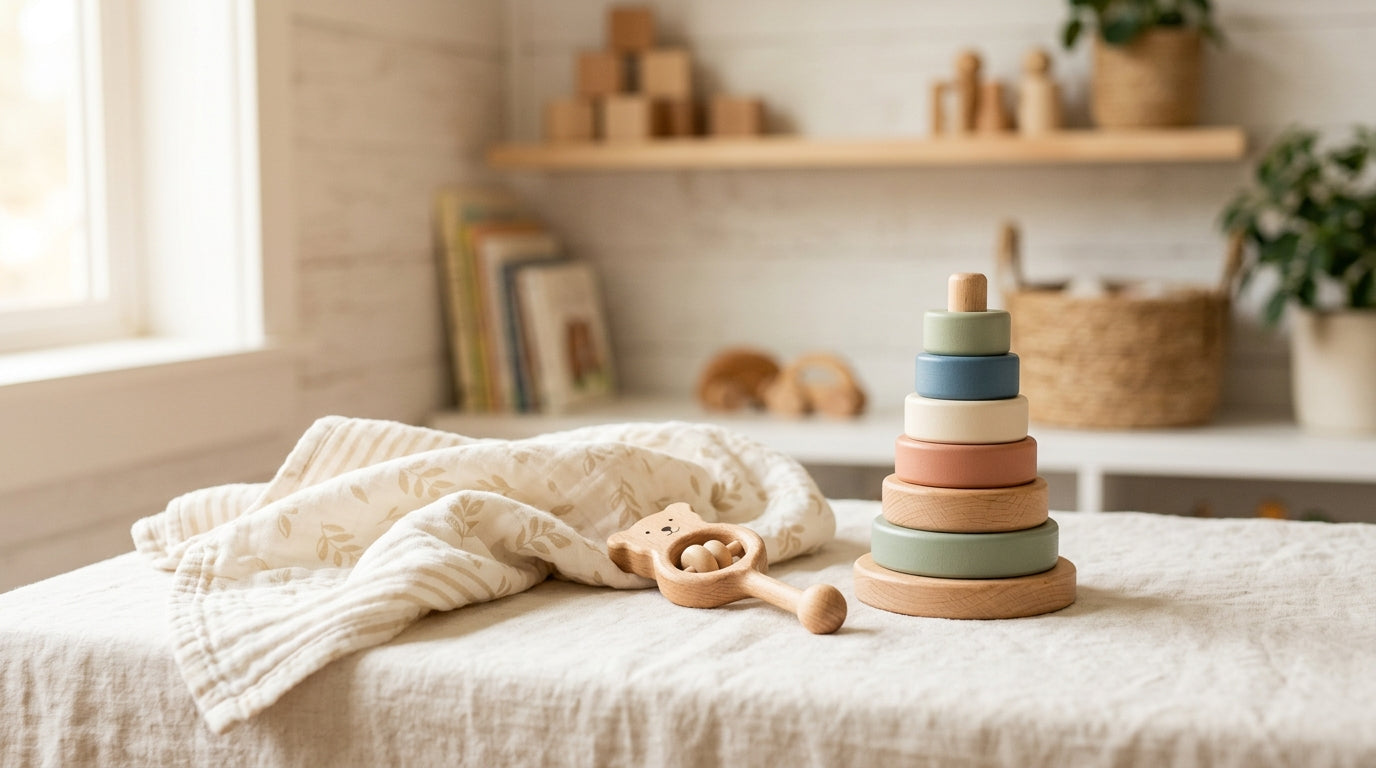
I'm completely obsessed with this thing. It consists of an untreated beechwood ring with a soft, crochet cotton sleepy bear attached to it. The wood provides the exact mechanical resistance his gums need—squishy silicone teethers just seem to make him angrier because they don't apply enough counter-pressure—while the crochet bear gives his fingers a completely different, rougher tactile texture to pull on. We handed this to him in the coffee shop, he clamped his jaws onto the wooden ring, aggressively shook the bear, and instantly went quiet. It was like hitting a mute button on a malfunctioning app. It saved our morning.
I should note that we also bought the Bunny Teething Rattle from them, which is objectively fine and does the exact same job, but the bunny has these long floppy crochet ears. While my wife thinks it's the cutest thing we own, I've noticed that the ears act like highly absorbent sponges for baby drool, and they take substantially longer to air-dry on our kitchen counter than the bear does. Stick with the bear. Less surface area for saliva retention.
If you want to understand the build quality I'm talking about before you commit, you should probably just browse through Kianao's teething toys collection and look at how they construct the bindings.
System maintenance for organic materials
Listen to me very carefully: don't put wooden baby accessories in the dishwasher. I repeat, don't try to speed-run the sterilization process by throwing untreated beechwood in with your coffee mugs on the heavy wash cycle.

Wood is porous and highly reactive to moisture and thermal shock. If you boil a wooden baby rattle or leave it submerged in a sink full of soapy water, the grain is going to warp, swell, and eventually crack, which ruins the structural integrity and creates exactly the kind of splintering hazard we just talked about avoiding.
Instead of panicking about germs and trying to nuke the toy from orbit, just wipe the drool off with a damp cloth, use a tiny drop of baby-safe soap if it fell on the floor of a brewery, and dry it immediately with a towel before letting it sit in the open air to finish evaporating. If the wood starts looking dull or parched after a few weeks of your kid going at it with his newly acquired teeth, you just rub a little bit of food-grade coconut oil into the grain with your thumb, let it soak in for an hour, and wipe off whatever is left on the surface.
Upgrading the entire play environment
Once you realize how much better the wooden handheld toys are, you're going to start side-eying the massive, neon-plastic activity center currently dominating your living room floor. It looks like a spaceship crashed into a primary school.
When the baby is doing tummy time or just lying on his back complaining about gravity, we eventually swapped the plastic arch for the Leaf & Rattle Play Gym Set. It's an A-frame structure made entirely of untreated solid wood. The hanging toys are these muted crochet shapes and wooden rings that gently clack together when he kicks them.
The best part? It actually folds flat. You can collapse it and slide it behind the sofa when your child-free friends come over, allowing you to maintain the illusion that your house is still a sanctuary for adults rather than a chaotic daycare facility. It's incredibly stable, requires zero tools to assemble, and doesn't require AA batteries.
Look, I know you're exhausted. I know you're currently relying on the flashy toys because they distract him for three minutes so you can make a sandwich. But transitioning to natural materials isn't just an aesthetic choice my wife bullied me into; it’s an operational upgrade. The sounds are less grating, the materials are vastly safer for him to ingest, and the durability means we aren't throwing shattered plastic into the landfill every month.
Do yourself a massive favor. Stop buying plastic junk with volume controls that inevitably break. Upgrade your gear. Head over to Kianao and grab a wooden teether before that next tooth breaks the gums.
Good luck tonight.
— Marcus (Month 11)
Troubleshooting the Wooden Rattle (FAQ)
Are wooden rattles actually safe for a baby to chew on?
Yeah, but you've to verify the specs. Apparently, safe wooden toys are milled from dense hardwoods (like maple, beech, or cherry) that don't splinter when subjected to repetitive biting. My pediatrician assured me that as long as the wood is unfinished or sealed with something food-grade like beeswax or coconut oil, it's actually vastly superior to them chewing on mystery plastics and silicone phthalates. Just check it for cracks once in a while like you'd inspect your car tires.
How do I sanitize this thing if I can't boil it?
You have to accept that your child's environment is covered in a baseline layer of ambient bacteria, so put away the bleach and the boiling water because soaking wood will destroy it instantly. Just run a damp, slightly soapy cloth over the surface to remove the visible grime and drool, wipe it completely dry with a clean towel, and let it air out. Wood really has natural antibacterial properties anyway, which is a fun fact I learned while aggressively Googling this at midnight.
At what age do they really start playing with rattles?
Around three to four months, you'll notice their palmar grasp reflex kicking in—basically, if you put a stick in their hand, their fingers automatically lock around it like a vice. By month five, they start swinging it around wildly to figure out cause and effect. And by month six, it basically just becomes a chew toy for their gums. So, it gets heavy usage for about a solid year.
What should I do if the wood starts looking dry and rough?
After a few months of intense mouthing and wiping, the natural oils in the wood will deplete, making it look a bit thirsty. You don't need any special chemical varnishes; literally just walk into your kitchen, grab a tiny smear of organic coconut oil or olive oil, rub it into the wood, wait an hour, and buff off the excess with a paper towel. It acts like a firmware patch for the wood grain.




Share:
Haakaa Teething Hacks: A Survival Guide to the Drool Apocalypse
Fox Blankets: Debugging Infant Sleep Safety and Stroller Heat