

I was sweating through my shirt in a Target parking lot in late October, wrestling with a foot that looked exactly like a Hawaiian sweet roll. My oldest son was eight months old, and I was determined to get him into this matching mommy-and-me outfit for our fall family photos. I had spent fifty bucks on these tiny black and white streetwear sneakers because they looked adorable on Instagram, and now I was paying for my vanity. He was screaming, the photographer was waiting, and the shoe was absolutely refusing to go on his foot.
My oldest is my cautionary tale for literally everything in motherhood, and footwear is no exception. I'm just gonna be real with you—nobody tells you that infant feet are basically square. They have no arches, no defined heel, just a thick, adorable layer of fat. Trying to shove that geometry into a low-profile, narrow leather street shoe is an exercise in pure parental delusion.
I ended up driving to the park with him wearing only one shoe, panicking the whole way. I ripped it off before we took the photos anyway because he kept trying to eat the suede toe box. That was my introduction to the reality of the mini-me sneaker trend.
The reality of wrestling baby sambas onto a chunky foot
If you're looking at buying a pair of these for your kid, you need to understand that the sizing is basically a practical joke played by footwear designers who have clearly never met a human infant.
Here's how the fit actually breaks down in real life:
- The length is fine: If you measure your kid's foot heel to toe, the sizing chart actually lines up pretty well, which lulls you into a false sense of security.
- The width is a nightmare: These shoes are notoriously narrow, so if your baby has wide, chunky feet with high insteps (which is like 90% of babies), you're going to be fighting for your life to get them past the heel.
- The laces are the enemy: The infant slip-on versions come with these fixed elastic laces that are supposed to make your life easier because you don't have to tie them, but they're strung so tightly across the top of the shoe that they act like a medieval torture device for chubby ankles.
The irony is that while I was fighting these rigid leather shoes, the rest of his outfit was incredibly easy. I had paired the sneakers with the Organic Cotton Baby Bodysuit from Kianao. That sleeveless onesie is a total workhorse in my house. It has this stretchy neckline that actually glides right over a squirmy baby's giant head without getting stuck, and the organic cotton means it survives the fifty million trips through my washing machine when he inevitably spits up on it. It just works with his body instead of against it, which is the exact opposite of how those sneakers felt.
What Dr. Miller said about rigid soles and walking
My mom, bless her heart, has always told me that babies need "sturdy, hard-soled shoes" to support their ankles when they're learning to stand. She also put me to sleep on my stomach in a crib completely lined with fluffy bumpers, so I tend to take her advice with a grain of salt.

When my son finally started pulling up on the furniture around ten months, I asked our doctor about it. Dr. Miller looked at me over her glasses and completely popped my aesthetic balloon. She basically said that kids need to be barefoot as much as humanly possible when they're learning to walk.
From what I understood of her explanation, it has to do with proprioception, which I think just means the brain's ability to know where the body is in space. Babies need to feel the floor. Their toes need to grip the carpet or the grass so they don't faceplant into the coffee table.
Those tiny streetwear sneakers have a thick, flat, heavy rubber sole. They're miniature versions of adult shoes, built for adult weight and adult balance. Strapping them onto a ten-month-old who's already top-heavy just makes them walk like Frankenstein. Dr. Miller basically told me to keep him in bare feet or little grippy socks inside, and only put the heavy rubber-soled shoes on him if we were walking on hot Texas asphalt or rough gravel.
Of course, while we were having this medical debate in the exam room, my son had grabbed the shoe out of the diaper bag and was aggressively chewing on the rubber sole to soothe his gums. I had to pry it out of his hands and swap it for our Panda Teether. I can't say enough good things about that little silicone panda. It's totally flat, so tiny hands can honestly grip it without dropping it every five seconds, and the textured back part was the only thing that gave him peace when those top teeth were coming in. It saved me from completely losing my mind in countless waiting rooms, and unlike the bottom of a shoe, I could honestly throw it in the dishwasher.
Taking kitchen scissors to a fifty dollar shoe
So there we were, a few weeks later. I refused to let my fifty-dollar investment go to waste just because the elastic laces were designed for a baby with pencils for feet.

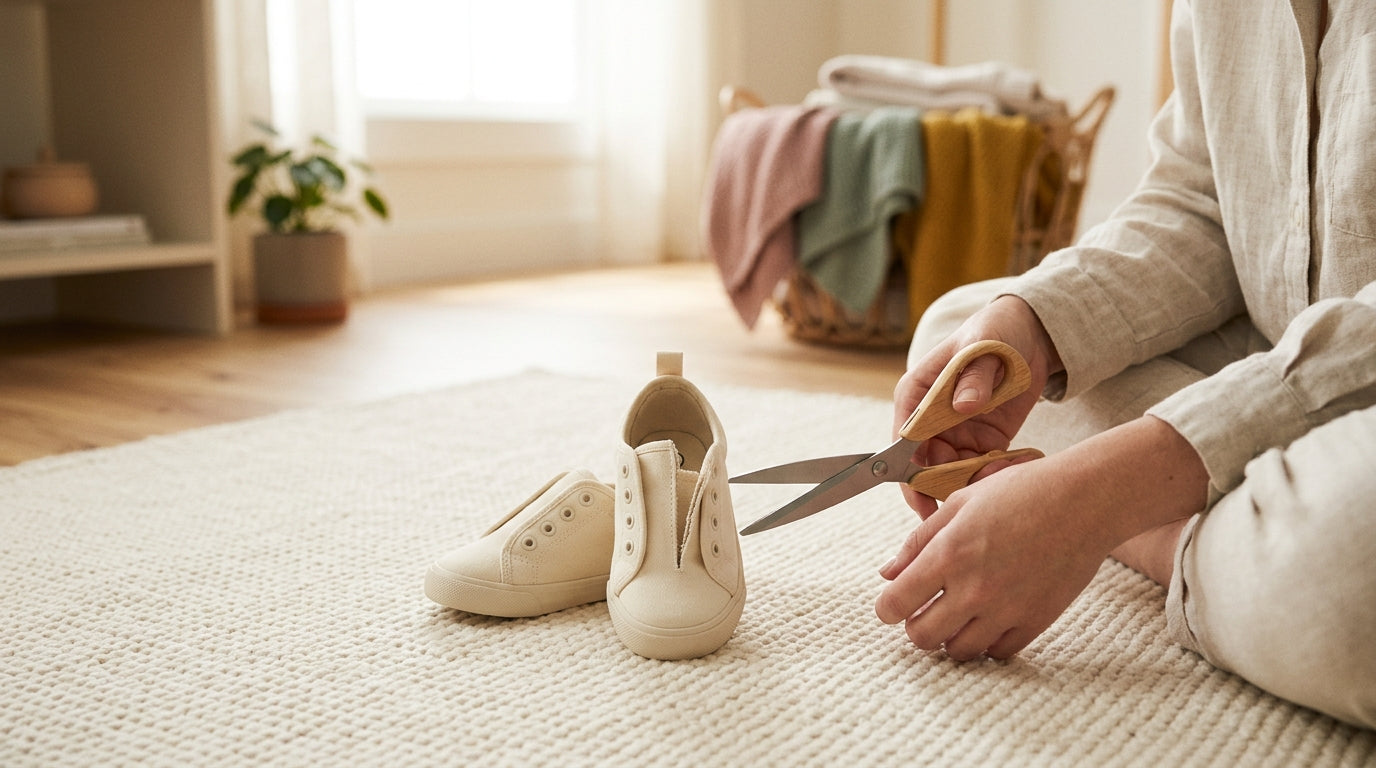
I sat on my living room floor, grabbed my heavy-duty kitchen shears, and literally cut the factory elastic laces right out of the shoes. It felt like a crime. I kept thinking I was ruining them, but the second I snipped that tight elastic, the tongue of the shoe finally flopped forward.
I threaded some standard black cotton laces through the eyelets instead. Suddenly, I could open the shoe wide enough to easily slide his fat little foot inside, and then just tie them securely. Dozens of parents in online forums do the exact same thing, which just goes to show how ridiculous the original design is. If you're shopping for these, do yourself a favor and try to hunt down the hook-and-loop velcro versions instead, or just be prepared to do some minor surgery on the slip-on ones to save your sanity.
Looking for baby gear that genuinely makes your life easier instead of harder? Browse Kianao's organic baby clothes collection for pieces designed for real life.
Hand-me-downs and the survival of the thick rubber sole
I've spent a lot of time complaining about these shoes, but I've a confession. I still have them in my house, and my third kid is wearing them right now.
Why? Because they absolutely refuse to die.
You can say whatever you want about the annoyance of the laces or the weight of the sole, but the durability is completely unmatched. Most soft-soled baby moccasins get shredded at the playground after three weeks of a toddler dragging their toes on the concrete. These sneakers? They survived my oldest dragging his feet on his ride-on toy, they survived my middle daughter wearing them through mud puddles, and they still look relatively put together for kid number three.
The dark gum rubber sole completely hides dirt, and the suede toe bumper somehow bounces back if you just brush it off. We even have a newer pair for my daughter that are the "Primegreen" vegan version, made with recycled materials, which makes me feel a tiny bit better about my consumer habits since they hold up for multiple kids.
We keep them in a basket by the door next to the Gentle Baby Building Block Set. The blocks are just okay, honestly. They're soft rubber, which is great when my two-year-old decides to aggressively throw one at the dog, but they mostly just end up collecting dust under my couch until I step on them while vacuuming. The shoes, on the other hand, seriously get used every time we go to the park.
So, are they worth it?
I guess it depends on what you want them for. If you think they're going to help your kid learn to walk, you're barking up the wrong tree. Save your money, let them stay barefoot, and let their little toes grip the floor the way nature intended.
But if you want a ridiculously durable playground shoe that makes them look like a tiny, aggressive hip-hop dancer, and you're fully prepared to attack the laces with kitchen scissors the day you buy them, then yeah. They're pretty great. Just don't try to put them on a screaming infant in a Target parking lot.
Ready to stock up on the things your baby really needs? Shop Kianao's full range of sustainable baby essentials today.
The messy questions nobody answers about infant shoes
How do I know if my baby's shoes are too tight?
Honestly, if you're sweating and cursing trying to get the shoe over their heel, it's too tight. Even if the length looks fine when you hold it up to their foot, babies have really thick tops of their feet. If you take the shoe off and there are angry red indentations across their skin, or if their toes are curled under and they can't wiggle them, you need a wider shoe or you need to cut those elastic laces out.
When should I seriously put shoes on my baby?
My doctor hammered this into my head—only when they're walking on surfaces that could hurt them. Think hot pavement, rocky dirt, or public restrooms (because gross). If they're just cruising around your living room or crawling at a friend's house, let them be barefoot. Those little toes need to spread out to help them balance.
Are the velcro versions really that much better than the slip-ons?
Yes. A million times yes. The slip-on versions with the fake elastic laces look cleaner, but the velcro ones open completely up like a clamshell. When you're trying to dress an infant who's doing the alligator death-roll on the changing table, you want the shoe that opens as wide as humanly possible.
Can I wash suede and leather baby shoes in the washing machine?
I wouldn't risk it with the leather ones unless you want them to dry into stiff, unwearable bricks. I usually just take a baby wipe to the leather parts—it gets the playground dirt off surprisingly well. For the suede toe part, I just let the mud dry completely and then brush it off with a dry toothbrush.




Share:
Debugging 3 AM Meltdowns With The Happiest Baby On The Block
Why That Viral Baby Saja Trend Totally Freaked Me Out