

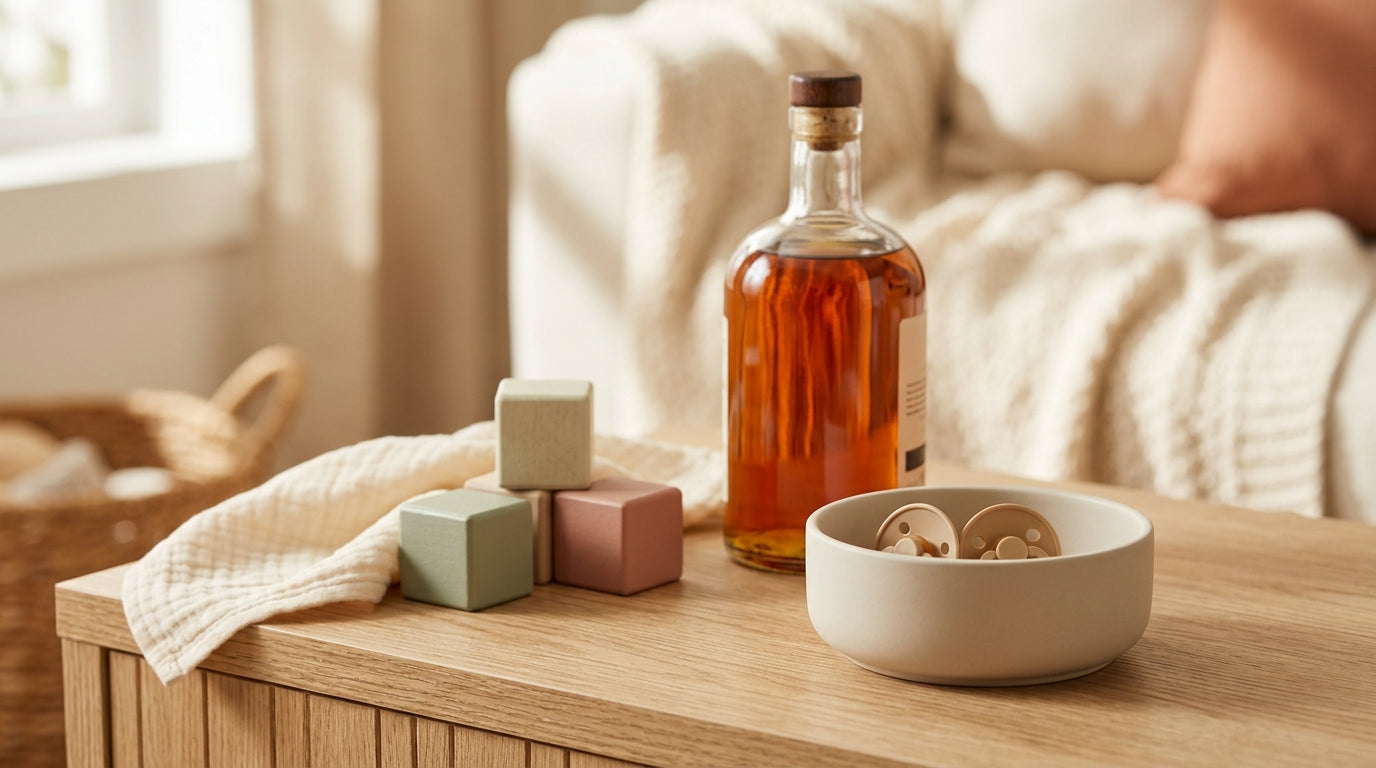
When my son's first tooth started aggressively pushing its way through his lower gums last month, I received three distinct pieces of troubleshooting advice. My dad, operating on legacy parenting code from 1989, told me to just rub a drop of whiskey on the baby's gums. My lead DevOps engineer, who has a three-year-old, told me not to worry about our liquor cabinet because kids can't reach the good stuff until they're at least two. And a fiercely debated Reddit thread claimed that babies are biologically repelled by the harsh ethanol smell of adult beverages anyway, so they'd never willingly drink it even if they found a left-out glass.
Three completely different data points, all delivered with absolute certainty, and every single one of them turned out to be dangerously wrong for our specific household environment.

The Reddit theory about babies hating the smell of alcohol actually sounded entirely plausible to my exhausted brain, right up until my wife Sarah brought home a very specific bottle from a distillery in Brooklyn. It was a boutique bottle, distilled using a custom heirloom corn—sometimes referred to affectionately as baby j's signature corn—and I made the mistake of leaving the tasting notes open on the kitchen island. I read them while holding an eleven-month-old who was actively trying to lunge out of my arms.
The specific threat profile of boutique spirits
Apparently, this specific distillation of baby jane corn doesn't smell like medicinal rubbing alcohol or burning peat. According to the label, it smells like cream soda, strawberries and cream taffy, salted caramel, and peach compote. I smelled the cork, and it literally smells like a dessert menu at a toddler's birthday party.
This is what I like to call a catastrophic security vulnerability in home childproofing. Our son is currently a twenty-pound biological machine programmed to relentlessly seek out sweet, high-calorie food sources. If he smells a harsh chemical cleaner, he'll usually wrinkle his nose and drop it, but if he smells strawberries and cream soda? He's drinking it.
And that's terrifying, because that sweet baby jane liquid is 91-proof. It's 45.5% alcohol by volume, wrapped in a candy-scented disguise. At our last checkup, I asked our pediatrician, Dr. Aris, about accidental ingestion risks, expecting a mild warning about upset stomachs. Instead, he casually dropped some horrifying medical facts that I'm still trying to process. He said something about how an infant's liver is basically running version 1.0 software and completely lacks the metabolic updates required to process ethanol, meaning even a tiny sip can cause a massive drop in their blood sugar, potentially leading to seizures or respiratory failure. It's not just a stomach ache; it's a complete system crash.
My dad's outdated firmware update for teething
Which brings me back to my dad's suggestion of rubbing liquor on the gums. I had to politely explain to him that we don't use central nervous system depressants as an analgesic anymore, mostly because we actually have data now. But I totally get why his generation did it. When an eleven-month-old has been screaming at 114 decibels since 2:00 AM and his temperature is hovering at a stubborn 99.1 degrees, you become desperate for a patch to fix the bug.

Instead of raiding the liquor cabinet, we finally found a hardware solution that actually works. We bought the Panda Teether Silicone Baby Bamboo Chew Toy, and it has practically saved my sanity. I'm genuinely obsessed with this thing. The night the upper incisor broke through, I threw this panda in our refrigerator for exactly fourteen minutes—because I time everything now, apparently—and handed it to him. The flat, wide shape is incredibly easy for his uncoordinated little hands to grip, and the silicone has this perfect rubbery resistance that seems to absorb all his frantic chewing energy. He just sits there gnawing on the bamboo-textured silicone ears while I quietly drink my cold coffee in the corner. It's dishwasher safe, which is a non-negotiable requirement in our house, and it doesn't pose a hypoglycemic risk to his underdeveloped liver.
We also tried another option from a different brand that was shaped like a bubble tea cup. The Violet Bubble Tea Teether is cute, and it has these little textured boba pearls on it, but honestly, it's just okay. The cylindrical shape makes it a bit too clunky for our son's current grip strength, so he ends up dropping it on the dog hair-covered floor every forty seconds, which means I spend more time washing it than he spends using it. Stick with the panda.
Why modern bar carts are an architectural failure
Once we established that sweet-smelling boutique whiskey is basically an unsecured honey-pot for a toddler, I had to evaluate our physical storage setup. This is where I realized that mid-century modern furniture designers clearly hated parents. The traditional home bar cart is, without a doubt, the most structurally irresponsible piece of furniture you can put in a house with a crawling baby.
First of all, whoever decided to put wheels on a multi-tiered glass shelf containing heavy, breakable bottles of toxic liquid needs to be investigated. Our son recently learned to pull himself up to a standing position, and his favorite new activity is using unstable objects as walkers. A rolling bar cart is essentially a mobile disaster unit waiting to be launched across the living room hardwood.
Secondly, the bottom shelf is exactly at eye level for an eleven-month-old. It's a perfectly illuminated display case of shiny, clinking objects just begging to be grabbed by tiny, sticky fingers. It completely defies my coworker's logic about kids not reaching high shelves, because the bar cart brings the danger right down to the ground floor. It's an aesthetic nightmare pretending to be decor.
If you're wondering how to seriously secure your adult beverages, skip the complex glass-door latches and just buy a pack of cheap magnetic adhesive locks for a high, solid-wood kitchen cabinet, shoving the bottles out of sight and out of mind.
Speaking of keeping things out of mind, if you're looking for safer, significantly less stressful additions to your home environment, you can browse Kianao's organic nursery and safety collections to find things that won't give you a mild panic attack when your baby interacts with them.
The two-hour countdown clock
There's also the operational complexity of breastfeeding when there's an open bottle of wine or bourbon in the house. Sarah enjoys a small pour of whiskey maybe once a month, but the logistics involved in that single drink require a spreadsheet. The CDC apparently says you're supposed to wait at least two hours per standard drink before nursing again, though trying to define a "standard drink" when you're pouring a 91-proof spirit feels like trying to do algebra in the dark.

Whenever she does decide to have a drink, I basically become the designated distraction module. My job is to keep the baby occupied and away from his mother for exactly 120 minutes. This is when the Rainbow Play Gym Set earns its keep. I lay him under the wooden A-frame, and the hanging elephant toy buys me at least twenty solid minutes of focused, non-crying baby time. It's made of actual wood instead of that garish neon plastic that normally gives me a migraine, and watching him try to calculate the physics of batting the wooden rings is deeply entertaining.
Mitigating spills and user error
Of course, adults make mistakes, and drinks get spilled. Last week I knocked a glass of water (thankfully not whiskey) right off the coffee table onto my son while he was practicing his wobbly standing routine. If he had been wearing some stiff, synthetic outfit with forty buttons, getting him dry would have been a wrestling match.
Thankfully, he was wearing the Sleeveless Organic Cotton Baby Bodysuit. I just grabbed the envelope shoulders, stretched it right down over his torso, and had him in a dry outfit in under thirty seconds. I love these bodysuits because the 95% organic cotton genuinely absorbs moisture quickly instead of letting it bead up and freeze his skin, and the elastane gives it enough stretch that I don't feel like I'm dislocating his shoulders to get it on. They survive the 40°C wash cycle without shrinking into doll clothes, which is a minor miracle in our laundry room.
Parenting an eleven-month-old feels like a constant exercise in identifying unseen risks and deploying rapid workarounds. You think you've safeguarded the environment, and then someone gifts you a sweet-smelling adult beverage that completely re-writes your threat model. It's exhausting, but occasionally, you figure out a system that works.
If you're currently auditing your own home for baby-safe upgrades, check out Kianao's collection of non-toxic, sustainable toys and gear before your toddler finds the next security flaw in your living room.
Unsolicited FAQs about babies and the liquor cabinet
What happens if a baby really drinks from a left-out adult glass?
Dr. Aris made it pretty clear that this is an immediate call to Poison Control or an ER visit, depending on the volume. Because their tiny bodies can't process the ethanol, even a small amount can cause their blood sugar to bottom out, leading to heavy lethargy, vomiting, or seizures. It's not a "wait and see if they sleep it off" situation; it's a medical emergency.
Are sweet-smelling spirits really more dangerous than regular ones?
In terms of chemical toxicity, no, alcohol is alcohol. But in terms of behavioral risk, absolutely. Babies are naturally repulsed by bitter or harsh chemical smells as an evolutionary defense mechanism, but if a high-proof bourbon smells exactly like a strawberry cream soda, they're going to try to drink it. It totally bypasses their biological warning system.
Is the old 'whiskey on the gums' trick for teething completely dead?
Yeah, please permanently delete this from your parenting hard drive. Aside from the alcohol toxicity risks, rubbing a burning liquid on already inflamed gum tissue is just incredibly painful for the baby. Stick to refrigerated silicone teethers or whatever infant pain reliever your pediatrician specifically calculates for your baby's current weight.
How do you safely store boutique bottles when you don't have upper cabinets?
If you're stuck with lower cabinets, you've to treat them like a hazardous materials locker. Buy the heavy-duty magnetic locks where the "key" is a separate magnet you keep high on the fridge. Forget the flimsy plastic push-down latches—an aggressive eleven-month-old can easily snap those if they pull hard enough on the drawer handle.
How long do you really have to wait to nurse after having a drink?
The standard guideline my wife follows is two hours per standard drink, but you've to seriously calculate what a standard drink is. A heavy pour of a 91-proof boutique whiskey takes noticeably longer for the liver to clear than a 4-ounce glass of low-ABV wine. When in doubt, she just waits longer or pulls from her frozen stash to be safe.




Share:
The Day My Toddler Brought a Wild Baby Hare Into Our Kitchen
The brutal truth about feeding your baby lamb meat at six months