

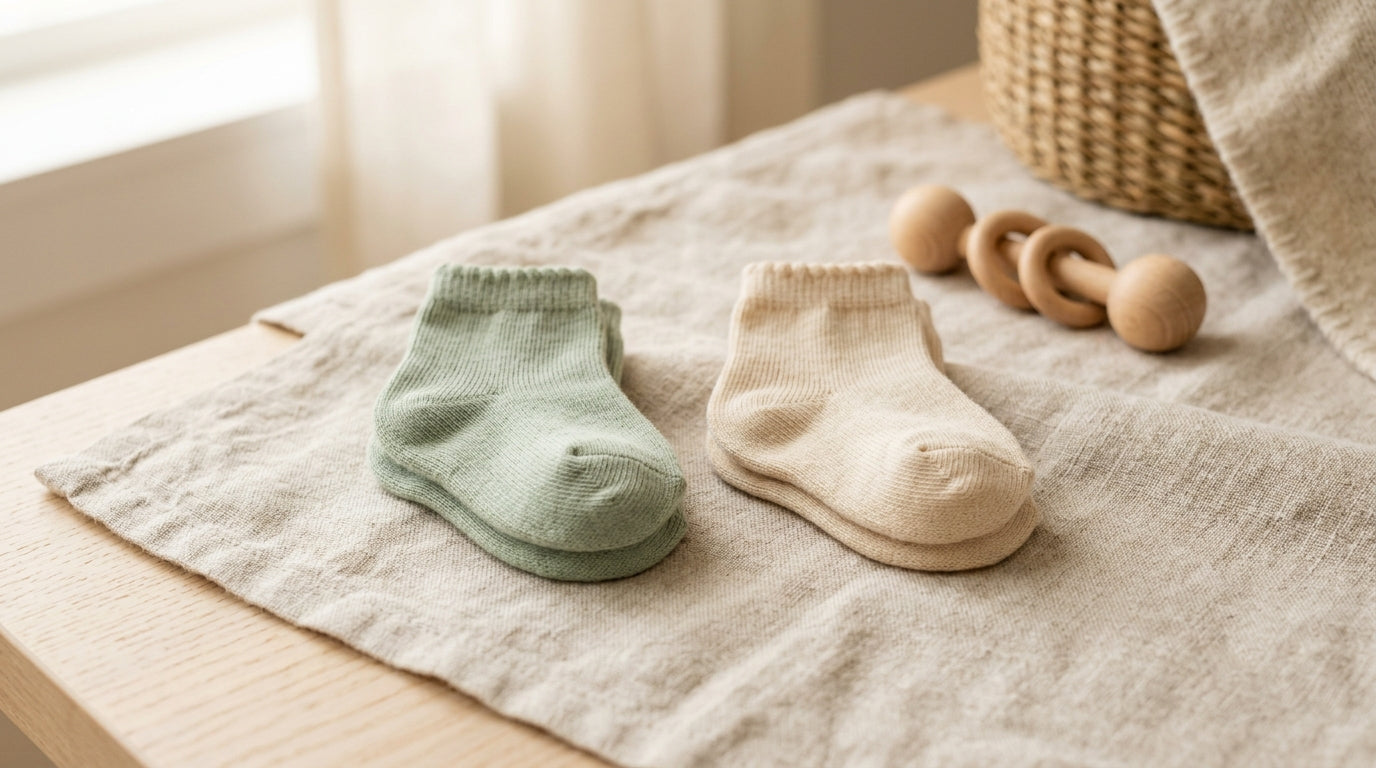
My left arm is currently wedged shoulder-deep inside the rubber gasket of our Bosch washing machine, fishing for a piece of fabric the size of a tea bag. Maya is howling from the nursery because her left foot is cold, and Evie is calmly sitting on the rug chewing on a wooden block, wearing exactly one sock. The other sock is presumably in the same alternate dimension as my pre-parenting dignity and unbroken sleep.
Before having twins, my conception of baby clothes was dictated entirely by detergent adverts where serene, well-rested mothers fold impossibly white garments in sunlit rooms. I thought baby socks were just adorable, miniaturised versions of adult clothing. I didn't realise they were actually instruments of psychological warfare, capable of vanishing into thin air and, occasionally, acting as medical hazards.
When you're expecting, people buy you things. Mountains of things. And nestled within those gift bags are always these tiny, synthetic-blend foot coverings that look like they belong to a Victorian doll. I enthusiastically stuffed my daughters' feet into them, completely ignorant of the fact that I was basically wrapping their toes in non-breathable plastic.
The grand deception of the 100 percent cotton label
There was a brief, highly arrogant period in my early fatherhood journey where I decided I was going to be a purist. I spent late-night feeds scrolling on my phone, bleary-eyed, aggressively searching for the purest cotton newborn socks money could buy. I scoffed at blends. If it wasn't 100% pure organic cotton, it wasn't touching my daughters' pristine, terrifyingly fragile feet.
So, I bought them. They arrived looking beautifully rustic and ecologically superior. I wrestled them onto Evie's feet, feeling quite smug about my parenting choices. Fourteen seconds later, Evie did a sort of bicycle-kick manoeuvre, and both socks flew off her feet, bouncing softly against the skirting board.
Here's a deeply annoying reality that nobody puts in the parenting manuals: 100% cotton has absolutely zero elasticity. Without stretch, a sock on a kicking infant is essentially just a temporary fabric hat for a foot. It doesn't grip the ankle. It doesn't mold to the heel. It just sits there until gravity or a slight breeze removes it.
It turns out you actually want a tiny bit of elastane in your organic cotton newborn apparel. The sweet spot, which I learned after spending an embarrassing amount of money on useless foot-tubes, is somewhere around 95% to 98% cotton and a small fraction of elastane. You need that stretch to keep the blood flowing properly and to prevent the sock from instantly migrating into the ether. I spent months feeling betrayed by the textile industry before realising that the 5% stretch is the only thing standing between me and total insanity.
What our GP said about sweaty baby feet
You wouldn't think an infant who does literally nothing all day could generate much sweat, but you'd be wrong. Babies are essentially tiny, inefficient radiators. They haven't quite figured out how to keep stable their own body temperature yet, which means they fluctuate between feeling like a block of ice and a hot water bottle.

During a routine check-up, after I casually complained about Maya's ankles looking perpetually red and irritated, our GP mentioned that newborn skin is supposedly about 30% thinner than ours. Apparently, it acts like a highly absorbent sponge for whatever synthetic nonsense is used in cheap dyes and fabrics. I don't entirely understand the cellular mechanics of this—my medical training consists of panic-reading NHS pamphlets at 3am—but it made terrifying sense.
When you put a polyester or nylon sock on a baby, you're trapping heat and moisture directly against that incredibly thin, permeable skin. It creates a sort of micro-sauna that breeds angry red rashes and contact dermatitis. Swapping out those synthetic blends for breathable, organic cotton meant Maya's skin actually had a chance to breathe, and her ankles slowly stopped looking like a pepperoni pizza.
Cheating the system entirely
Honestly, after losing my mind over missing socks and worrying about restrictive elastics, my preferred strategy is simply bypassing the sock economy whenever humanly possible.
I've become fiercely, perhaps unreasonably, loyal to the Baby Romper Organic Cotton Footed Jumpsuit. It completely eliminates the foot-covering variable. The feet are integrated into the suit. They can't be kicked off, they can't be eaten by the washing machine, and there's no tight ankle band cutting off circulation. It's made of 95% organic cotton with just enough stretch, and it buttons all the way down the front. At 2am, when I'm functioning on the cognitive level of a tired houseplant, not having to align tiny snap-buttons or search for rogue socks is a big relief.
I usually pair it under something simple, or if it's warm, I'll just use the Sleeveless Organic Cotton Baby Bodysuit on its own. It's a perfectly fine, highly functional base layer. It doesn't change my life the way integrated feet do, but it's soft enough that the girls' eczema doesn't flare up, and it survives the endless cycle of the washing machine without losing its shape. It's just a solid, dependable piece of fabric that doesn't actively make my life harder, which is high praise in the realm of baby gear.
Putting silicone traction grips on socks for a three-week-old is a profoundly useless invention for a creature that hasn't yet mastered holding up its own heavy, wobbling head.
If you're currently reconsidering your entire approach to infant laundry and synthetic fabrics, you might want to browse Kianao's organic baby clothes before you buy another multipack of polyester foot prisons.
The absolute terror of the rogue hair
Let's talk about the inside of the sock, because this is where the real nightmare fuel lives.

There's a medical phenomenon called Hair Tourniquet Syndrome. It sounds like a medieval torture device, but it's really just a stray hair or a loose thread from the inside of a poorly made sock wrapping itself tightly around a baby's toe. Because babies are bad at communicating anything other than broad, existential rage, you might just think they've colic, when in reality their toe is being slowly amputated by a strand of your partner's hair.
Once another parent told me about this at a soft play centre, I spent the next two weeks frantically inspecting my daughters' toes with the intensity of a diamond appraiser. Cheap socks are full of loose, looping threads on the inside. You flip them inside out and they look like a tangled bird's nest. High-quality organic cotton options tend to be tightly knit with smooth interiors, significantly lowering my daily blood pressure.
I also learned—far too late to save my early sanity—that you're supposed to wash baby clothes inside out in a mesh laundry bag to catch those stray hairs before they weave themselves into the fabric. So instead of spiralling into a panic every time you put a garment on your child and frantically inspecting every seam with a flashlight, it's generally easier to just invest in well-constructed clothes and adopt slightly better laundry habits.
Decoding the labels while severely sleep-deprived
If you spend enough time looking at baby clothing tags, you start to feel like you're deciphering an ancient, highly bureaucratic language. You'll see things like GOTS and OEKO-TEX thrown around.
From what I've managed to gather through the fog of sleep deprivation, GOTS (Global Organic Textile Standard) is basically the holy grail. It means the cotton wasn't sprayed with pesticides that linger in the fibres, and the people who harvested it weren't treated appallally. OEKO-TEX Standard 100 just means the final product has been tested for a massive list of harmful substances, including PFAS (those 'forever chemicals' that seem to be in literally everything right now, terrifyingly enough).
I don't need a degree in chemistry to know I don't want PFAS touching Evie's sweaty little feet. I just want to see a label that reassures me I'm not actively poisoning my children while trying to keep them warm.
And if they somehow manage to strip off their carefully selected, certified organic layers anyway (which they'll, because twins operate with a hive-mind dedicated to chaos), I just throw the Organic Cotton Baby Blanket with Bunny Print over their legs and surrender to the madness. It has these slightly absurd, cheerful yellow bunnies on it that Evie likes to stare at while she refuses to nap, and it's breathable enough that I don't have to worry about them overheating when they inevitably pull it over their faces.
Parenting is mostly just a series of small, exhausting negotiations with tiny dictators who have no concept of their own mortality or basic thermodynamics. You can't control the fact that they'll scream at a shadow on the wall, or that they'll refuse to eat anything green for three consecutive days. But you can control the fabric that touches their skin. It's a small victory, but when you're fishing your arm out of a washing machine gasket at ten in the morning, holding a single, triumphant organic cotton sock, you take whatever victories you can get.
Ready to stop fighting a losing battle with cheap fabrics and missing laundry? Explore our full range of organic baby essentials before your next inevitable midnight wardrobe change.
Questions I frantically googled at 3am
Do newborns really need to wear socks indoors?
Look, our health visitor seemed to think their feet should be covered because they lose heat quickly, but if your house is reasonably warm and they're layered up in a sleep sack, they'll survive barefoot. I prefer footed rompers anyway because it means I don't have to think about it. If their toes feel like tiny ice cubes, put a breathable layer on them.
Why are there no grips on newborn socks?
Because they can't walk. Putting traction dots on the feet of a potato that just lies on a playmat all day is pointless. Worse, those little silicone dots can genuinely press into their thin skin and cause pressure marks. Save the grips for when they're really trying to pull themselves up on the coffee table.
Is organic cotton really that different from regular cotton?
I used to think it was just a marketing scam to make me spend more money, but apparently regular cotton is heavily treated with pesticides and synthetic fertilisers that don't entirely wash out. Given that Maya will aggressively chew on her own toes given half a chance, I'd rather she wasn't ingesting chemical residue.
How do I stop them from kicking their socks off?
You don't. You can't defeat the baby bicycle kick. The best you can do is buy socks with that tiny 2% elastane blend so they've a fighting chance of clinging to the ankle, or just give up and buy footed trousers. Fighting the baby kick is a young man's game, and I'm far too tired for it.
What are flat-toe seams and do I care?
I didn't know this was a thing until we dealt with sensory meltdowns. Cheap socks have thick, bulky seams running across the toes that rub against the skin inside a shoe or sleep sack. Flat seams are exactly what they sound like—they lie flat. If your baby is prone to eczema or just generally kicks up a fuss when you dress them, checking the inside seam is weirdly good.




Share:
The Truth About Organic Infant Socks (and Peeling Ankles)
Dear Past Me: Surviving the Great Cozy Legging Winter Crisis