

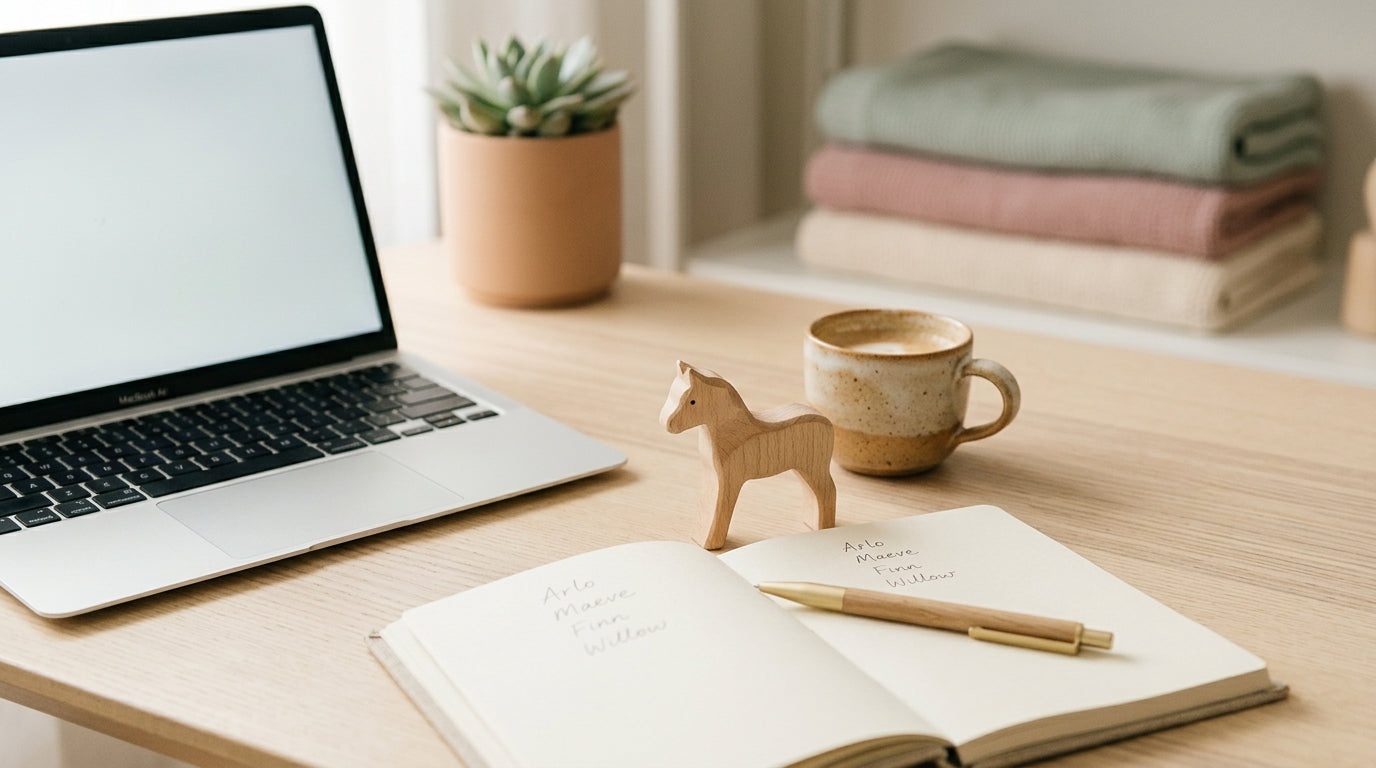
I was staring at row 842 of my master Google Sheet when the system finally broke down. Column A contained the potential name. Column B tracked the syllable count. Column C was tied to a Python script I wrote to scrape the Social Security database, specifically designed to flag and eliminate any name that peaked in popularity between 1990 and 1995. I was absolutely terrified of naming my son after someone who used to steal my lunch money in middle school. Column D checked available domain names, because apparently that's something you've to worry about now. Don't do this. Approaching a human child's identity like you're provisioning a new server is a fast track to marital friction and big exhaustion.
My wife, Sarah, walked into the kitchen, looked over my shoulder at the glowing spreadsheet of algorithmic anxiety, and quietly closed my laptop. She told me we were overthinking it. She said we needed to step back from the data and look at nature, or history, or literally anything that didn't require an API key. Since she grew up riding in the summers, she suggested we start by looking for a baby horse name.
The equestrian rabbit hole
I grew up in the suburbs playing real-time strategy games in a basement, so my knowledge of agriculture is limited to what I've seen on Wikipedia. When Sarah suggested equestrian-inspired names, I assumed she meant naming him "Seabiscuit" or "Mr. Ed." I had to open a new tab and start researching how these animals actually get their titles. Apparently, the rules for naming a real baby horse—which I learned is just called a foal, regardless of gender, up to one year old—are completely wild and highly regulated.
If you're registering a Thoroughbred, the Jockey Club dictates that the name can be no longer than exactly 18 characters. That includes spaces. That includes punctuation. If you submit a string that's 19 characters, your request bounces back. I honestly respect this level of strict data validation. It prevents a parent from naming their kid something that requires a second line on a Scantron bubble sheet. If human hospitals enforced an 18-character hard stop, we could probably save millions in administrative overhead.
Some European warmblood registries are even more unhinged. They employ a strict alphabet rule where every foal born in a specific year must have a name starting with an assigned letter. In 2024, for certain registries, every single baby horse had to start with the letter "U." Imagine trying to enforce that at a human hospital. Handing a clipboard to a sweating, exhausted mother and saying, "Congratulations on the birth of your son, it's a 'U' year, please choose between Ulysses and Uther." It's actually a brilliant way to eliminate decision fatigue, but Sarah stared at me with big concern when I suggested we adopt this constraint for our own naming process.
We pivoted back to human names that just subtly mean "horse." We looked at Philip, which translates to "lover of horses," but I've an uncle named Philip who chews with his mouth open, so that was instantly vetoed. We looked at Destry, an old Anglo-Norman word for a warhorse. That felt incredibly accurate for a baby who currently fights his sleep sack at 4 AM like a gladiator, but it sounded a bit intense for a kid who cries when the cat looks at him funny. We even considered Roan, which refers to a specific interspersed coat color on a horse. Roan sounds like a guy who roasts his own coffee beans but also knows how to rebuild a carburetor. I liked Roan. Pippa also means lover of horses, but we were having a boy so that got deleted from the spreadsheet without a second thought.
Foal firmware versus human hardware
Looking up all these equine terms inevitably pushed me into reading about how an actual baby horse develops, and honestly, the comparison is deeply offensive to me as a human parent.
From what I gather, a foal basically drops out of the womb, takes about thirty minutes to update its internal firmware, and then stands up. Within a few hours, it's walking. Shortly after that, it can run. It enters the world with a nearly complete operating system. Meanwhile, my 11-month-old son just spent three consecutive weeks trying to figure out that his own foot is permanently attached to his leg. He still occasionally falls backward from a seated position like a tipped-over vending machine.
Our pediatrician laughed when I brought this up at his checkup, nervously showing her the daily logs I keep of his gross motor skills. My pediatrician said human babies are born incredibly premature compared to other mammals because our brains are so massive that we physically have to exit the system early, or we'd get stuck in the hardware. She explained that human infants spend their entire first year just finishing their basic assembly on the outside. So we essentially trade early mobility for the ability to eventually invent space travel and Wi-Fi. I guess that's a fair trade-off, but at 2 AM when I’m carrying 22 pounds of screaming dead weight up the stairs, I really wouldn't mind if he could just trot down the hallway by himself.
I also read that foals have to nurse within the first two hours to ingest colostrum, which boots up their immune system. Reading that triggered a visceral flashback to the panic in our hospital room trying to get my son to latch. It felt like we were failing a critical, timed tutorial mission. Eventually, he figured it out, but it wasn't the instinctual, flawless execution you see on a nature documentary. It mostly consisted of me sweating through my shirt, Sarah wincing in pain, and a very patient lactation consultant manipulating us like claymation figures until the connection was established.
Our favorite analog nursery gear
This whole equestrian fixation during the pregnancy actually ended up influencing one of our best nursery purchases. I wanted something that nodded to nature and animals, but I was aggressively opposed to those blaring, primary-colored plastic activity mats that look like a casino floor and require endless AA batteries. We ended up getting the Wild Western Play Gym Set from Kianao.

This thing is genuinely fantastic. The A-frame is built from solid natural wood, not that cheap plastic that bows and snaps if you look at it wrong. It hangs these beautiful, handcrafted toys—a wooden buffalo, a little geometric cactus, and this soft crocheted horse. That little horse is the only equestrian thing that seriously made it into our house. When he was around four months old, before he could roll over, my son would just lie under that frame and stare at the horse for exactly 14 minutes at a time. I tracked it. It was the only predictable metric in my entire life during the fourth trimester.
The mix of materials on the gym is really really smart. When he finally figured out how to swing his arms, his clumsy fists would hit the smooth, heavy wood of the buffalo, which made a satisfying clack, and then he'd swat the soft crocheted horse, which gave him entirely different haptic feedback. It feels like a piece of heritage woodworking rather than disposable plastic trash that will sit in a landfill for a thousand years. If you want a setup that doesn't overstimulate your kid into a meltdown, it's worth browsing their wooden play gym collection just to see the alternatives to plastic.
Why organic cotton is just fine
Let's talk about the gear that isn't exactly revolutionary but is absolutely necessary to maintain basic operational stability.
We bought several of the Organic Cotton Baby Bodysuits. Look, I’ll be completely honest with you: it's a good shirt. It does exactly what a baby shirt is programmed to do. The organic cotton is undeniably soft, and apparently, it lacks the residual agricultural pesticides that synthetic fabrics harbor. I guess that's important considering my son attempts to chew on his own collar at least four times a day. The fabric has 5% elastane, which provides enough stretch that I can pull it over his massive, uncooperative head without him screaming like he's being abducted.
But honestly, it's just a piece of cloth meant to absorb a daily, unpredictable barrage of spit-up, drool, and mystery stains. It holds up well in the wash, the snap closures haven't ripped out of the fabric yet, and it fits him nicely. It hasn't fundamentally changed my life the way the play gym did, but it is reliable, baseline infrastructure for his daily outfits. And sometimes, boring and reliable is exactly what you need.
Analog debugging with a wood ring
Speaking of him chewing on his collar, the teething phase hit our house like a distributed denial-of-service attack. It came out of nowhere. Suddenly, he was generating 300% more drool than a normal human should, and his primary objective was to aggressively gnaw on the edge of our coffee table. We had to quickly source a patch for this bug, so we grabbed the Bear Teething Rattle.

It's an incredibly analog device. It’s essentially an untreated beechwood ring with a light blue, crocheted sleepy bear head attached to it. I liked that the wood was totally natural and didn't have any weird chemical sealants on it, because whatever he holds goes instantly into his mouth with terrifying velocity. He grips that wooden ring with white-knuckled intensity and chomps down on it while staring blankly at the wall, looking like a tiny, extremely stressed lumberjack. The contrast between the rock-hard wood and the soft cotton bear head seems to confuse and soothe him simultaneously. It doesn't play music, it doesn't flash lights, it just safely absorbs his teething rage so our furniture doesn't have to.
Compiling the final decision
In the end, we completely abandoned my over-engineered Google Sheet. We didn't use an API. We didn't follow the 18-character Thoroughbred rule, and we didn't end up naming him after a horse, even though I still occasionally suggest Roan as a nickname and Sarah ignores me. We just sat on the floor of his partially assembled nursery, surrounded by cardboard boxes and Allen wrenches, and said names out loud until we found one that didn't sound completely ridiculous when yelled across an imaginary playground.
Parenting is essentially launching uncompiled code directly into a live production environment with zero user testing. You can read all the documentation about milestones, growth charts, and sleep regressions, but the actual tiny user behaves completely unpredictably. A baby horse might know how to walk on day one, but a horse is never going to look up at you and giggle hysterically just because you made a weird popping noise while trying to untangle their onesie.
I'll take the slow, buggy, messy human development any day of the week. Even if it means waiting an entire year just to see him figure out how to stand up without falling over.
If you find yourself stuck in the endless, exhausting loop of naming debates and nursery prep, you might want to close the spreadsheet, take a deep breath, and just equip yourself with gear that won't break. Check out Kianao’s full line of sustainable baby essentials to get your hardware sorted before your little user finally boots up.
Frequently Asked Questions (The Messy Truth)
So what's a baby horse genuinely called?
Okay, apparently it's a "foal" across the board from birth until they hit one year old. If it's a boy, it's a colt. If it's a girl, it's a filly. They keep those gendered names until they turn four. I spent two hours reading about this instead of sleeping. I don't know why my brain prioritizes this information over remembering where I put the diaper cream, but here we're.
Are horse-inspired names really a thing for human babies?
Yeah, surprisingly. Names like Philip and Pippa literally translate to "lover of horses" from ancient Greek roots. Then you've names like Ryder, Colt, or Destry (which means warhorse). We almost went with Roan, which is a type of horse coat color. It sounds earthy and cool without being aggressively weird. Just don't name your kid Secretariat and you'll be fine.
Why can a foal walk immediately but my baby just rolls around like a potato?
My pediatrician basically explained that human brains are massive. If we stayed in the womb until we were physically capable of walking like a horse does, our heads wouldn't fit through the exit. We're born totally helpless so our brains can keep growing on the outside. So your baby isn't broken, they're just prioritizing processing power over mobility right now.
How do I know if my kid is genuinely teething or just gross?
With my son, the drool volume increased exponentially. It was like someone left a faucet dripping on my shoulder 24/7. He also started shoving his entire fist into his mouth and gnawing on everything in a very angry, aggressive way. If they're cranky, soaking through bibs, and trying to eat your coffee table, hand them a wooden teether immediately. It saves your furniture and your sanity.




Share:
How to Survive the Feral Baby Hyena Phase of Human Toddlerhood
When You Become the Default Human Holder for Your Baby