

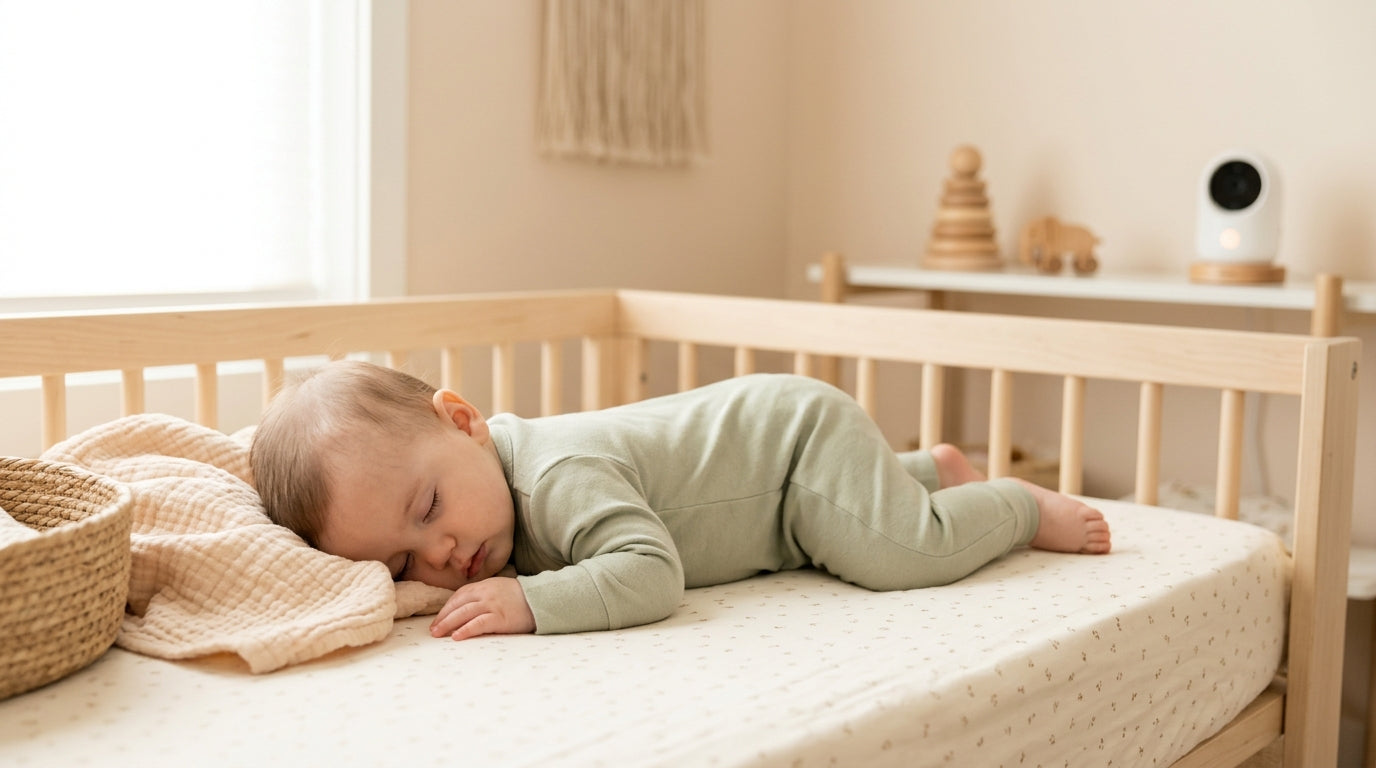
The glowing screen of the baby monitor was blinding in the pitch-black bedroom, and my heart was hammering against my ribs at roughly 140 beats per minute. It was 3:14 AM. The temperature in the nursery was exactly 69.4 degrees, just like I programmed it. But on the video feed, my five-month-old daughter was entirely face-down in the mattress. She looked like a crashed hard drive. I elbowed my wife, Sarah, frantically whispering that the baby had somehow executed a barrel roll while we slept. Sarah just mumbled something about leaving her alone and rolled over. So there I was, sitting in the dark, furiously typing "when can a babie sleep face down" and "is babi breathing normal" into my phone with shaking thumbs, convinced I needed to rush in and flip her like a pancake.
If you're a new parent, you already know the absolute terror of the sleep flip. For the first few months of parenthood, I operated under a rigid, terrifying set of parameters. You put the kid on their back. Always. It was the one unbreakable rule of the house, like never deploying code on a Friday. I treated her crib like a sterile testing environment where the variables had to be perfectly controlled, but suddenly, she was installing her own unauthorized firmware updates and changing her sleeping position.
The great back-to-sleep doctrine
Before this whole rolling fiasco started, I thought I had everything figured out. I really did. I tracked every diaper, logged every ounce of formula, and bought into the idea that if I just followed the manual, the baby would stay safe. Apparently, back in the 90s, everyone realized that tummy sleeping was a massive bug in the system, deeply linked to SIDS. Dr. Lin, our incredibly patient doctor, explained it to me at our two-month visit while I aggressively took notes on my phone.
From what Dr. Lin said, the danger for tiny infants is that they just aren't built to handle their own exhaust fumes. If they sleep face-down, they end up trapped in a tiny pocket of carbon dioxide, breathing in their own stale air until their oxygen levels tank. It's a hypoxia loop. Plus, apparently, tummy sleeping drops their blood pressure and pushes them into this super deep sleep state where their brain just forgets to wake them up if something goes wrong. I remember leaving that appointment totally convinced that if she so much as tilted 45 degrees to the left, disaster would strike.
I was so paranoid about it that I used to watch her chest rise and fall on the monitor for twenty minutes before I let myself close my eyes. I genuinely believed that choking was a massive risk if she spit up on her back, but Dr. Lin shot that down instantly, drawing a weird diagram of a baby's trachea to show me that gravity actually protects their airway when they're supine. It was a lot of physics for a Tuesday morning, but it cemented my belief that the back was the only safe zone.
But then, right around four and a half months, she learned how to roll. And my entire system completely fell apart.
My beef with sleep wedges
Let me get sidetracked for a minute because this drives me absolutely insane. When she first started trying to roll at night, I panicked and went down a rabbit hole looking for hardware solutions to keep her pinned on her back. The internet is completely overflowing with these foam wedges and padded risers marketed specifically to anxious, sleep-deprived dads like me.

They look like tiny foam straitjackets. The ads promise that they'll hold your kid perfectly in place so they can't flip over. I spent three days agonizing over reviews, trying to figure out which one had the best structural integrity. I was this close to overnighting one from a sketchy third-party seller because I was so desperate to stop her from ending up on her stomach.
Sarah caught me adding it to the cart and practically threw my phone across the room. She was right, obviously. It turns out the FDA actually has massive warnings against these things because if a baby *does* manage to shift around, their face gets smashed right into the padded incline, creating an infinitely worse suffocation hazard than a flat mattress. Why do companies even manufacture this junk? It's basically preying on parents who are running on two hours of sleep and a dangerous amount of cold brew. Just ditch the swaddle the second they start rolling and put them in a standard sleep sack.
The physics of the midnight barrel roll
So, back to the 3 AM panic. That first night she flipped, I actually did sneak into her room like a ninja and gently rolled her back over. She immediately woke up, screamed like a tiny banshee for forty minutes, and then promptly flipped back onto her stomach the second I put her down. We played this horrible, exhausting game of nighttime whack-a-mole for three straight days. I'd flip her, she'd scream, she'd flip back.
Finally, I dragged my exhausted self back to the doctor. I walked in, probably looking like a literal zombie, and asked the million-dollar question about figuring out exactly when can babies sleep on their stomach without me having a heart attack. Dr. Lin just laughed. Not a mean laugh, just the kind of laugh reserved for clueless first-time dads who overcomplicate everything.
She told me the golden rule: if the baby has the core strength to roll themselves onto their stomach, and they can roll themselves *back* again, the system is secure. They have the physical hardware to lift their heavy little heads and clear their airway if they need oxygen. You just have to let the physics engine do its thing. Of course, you still have to start them on their back when you drop them in the crib. Every single time. But if they migrate into a weird face-down yoga pose ten minutes later, you just leave them alone.
The caveat here—because there's always a caveat with babies—is the rolling direction. If your kid can only flip tummy-to-back, or only back-to-tummy, you're stuck on flipping duty until they master the two-way rotation. Thankfully, my daughter had been practicing her combat rolls on the living room rug for weeks, so she was fully cleared for two-way traffic.
Hardware that survived the transition
Once we stopped fighting her natural sleep position, we had to re-evaluate her entire crib setup. You really can't have any loose junk in there once they start moving around like a Roomba in the dark.

My absolute favorite piece of gear during this phase has been the Long Sleeve Organic Cotton Baby Bodysuit. When she started sleeping on her stomach, she'd somehow wiggle out of regular pajamas or the zippers would dig into her chest. This bodysuit has these reinforced snaps that genuinely stay closed no matter how much she thrashes around trying to get comfortable. The organic cotton is super stretchy, so it doesn't restrict her arms when she's pushing up off the mattress to look around. We bought it in four different colors. It's basically her uniform now.
On the flip side, we've the Whale Organic Cotton Blanket. Don't get me wrong, the material is ridiculously soft, and the little gray whales look great in her room. But honestly, it's just okay for us right now. Because she's only 11 months old, Dr. Lin was very clear that we still can't have loose blankets in the crib. So the blanket just sits folded on the rocking chair. We use it for tummy time on the floor during the day, but as a sleep accessory, it's totally benched until she's older.
Trying to build a safe sleep environment that doesn't drive you crazy? Check out our baby sleep collection for breathable layers.
Also, just a heads-up: right around the time they learn to sleep on their stomachs, their teeth usually decide to ruin your life. Sarah bought the Panda Teether, and it's been a lifesaver during the day. She gnaws on the little bamboo textured parts like a rabid puppy. It doesn't help with the sleep stuff, obviously, but it keeps her from screaming while I'm trying to drink my morning coffee, so it's a win in my book.
Surrendering to the baby logic loop
We're at 11 months now, and I can confidently say that my daughter sleeps on her stomach 95 percent of the time. She usually shoves herself all the way up into the top corner of the crib, squished against the mesh, looking incredibly uncomfortable. But she sleeps.
The transition from "rigid back-sleeping enforcer" to "letting her sleep face-down in the corner" wasn't easy for me. It required a complete rewrite of my internal anxiety code. I had to stop obsessively watching the monitor. I had to trust that her body knew what to do, which is incredibly hard when you spend the first few months convinced they're as fragile as spun glass.
Babies are weird, durable little creatures. They don't care about the rules we read on the internet, and they certainly don't care about the anxiety attacks they give us at 3 AM. If your kid is rolling like a gymnast and the crib is empty, just close your eyes and get some sleep. You're going to need it for whatever chaotic milestone they invent next.
Ready to upgrade your baby's crib wear for the rolling phase? Grab our stretchy, breathable Organic Cotton Bodysuits before your next sleepless night.
My completely unscientific dad FAQs
Do I've to flip them back if they roll over in their sleep?
If they can comfortably roll both ways on their own, no, leave them alone unless you enjoy making yourself and your baby miserable. Dr. Lin told me that once they've the strength to do the two-way flip, their airway risk drops off a cliff. If they can only roll one way and get stuck like a turtle, yeah, you've to go in and rescue them.
Can babies sleep on their stomachs on a playmat?
Supervised tummy time while they're awake is great, but if they fall asleep on the mat, you've to move them to the crib. I tried to let my daughter nap on the rug once because she looked so peaceful, but Sarah reminded me that soft surfaces and rugs aren't safe for sleep, so I had to endure the wrath of moving a sleeping baby.
What if my baby hates back sleeping from day one?
It's brutal, I know. For the first few months, you just have to power through it. We used a white noise machine cranked up pretty high and a pacifier to keep her calm. Apparently, pacifiers trick their brain into staying a little more alert, which is why pediatricians love them for SIDS prevention. But you can't just put a newborn on their stomach because it's easier. The physics don't support it yet.
Are weighted sleep sacks safe for stomach sleepers?
Hard no. I thought about buying one when the sleep regressions hit, but my doctor practically yelled at me. If they roll onto their stomach wearing a weighted sack, they're fighting gravity and extra weight to expand their lungs. It's a massive hazard. Stick to regular, lightweight sleep sacks.
When can we finally put a blanket in the crib?
I'm impatiently waiting for this one. Everything I've read and been told says wait until they hit 12 months. Before that, they're just too clumsy to untangle themselves if it gets wrapped around their face. Until her first birthday, she's stuck wearing layers.




Share:
The Great Eye Colour Waiting Game: A London Dad's Guide to Melanin
The Great Upright Wobble: A Guide to Your Baby Sitting Solo