

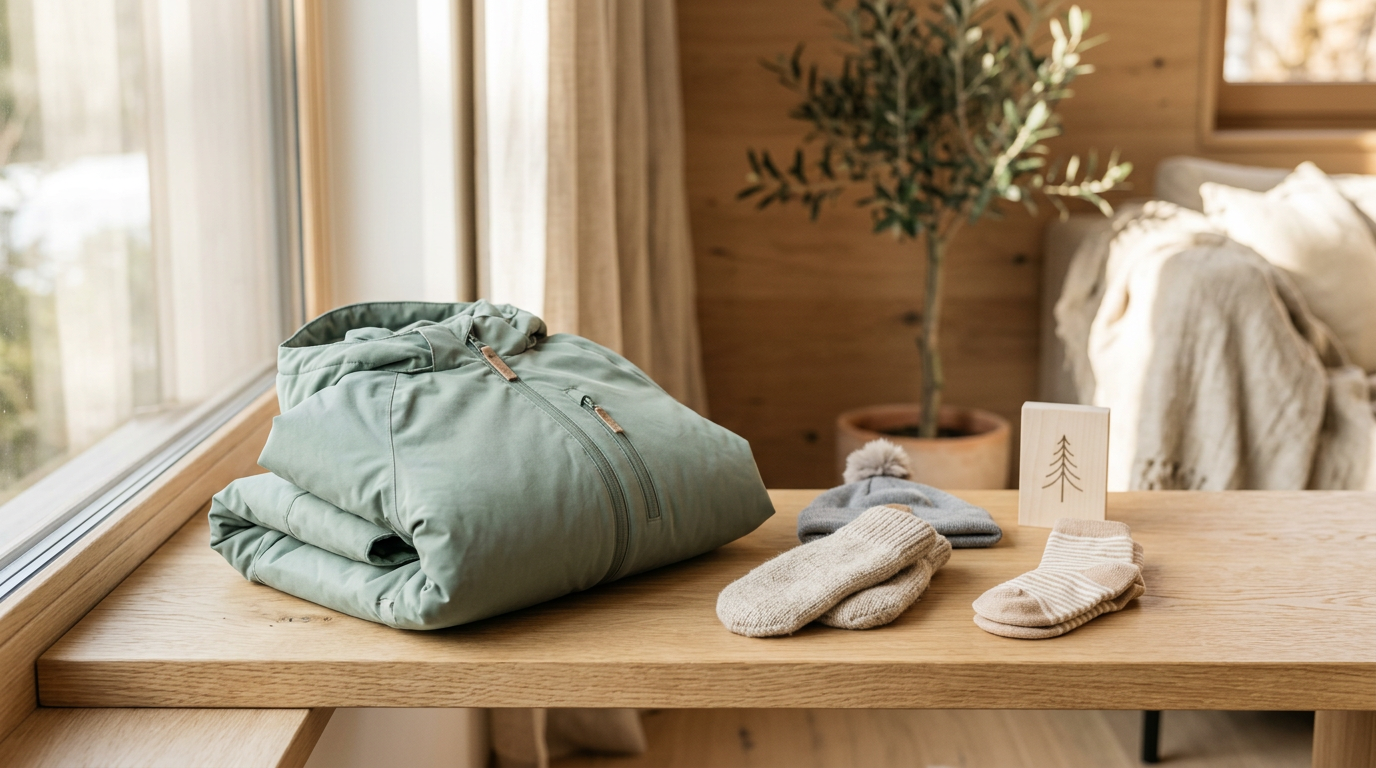
Dear Marcus of exactly six months ago, currently staring blindly at a wall of synthetic winter gear at the REI in the Pearl District while Sarah texts you asking if you've found anything waterproof yet. I'm writing to you from the future, specifically from a puddle of melted Mt. Hood snow currently pooling on our hardwood floor. You're about to make so many mistakes. You think you can just grab the puffiest garment off the rack and call it a day, but my understanding of winter gear just got a massive firmware update, and you need to pay attention before you ruin this weekend.
I know you're exhausted. The baby woke up three times last night, and your brain is operating on a bare minimum power-saving mode. But buying a skianzug kinder for an eleven-month-old who's currently learning to walk is not a simple transaction. It's a highly technical procurement process that requires an understanding of fluid dynamics, thermal retention, and the physical limitations of a squirming human who actively fights having his arms bent.
Put down that adorable beige puffy thing. Let's troubleshoot this before you waste two hundred dollars.
The Great Nomenclature Bug
You probably think a snowsuit and a ski suit are the exact same thing, just marketed differently to extract more money from panicked parents. I certainly did. But apparently, they serve entirely different use cases, and confusing them will result in a screaming, sweaty infant.
A snowsuit is basically a wearable sleeping bag. It has one job: maximum heat retention for a stationary meat sack. If the baby is just going to sit in the stroller and stare at the sky while you drink a coffee, buy a snowsuit. But an eleven-month-old who's constantly crawling, pulling up, and face-planting in the snow is basically running a marathon. For that, you need a true ski suit. The focus here's temperature and moisture regulation so they don't overheat, sweat, and then rapidly freeze the moment they stop moving. I learned this the hard way when I unzipped his suit after ten minutes of him thrashing in a snowdrift and steam literally poured out of his collar like a broken radiator.
Hardware Specs for the Snow
Forget the marketing copy. Ignore whatever cute animal is embroidered on the chest. You need to look at the hard data on the tag, specifically the numbers that tell you if this thing will actually keep water out.
When you kneel down in the snow, your body weight compresses the moisture against the fabric. Because our son's primary mode of transportation is aggressive knee-bashing crawling, he's basically applying hydraulic press levels of pressure to the knee patches of his suit. The metric you need is the Wassersäule, or water column.
- 3,000 mm: This is a light drizzle jacket. It's useless. Don't buy this.
- 5,000 mm: The absolute minimum baseline for a child actually touching snow.
- 10,000 mm: The target spec. This is what you want for a ski suit.
You also need to frantically check the seams while simultaneously ignoring the tag size to guess if the cuffs will actually fit over their tiny boots. If the seams aren't taped, the 10,000 mm water column rating is irrelevant because the melted snow will just leak through the microscopic needle holes and soak his thighs anyway. I spent twenty minutes analyzing the stitching on a suit last week while another dad watched me in silent solidarity.
Then there's the MVTR value. Apparently, this stands for Moisture Vapor Transmission Rate, which I guess means how fast sweat escapes before your kid turns into a human terrarium. A rating of 5,000 g/m²/24h is fine for a toddler, but just know that if this number isn't on the tag, the suit is probably as breathable as a heavy-duty trash bag.
Why Cotton is a System Failure
This is where I completely corrupted our layering system on day one. I assumed that because cotton is soft and natural, it makes the perfect base layer. Our pediatrician, Dr. Chen, looked at me with deep pity when I mentioned my strategy.

Cotton absorbs sweat and holds onto it like a sponge. When your baby stops crawling and the cold air hits that damp cotton, their core temperature drops instantly. You're basically wrapping them in a wet towel under their winter gear. You have to use synthetic functional underwear or merino wool against the skin. I didn't believe this until I touched his back after a snow session and his cotton onesie felt like it had just come out of the washing machine before the spin cycle.
Once you get them indoors, though, you strip that damp synthetic base layer off immediately. This is when the organic fabrics seriously come into play.
I'm honestly obsessed with the Plain Bamboo Baby Blanket for our post-snow recovery routine. We have the terracotta color. When we get back to the lodge and peel off the stiff, crinkly layers of waterproof nylon, his skin is always a little red and confused. This bamboo blend really controls his temperature so he doesn't wake up screaming from being too hot after his nap. I just wrap him in this the second he's in clean clothes, and the system reboots peacefully.
Nobody cares what color the mid-layer fleece is since it's buried under waterproof nylon anyway.
If you're looking for layers that seriously breathe when you're back indoors, explore our baby blankets collection to upgrade your baby's thermal regulation stack.
Safety Protocols and Tree Branches
I never thought about hoods until a random Tuesday appointment. Dr. Chen casually dropped a terrifying tidbit while checking the baby's ears. The hood on a winter suit must be fully detachable with snap buttons, not a zipper, and definitely not permanently sewn on.
The logic is dark but sound. When your child is slightly older and tearing through trees or climbing on playground equipment, a fixed hood can snag on a branch. If it's attached with snaps, the tension pops the buttons and the hood comes off. If it's sewn on, your child is suddenly suspended by their neck. It's a massive strangulation hazard that I had literally zero awareness of, and now I aggressively yank on the hood of every jacket I see to test the snap resistance.
You also need to check for PFAS. These are the "forever chemicals" used in cheap waterproofing. They're toxic, terrible for the water table, and frankly, my kid chews on his own collar constantly, so I'd rather he not ingest industrial fluorocarbons. Look for tags that specifically state the impregnation is PFAS-free or fluorocarbon-free.
As for visibility, this is not the time for aesthetic earth tones. I don't care if a dark sage green matches your Subaru. When the fog rolls in on the mountain at 3 PM, a child in a beige suit becomes completely invisible against the dirty snow and bare trees. The marketing categories for a skianzug kinder mädchen or skianzug kinder jungen are mostly just arbitrary color filters applied to the exact same chassis. Buy the most obnoxious, retina-burning neon color you can find with massive reflective patches. You want them to look like a tiny, glowing traffic cone.
The Sale Rack Trap
Here's a classic Marcus mistake. You will see a sign for a skianzug kinder sale and think you're outsmarting the economy. You will find a premium suit marked down by sixty percent, but it's two sizes too big. You will buy it anyway, assuming he will "grow into it."

Don't do this.
If a ski suit is too large, the snow skirts inside the ankles won't grip the boots tightly. The moment he takes a step in deep snow, the pant leg rides up, the snow packs into the top of the boot, and melts directly into his socks. Game over. He will also trip constantly because the crotch of the suit hangs down to his knees, completely restricting his stride. An eleven-month-old is already drunk and unbalanced; don't give him clown pants.
Instead, look for a suit with a "Grow-Up" feature. I thought this was a gimmick until Sarah showed me how it works. Inside the lining of the arms and legs, there's a specific, brightly colored seam. When the kid grows, you take a seam ripper, slice that specific thread, and the sleeve literally unfolds, extending the length by about four centimeters. It's like finding hidden storage space on a hard drive you thought was full. You can honestly get two full winters out of one accurately sized suit this way.
Post-Snow Recovery and Laundry Destruction
There will be days when the weather is just too aggressive, and you refuse to deal with the whole twenty-minute sequence of shoving him into the ski suit. For those quick stroller walks around the neighborhood, we usually just bundle him up and throw a heavy blanket over his lap to block the wind.
Sarah bought the Organic Cotton Baby Blanket Eco-Friendly Purple Deer Pattern for this exact scenario. Honestly, it's fine. It's intensely purple with bright green deer, which hurts my tired eyes a little bit, but the double-layer organic cotton is incredibly thick and heavy enough that a stiff breeze won't blow it off the stroller. I still prefer the minimal aesthetic of the bamboo one, but this purple one survives the wash cycle like a champ, which is key because I inevitably spill coffee on it every single morning.
Speaking of the wash cycle, here's your final warning: If you put a waterproof ski suit in the washing machine with fabric softener, you'll instantly destroy it. Fabric softener coats the micropores of the membrane, permanently ruining the breathability and the water resistance. You will turn a $150 piece of technical gear into a sweaty plastic bag in forty-five minutes. Wash it on cold, use specialized technical detergent, and never, ever put it in the dryer.
Good luck out there, Past Marcus. Buy the neon traffic cone suit. Check the water column. And for the love of everything, take the cotton onesie off him before you go outside.
Before you dive into the chaotic troubleshooting steps below, take a second to check out our organic baby essentials so you've something soft to wrap them in when the snow day inevitably ends in tears.
Frequently Asked Troubleshooting Questions
Why is my kid still freezing in a thick ski suit?
Because you messed up the base layer. If they're wearing cotton against their skin, it soaked up their sweat when they were moving and is now holding a freezing wet layer against their chest. Swap it for merino wool or synthetics, and wrap them in a breathable blanket the second you get back inside.
Can I just put the suit in the dryer to warm it up before we go outside?
Absolutely not. The extreme heat of the dryer will melt the taped seams and completely fry the waterproof membrane. You will permanently brick the suit. Hang it over a chair near (but not touching) a radiator like a normal person.
Are bright colors genuinely a safety thing or just ugly?
Both. They're usually quite ugly, but they're a non-negotiable safety feature. I lost sight of my kid for exactly four seconds against a grey snowbank last week. If he hadn't been wearing a neon orange hat, I'd have had a full panic attack. Buy the ugly bright colors.
Should I buy a size up so it lasts until next year?
No, because then the snow cuffs won't seal around their boots, and snow will pack into their socks. Buy their current size, but look for a suit with a hidden extendable seam in the lining so you can lengthen the arms and legs next November.
How do I know if the hood is safe?
Yank on it. Hard. If it's attached with snap buttons that pop off under pressure, it's safe. If it's sewn tightly to the collar or uses a permanent zipper, it's a strangulation hazard waiting to snag on a playground structure.




Share:
The truth about high-end baby presents and what parents want
The Messy Truth About Why We Finally Switched To Silicone Bibs