

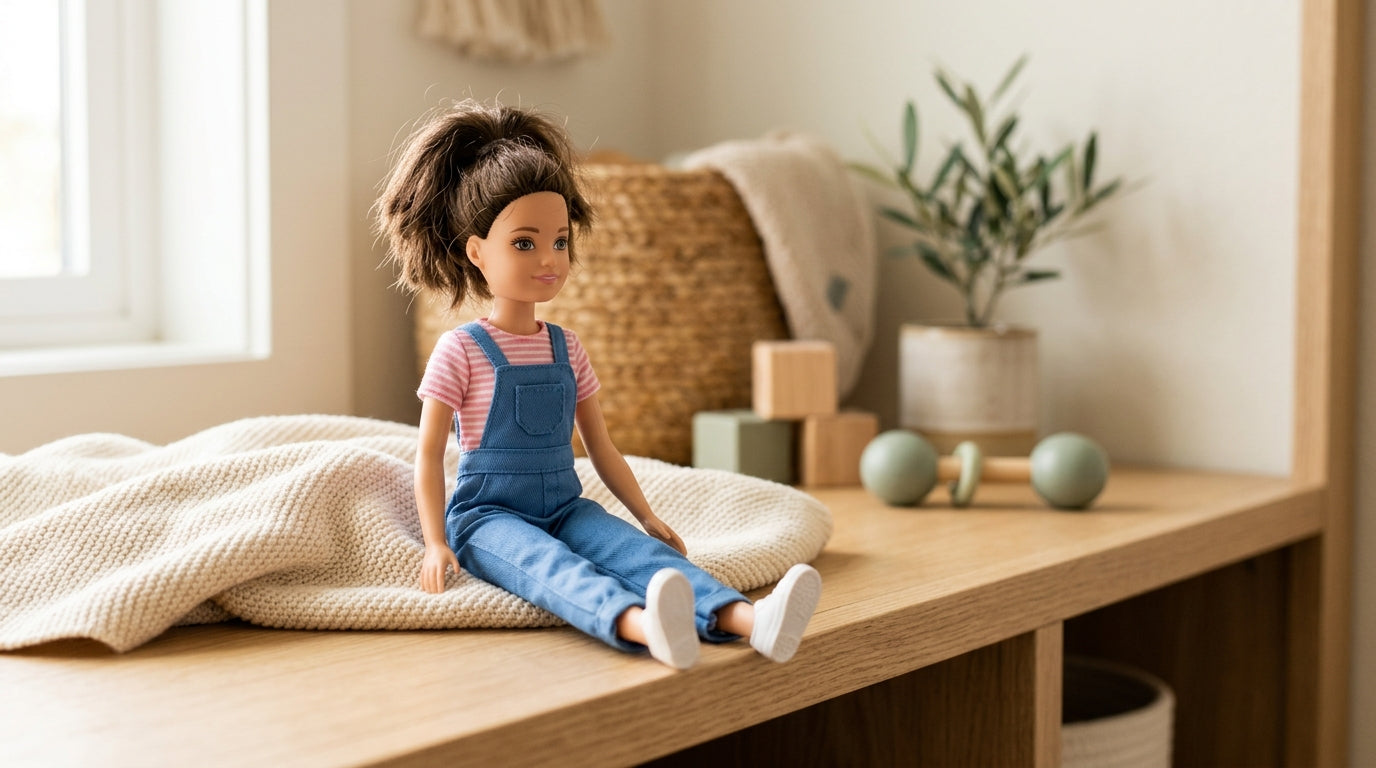
I'm currently on my hands and knees in our London flat, using a high-powered camping headlamp to scan the living room rug for a piece of pink plastic no larger than a grain of rice. The grand parenting lie is that miniature pretend play sets are charming, quiet-time tools that teach young children empathy and responsibility, but having lived through the invasion, I can assure you they're actually a covert stress-test designed to age you prematurely. If you've a civilized five-year-old who sits quietly at a desk, perhaps you enjoy these toys, but if you've two-year-old twins actively roaming the ecosystem, these playsets are essentially a biohazard zone of micro-plastics.
I'm talking, of course, about the whole Barbie Skipper Babysitters Inc line and the tiny baby dolls that come with it. My sister—who clearly harbors some deep-seated resentment toward me from our childhood—gifted a set to the girls for their second birthday, completely bypassing the glaring "Not for under 3 years" warning on the box. Since then, my life has been a frantic game of confiscation.
The microscopic terrors hiding in my rug
Let’s talk about the accessories for a moment, because the sheer scale of these items defies human logic. The sets come with these minuscule baby bottles that are so small they slip through the gaps in our floorboards. If you drop one, it ceases to exist in this dimension until one of the twins magically finds it three weeks later and immediately places it on her tongue like a tiny, toxic communion wafer.
Then there's the toy smartphone. Why does Skipper need a smartphone the size of my thumbnail to babysit? It has a tiny sticker screen that immediately peels off when exposed to human saliva, leaving behind a jagged little rectangle of choking hazard. I spent twenty minutes yesterday trying to pry this microscopic device out of Twin A's clenched fist while she looked at me with the fierce, unblinking intensity of a feral cat guarding a mouse.
The physical impossibility of human hands manipulating these objects is maddening enough, but the real existential dread sets in when you realize how easily they camouflage themselves in a standard rug. I live in perpetual fear of the vacuum cleaner sound suddenly turning into a horrific rattling noise as it ingests a tiny plastic teddy bear.
The idea that the little bouncing plastic stroller mechanism in these sets somehow helps with a child's mechanical reasoning and spatial awareness is absolute rubbish.
Why the pediatrician terrified me about plastic
When the twins were born, our NHS health visitor, Dr. Evans, didn't hand me a neat, bulleted pamphlet on safety protocols or clinical risk factors. She just sighed, looked at my profoundly sleep-deprived face, and told me that if an object could fit inside a toilet roll tube, it was essentially a heat-seeking missile for a toddler's trachea. I'm reasonably convinced that a baby's respiratory system actually generates its own localized gravitational pull, specifically calibrated for brightly colored pieces of PVC.

This is the fundamental problem with introducing tiny doll sets into a house where the primary residents still explore the world exclusively via their mouths. The medical establishment refers to this as the "oral phase of development," which is a very polite way of saying your child is a mindless vacuum trying to consume the inedible.
I tried researching whether there was an age where this impulse safely vanishes, but the science is rather murky. Some developmental psychologists seem to suggest that by age three, children understand that plastic shoes aren't snacks, but given that Twin B recently tried to take a bite out of my leather wallet, I suspect the timeline is deeply flawed. Filtering all this expert advice through my own daily reality, I’ve decided to just assume everything smaller than a tennis ball is actively plotting my family's demise.
Finding things they can actually chew
The inevitable result of banning the miniature dolls is that you've to replace them with something the children are really allowed to interact with. If you're desperately trying to swap out micro-plastics for something that won't require a Heimlich maneuver, you might want to look at a few organic baby accessories that genuinely make sense for this age bracket. Explore the Kianao organic collection if you value your sanity and want toys that don't induce panic attacks.
In our house, the current obsession is the Gentle Baby Building Block Set. I bought these mostly because I was terrified of stepping on hard wooden corners in the dark on my way to the kitchen at 3am. They're made of soft rubber, they squeak slightly when compressed, and they're completely devoid of removable parts. I really genuinely like them. When Twin A chucks a yellow block at Twin B's head (which is a daily occurrence, despite what the gentle parenting blogs promise you about sibling harmony), it just bounces off. No tears, no emergency trips to A&E, no tiny plastic accessories lodged anywhere. They're my favorite thing in the playroom right now, entirely because they demand absolutely zero vigilance from me.
On the other hand, the Kianao Squirrel Teether is... fine. It's a silicone ring shaped like a mint-green woodland creature clutching an acorn. I bought it during a desperate late-night online shopping binge because my internet search history was a tragic, exhausted mix of "how to extract object from nostril" and "babys first choking hazard." It doesn't miraculously stop the crying—only time and a heavy dose of Calpol do that—but it's a solid, one-piece block of food-grade silicone. It keeps their jaws occupied, which means they aren't hunting the skirting boards for discarded Barbie shoes. It does the job, even if they occasionally use the squirrel's tail to aggressively scratch their own noses.
The empathy argument feels like a trap
You will inevitably hear people defend the tiny babysitter dolls by bringing up the developmental benefits of pretend play. They say neuroimaging shows that caretaking play activates the empathy and social-processing centers in the brain. I'm not entirely sure how an fMRI machine captures a toddler violently forcing a plastic bottle into a plastic baby's face while screaming, but presumably, the researchers know what they're looking for.

I do see glimpses of this supposed empathy, usually right before disaster strikes. Twin A will carefully swaddle the tiny plastic baby in a tissue, pat it gently on the head, and then immediately drop it off the back of the sofa to see if it bounces. Empathy, in a two-year-old, is a highly experimental concept. They aren't nurturing; they're running chaotic physics experiments.
And let's be entirely honest with ourselves about the material reality of these toys. The Barbie universe is constructed almost entirely of conventional, non-biodegradable plastics like PVC and ABS. These tiny pacifiers and highchairs are going to outlive us all. Long after humanity has relocated to Mars, archeologists will be digging through the sediment of London and uncovering perfectly preserved miniature neon pink sunglasses.
When the twins are melting down over who gets to hold the one safe toy we own, I usually just abandon the pretend play entirely and wrap the screaming child in our Mono Rainbow Bamboo Baby Blanket like an angry, aesthetically pleasing terracotta burrito until everyone calms down. It's much softer than a plastic doll, it wipes up actual drool instead of pretend drool, and I don't have to worry about anyone accidentally swallowing it.
The great sibling divide
If you find yourself trying to establish a tabletop-only quarantine zone for tiny plastic pacifiers while simultaneously lecturing your eldest about choking hazards and barricading the baby in the hallway, just know the vacuum will claim the pieces by Tuesday anyway.
The reality of mixing older children's toys with a crawling baby is just an exercise in futility. You can't police every square inch of the carpet. You will miss a piece. The baby will find it. It will happen exactly when you turn your back to pour a cup of lukewarm instant coffee. Parenting is basically just continuous risk management, and bringing hundreds of micro-accessories into the house is like inviting chaos in for tea.
I've instituted a rather draconian policy in our flat: if a toy has a piece smaller than a plum, it goes in the high cupboard until they're both at least five years old. My sister thinks I'm being overprotective and stifling their creativity. I think she doesn't have to sit in the waiting room at the local hospital while a nurse tries to retrieve a miniature hairbrush from a sinus cavity.
Until they can reliably distinguish between food and petroleum byproducts, we're sticking to toys that are too large to swallow and too soft to cause concussions. Everything else is just unnecessary stress.
If you're ready to clear the miniature plastic minefield out of your living room and invest in things that won't require a constant state of hyper-vigilance, take a look at the Kianao collection of sustainable baby products. Your blood pressure will thank you.
Answers to questions you might honestly have
Are the babysitter doll sets genuinely safe for a two-year-old?
Absolutely not. The box explicitly says ages 3 and up, and honestly, even that feels wildly optimistic. The accessories are laughably small—we're talking pieces the size of a fingernail clipping. Unless you want to spend your afternoons sweeping the floor with a magnifying glass, keep them far away from anyone under four.
Do dolls really teach empathy?
Apparently, but I've mostly watched my twins use dolls as blunt force weapons or test subjects for gravity. They might be developing empathy deep down in their neural pathways, but on the outside, it mostly just looks like chaos. You don't need tiny plastic accessories to teach them how to care for things; a soft blanket and a stuffed animal work just fine.
What do I do if an older sibling leaves tiny toys around the baby?
You will slowly lose your mind trying to enforce rules about this. Your best bet is to make the older child's room the designated "tiny toy zone" and put a child lock on the outside of the door so the baby can't wander in. If a tiny piece makes it into the living room, confiscate it immediately. No warnings.
Are there eco-friendly alternatives to plastic doll sets?
Yes, and they're usually much safer. Look for soft organic cotton dolls or wooden playsets. They tend to have chunky, integrated parts rather than dozens of microscopic accessories. Plus, they don't look like brightly colored landfill when they inevitably end up scattered across your floor.
How do you keep track of all those tiny accessories?
You don't. You lose them almost instantly. They disappear into the sofa cushions, get sucked up by the vacuum, or mysteriously vanish into the void. My advice? Throw the smallest pieces away before you even show the toy to the child. They won't miss what they never knew existed.




Share:
Banana pancakes for baby: Why my first twin batch was a disaster
Debugging The 90s Plush Stash: The Great Beanie Baby Tag Dilemma