

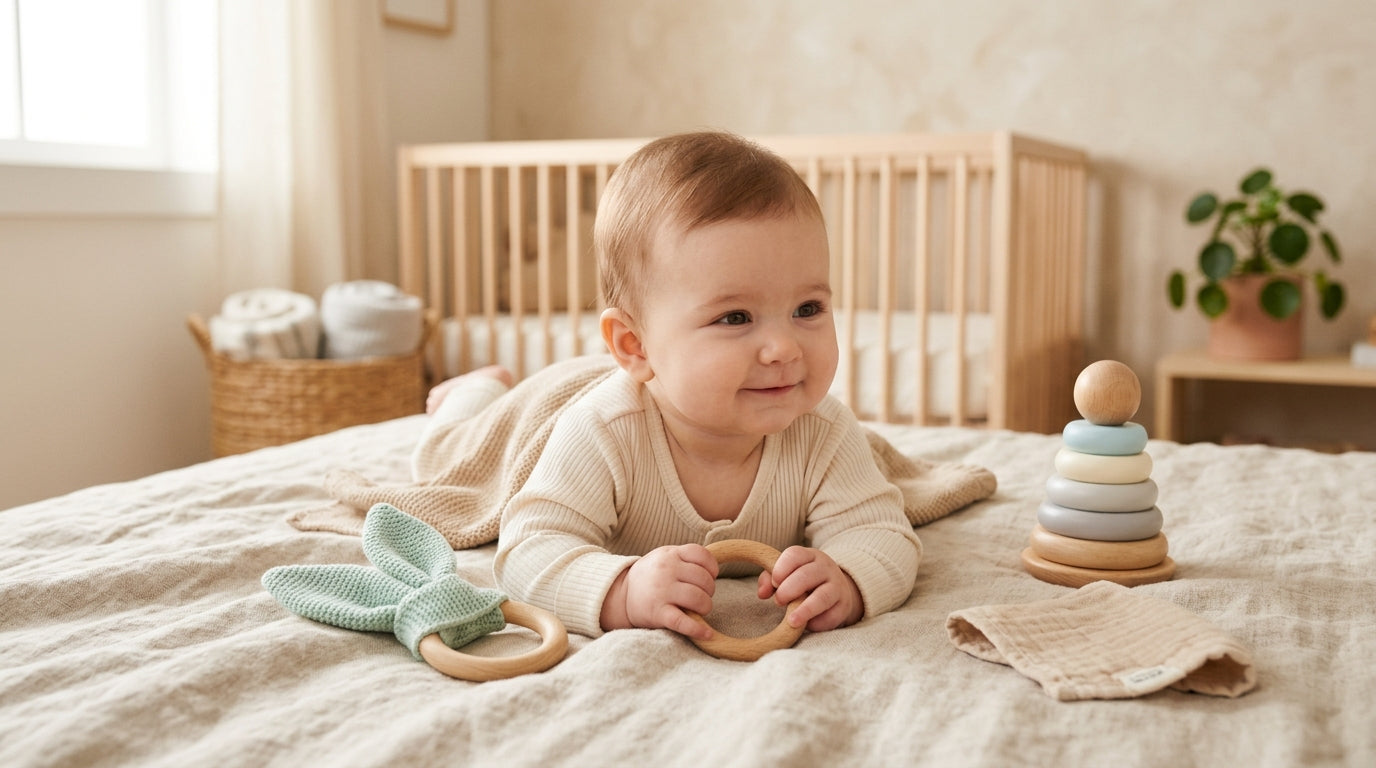
My mom visited us in Portland last week and confidently announced that infants are adorable so we don't accidentally leave them in the woods when they haven't slept in three days. The very next morning, my lead developer coworker told me over Slack that their facial proportions are just a biological UI designed to manipulate our parental APIs. Then, a random guy at a coffee shop on Hawthorne told me I just needed to absorb my son's "untainted aura." I was holding my 11-month-old, surviving on exactly two hours and fourteen minutes of fragmented sleep, trying to figure out which of these three people was actually right.
I was so tired that night I was typing one-handed in the dark, searching Google for "why do babi" before my thumb slipped, then trying again with "are babie manipulative" before finally just staring at my son's giant, sleeping head in the crib. Every time I look at him, my frustration completely evaporates. It's incredibly annoying how well it works.
So I asked my doctor about it at his last checkup, mostly because I needed a logical explanation for why I let a tiny human slap my glasses off my face and just smile back at him. Apparently, the extreme physical appeal of babies isn't magic or auras, but a highly aggressive firmware update to human evolution.

The default user interface of a tiny human
Dr. Chen, our doctor, was checking my son's 99.1-degree fever when she casually dropped a German word on me: Kindchenschema. Some ethologist named Konrad Lorenz mapped out this whole concept back in the 1940s. He basically identified the exact hardware specs that force human adults into caregiving mode.
My son's head is currently tracking in the 94th percentile. If you scaled his proportions up to my six-foot-two body, I'd look like a terrifying alien gray. I'd have a massive cranium, eyes taking up half my face, entirely no neck, and limbs that look like overstuffed sausages. But on an 11-month-old, these exact physical specs act like a cheat code.
The system requirements for activating human empathy are startlingly specific. You need the huge eyes set weirdly low on the face, the chubby cheeks that swallow their tiny button noses, and skin that bounces back when you poke it. My wife Maya is constantly pointing out how his fat little wrists don't even have joints, just deep rubber band creases. When you bundle all these bizarre physical anomalies together, it bypasses our logic centers entirely.
Overriding my parental motherboard
I track a lot of data. I know we went through exactly 47 diapers this week and I know his room sits at exactly 69.5 degrees. But tracking my own neurological response to him is wild. Some researchers in Oxford apparently figured out that when you see an infant's face, your brain reacts in one-seventh of a second. That's 140 milliseconds to completely hijack your orbitofrontal cortex.

I didn't really believe this until I started paying attention to my own physiological responses. I'll be stressed about a server migration at work, my heart rate hovering around 105 bpm. He'll crawl over, grab my pant leg, look up with those massive eyes, and I can literally feel my chest decompress. My smartwatch shows my heart rate dropping to 75 bpm almost instantly. It's a massive, unearned dopamine dump.
It's essentially a chemical hostage situation. You look at them, your brain floods with oxytocin, and suddenly you're highly motivated to keep this loud, demanding creature alive. It's why I keep buying him things he absolutely doesn't need but looks ridiculous using. The only thing that has actually been a massive win for us lately is the Silicone Sloth Teether Toy. We've bought maybe seven different teethers, and most of them just get aggressively launched across the living room. But this weird little sloth has these textured tree branches that perfectly reach his back gums. He sits there furiously gnawing on it while maintaining intense eye contact with me, and it's the funniest, most endearing thing in the world. I honestly think the visual of him fighting a silicone sloth triggers as much oxytocin for me as it does gum relief for him.

The survival mode glitch
Here's where I get incredibly frustrated with human biology. If you look at a baby horse, it falls out of its mom and is walking an hour later. Human infants? They take a year just to figure out how to stand up without a concussion. They're completely, hopelessly useless at keeping themselves alive.
Babies are basically tiny drunk assassins targeting their own structural integrity. I spend 80% of my waking hours preventing my son from casually throwing himself down a flight of stairs or trying to eat a power cord. They have absolutely zero spatial awareness. He will crawl top-speed toward the dog's water bowl, slip on the hardwood, and look at me like I personally orchestrated his downfall.
And the corners. I've never seen a creature so magnetically drawn to 90-degree angles in my life. We've padded the coffee table, the TV stand, and the bottom shelf of the bookcase, but he will somehow find the one unpadded half-inch of drywall corner and aggressively aim his giant forehead right at it.
Even their own bodies are weapons used against themselves. He regularly scratches his own cornea with his wildly uncoordinated fingernails, starts sobbing, and then demands I fix the pain he just inflicted on himself. If a roommate did this, you'd move out. When your kid does it, you just sigh, file down their tiny claws, and kiss their forehead because the biological cuteness protocol overrides your common sense.
Sensory hacking protocols
Apparently they smell good because of leftover amniotic fluid, which is gross if you think about it for more than two seconds.

But the auditory hacking is real. When he does that specific, breathless belly laugh because I made a weird popping sound with my mouth, I feel a physical pull in my chest. Some linguist friends of Maya told us there's a Sanskrit word for this sudden intense feeling of communal sharing, but to me, it just feels like my brain is rewarding me for successfully debugging his mood.
The sounds and the textures work together to keep you engaged. I've noticed that tactile feedback is a huge part of the trap. We got this Crochet Deer Rattle Teething Toy from my sister, and the organic cotton is so soft that I find myself just running my thumb over it while he's holding the wooden ring. The combination of his soft skin and the soft materials basically forces you to keep touching them, which again, spikes your bonding hormones. It's an endless feedback loop.
Of course, not everything is perfectly designed. Mealtime is still a glitchy mess. We use the Waterproof Space Baby Bib, and while it's fine and does catch the heavy avocado chunks in the silicone pocket, he still manages to smear sweet potato puree completely up his neck and into his hairline. It's a solid bib, the space pattern is cool, but whoever designed the human neck to have that many overlapping fat folds didn't think about pureed carrots.

Troubleshooting the 3 AM system failures
When you understand the mechanics behind their aesthetic, it actually helps you debug the really hard moments. At 3 AM, when he's screaming because a tooth is shifting or the ambient room temperature dropped a quarter of a degree, I try to lean into the biology.
Instead of fighting the exhaustion or looking at my phone, I'll deliberately try to smell the top of his head or do chest-to-chest contact to force my brain to dump whatever bonding chemicals it has left in the reserves, tricking my nervous system into calming down so I don't lose my mind.
It's not perfect. Sometimes I'm just tired and want to sleep, and no amount of chubby cheeks is going to fix that. But realizing that I'm literally programmed to forgive him makes the whole parenting thing feel a little less personal. He isn't trying to break me. He's just running the only software he has, and I'm responding exactly the way I was built to.
If you're trying to figure out how to optimize this whole bonding process without surrounding your kid in ugly plastic junk, you might want to check out some gear that really fits the aesthetic.
The cuteness won't pay for his college, and it won't give me my sleep back. But it keeps me showing up every day, staring at his giant head, wondering how something so destructive can be this heavily loved.
If you're still trying to figure out the specs on your own tiny human, here are a few things I've learned from frantically searching the internet at midnight.
FAQ
Is there a specific age when they stop hacking our brains?
From what I've read and from Maya constantly reminding me, the extreme "baby schema" features peak around 6 to 11 months. That's right where we're now. Their faces start to elongate and they lose some of that intense roundness once they become toddlers. You still love them, obviously, but the automatic physiological dopamine trap supposedly tapers off a bit as they learn to honestly walk and communicate instead of relying purely on being adorable for survival.
Why do I feel weirdly aggressive when I see my kid being super cute?
Dr. Chen laughed at me when I asked her this, but it's a real thing called "cute aggression." Apparently, when your brain gets flooded with too much positive emotion from seeing something impossibly small and squishy, it throws in a little bit of aggression to balance the emotional scales. It's just a neurological overflow error. That's why you want to squeeze their fat little thighs or bite their toes. You aren't crazy, your brain is just aggressively trying to keep stable itself.
Does skin-to-skin contact seriously do anything after the newborn phase?
I used to think it was just hospital protocol, but even at 11 months, holding him bare-chested when he's having a meltdown completely resets both of us. The tactile feedback of their soft skin against yours triggers a massive oxytocin release. It physically lowers your heart rate and cortisol levels. I treat it like a hard reboot when all other soothing methods are failing.
Why do they purposely throw things just to smile at me?
My son throws his spoon 13 times a meal and gives me this huge, gummy grin. They aren't trying to mock us. They're just testing cause and effect, and they use their cuteness as a buffer to keep us engaged in the "game." They know those big eyes will usually prevent us from walking away. It's an incredibly manipulative and highly works well feedback loop.
Are some babies scientifically considered more cute than others?
Objectively, maybe? But biologically, your brain is hardwired to find your own kid the absolute peak of human existence. The oxytocin bond you've with your specific baby acts like a filter. I've looked at photos of other babies and thought "yeah, fine," but looking at my son makes my chest hurt. Your internal hardware is literally biased to prioritize the survival of your own legacy code over everything else.




Share:
Why an innocent sip of water is your baby's worst enemy
Who Is Baby Gronk? (And Why My Toddler Is Retiring From Sports)