

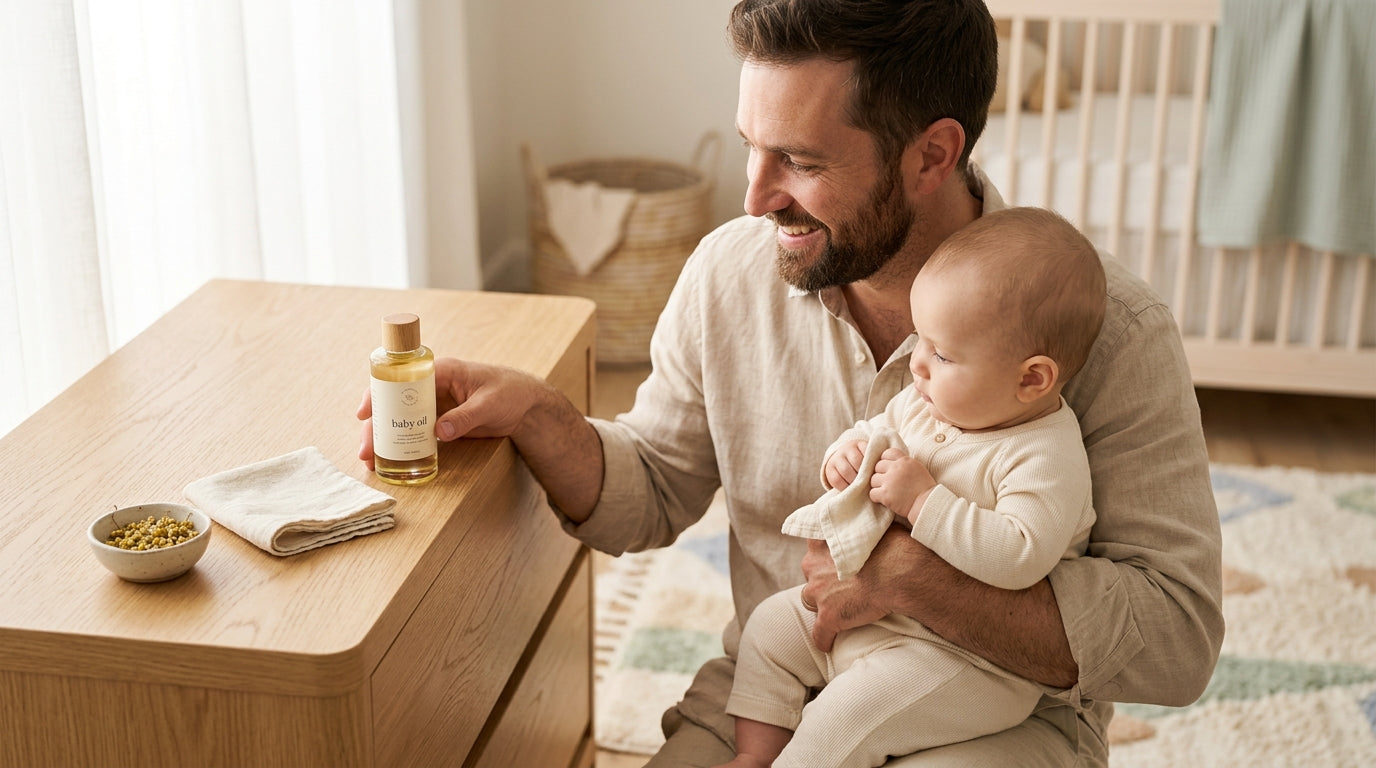
I was sitting on the floor of our living room, sweating through my t-shirt, trying to peel a heavy-duty waterproof band-aid off my eleven-month-old's thigh without triggering a level-five meltdown. He had scraped his leg on a rogue piece of patio furniture, and in my infinite wisdom, I had applied the most industrial adhesive strip I could find at the local pharmacy. Two days later, that band-aid was basically fused to his DNA. Every millimeter I pulled resulted in a sharp intake of breath from him and a spike in my own resting heart rate. My wife, Sarah, walked in, assessed the hostage situation, and calmly handed me a bottle of baby oil.
I just stared at it. I had spent the last eleven months assuming this stuff was exclusively for those overly aesthetic infant massage routines you see on Instagram, the ones where the baby is inexplicably smiling instead of trying to eat the carpet. I squeezed a few drops onto the edge of the adhesive, rubbed it in, and the band-aid literally just slid off his leg. He didn't even blink. I sat there holding the slick piece of plastic, genuinely bewildered by parenthood yet again, wondering what the actual purpose of this liquid was and why nobody had issued me a manual for it at the hospital.
The great olive oil bug of month three
To understand my confusion about what baby oil is even doing in our house, we've to rewind to when our son was about three months old and his scalp decided to start peeling like a bad sunburn. Cradle cap, apparently. His head looked like a poorly baked croissant. Living in Portland, our immediate community is highly opinionated about skincare, and my neighbor insisted that I just needed to rub raw, organic olive oil onto his head because it was "natural."
I approach parenting the same way I approach debugging poorly written code: I try a patch, track the data, and see if the system crashes. I applied the olive oil. I even made a little spreadsheet tracking his scalp flakiness and how many times an hour he seemed to be scratching at his ears. Over the next week, the flaking didn't get better. In fact, it escalated into this angry, red, irritated map across his forehead. The patch had critically failed.
When I finally took him to the pediatrician, admitting my olive oil experiment with massive dad-guilt, she actually laughed. My pediatrician explained that a baby's skin barrier is essentially version 1.0 software—it’s super thin, highly permeable, and missing half of its protective features. From what I understand of her explanation, there's a very common yeast on human skin called Malassezia. Apparently, this specific yeast absolutely loves to eat the oleic acid found in olive oil and sunflower oil. By slathering his head in pantry staples, I wasn't moisturizing him; I was throwing a catering buffet for the exact yeast that causes cradle cap and infant eczema.
She told me about this clinical study from the University of Manchester where researchers actually tested these "natural" oils on newborns and found that they actively impede the development of the infant skin barrier. This blew my mind. I spent three days complaining to anyone who would listen about how "natural" is a terrible metric for safety, ranting about how poison ivy is also natural but you don't see me rubbing it on my kid's face. If you want to actually protect their skin without feeding the local yeast population, you need an inert barrier. Something that just sits there and blocks out the world. You know, like actual baby oil formulated with safe, dermatologist-vetted stuff like coconut oil or high-grade pure squalane.
Moisture is a logic puzzle
Once I understood the yeast situation, I had to figure out how to seriously apply the right oil without turning my son into a greased piglet. My first instinct was to just squirt it onto his dry arms when they looked a little ashy. It just sat there, making him shiny and transferring grease onto every piece of furniture he touched. Sarah caught me wiping his slick little arm with a paper towel and had to correct my fundamental misunderstanding of fluid dynamics.

Baby oil is not moisture. It’s an occlusive. I had to google this, but apparently, an occlusive is just a physical wall. It doesn’t hydrate the skin; it traps the hydration that's already there. If you put it on dry skin, you're essentially just locking the dryness in beneath a layer of oil. It’s like putting a waterproof phone case on a phone that's already on fire.
So, our entire bath time routine had to be rewritten. Now, I pull him out of the tub—water temperature tracked precisely at 98.6 degrees because I'm a neurotic mess—and while he's still actively damp and yelling about being cold, I do a quick swipe of oil over his arms and legs to trap that bathwater against his skin. Then comes the most critical step of the operation: immediate containment.
If you let a damp, oiled-up eleven-month-old loose in your house, you'll never catch them. They defy physics. The moment the oil is on, I immediately wrap him up tightly in our Polar Bear Organic Cotton Blanket. I'm going to be totally honest, we own maybe nine different blankets that we got from the baby shower, but this is the only one I honestly use. Mostly because it’s double-layered organic cotton that somehow absorbs the excess oil without feeling greasy, but also because the polar bear print is objectively cool without being aggressively bright. It breathes really well, so he doesn't overheat while the oil does its sealing work, and it has miraculously survived being thrown in the wash on high heat after a catastrophic diaper blowout last month. It’s the closest thing I've to a foolproof piece of parenting gear.
Explore our organic baby essentials to find your own foolproof nursery gear.
The WD-40 of my living room
Once I realized what baby oil was genuinely designed to do, I started noticing that it operates a lot like a utility script you write for one specific task that ends up solving five other problems by accident. Because it's just a pure, inert lubricant, it's insanely versatile.

Take the teething distraction phase. Applying oil to an angry, tired baby requires distraction. I usually hand him the Squirrel Teether Silicone Baby Gum Soother while I'm trying to get his pajamas on. It’s fine. It’s a piece of food-grade silicone shaped like a squirrel holding an acorn. He likes it well enough, though if I’m being completely transparent, he’d probably prefer to chew on my laptop power cord or a handful of dirt. But it's squishy, it distracts his hands so he stops trying to grab the oil bottle, and I can just toss it in the dishwasher when he inevitably chucks it across the room into the dog's bed.
But the real revelation came when he started his sticker phase. My mother-in-law gave him a sheet of cheap paper stickers, and he immediately managed to plaster a neon green dinosaur directly onto the side of his Wooden Animals Play Gym Set. I love this play gym. It's just clean, minimalist, sustainably carved wood with an elephant and a bird. It doesn't play terrible electronic music, it doesn't light up, and it doesn't overstimulate him. It’s a beautiful piece of natural wood that suddenly had a half-shredded, impossibly sticky dinosaur fused to its leg.
I spent twenty minutes trying to scratch it off with my thumbnail, which just resulted in tearing the top layer of paper off and leaving that horrible, crusty white adhesive residue behind. I was ready to take sandpaper to it. Sarah just sighed, walked over with the baby oil, put three drops onto a cotton pad, and wiped the residue completely away in about four seconds. The oil just dismantled the chemical bonds of the adhesive without damaging the natural wood finish of the gym. I just stood there, staring at the little bottle. It removes hospital band-aids. It traps water on my kid's skin. It dissolves industrial toddler stickers. Sarah apparently uses it to get waterproof mascara off her eyelashes when her regular stuff runs out. I used a drop of it on a squeaky hinge on the nursery door last week and the door has been completely silent ever since.
I started this journey thinking baby oil was just a scented luxury item designed to make infants smell powdery. Now I view it as the WD-40 of my parenting toolkit. It’s a troubleshooting tool that fixes friction, whether that friction is a dry skin barrier failing to compile, an adhesive refusing to yield, or a squeaky door threatening to wake a sleeping child. It’s messy, it requires a specific deployment protocol, and if you drop the bottle on tile you'll recreate an ice-skating rink in your bathroom, but I honestly wouldn’t try to run this household without it.
If you’re gearing up for the slippery chaos of bath time, make sure you've the right gear to catch them when they get out. Grab a breathable, organic layer like our Polar Bear Blanket before your next bath routine.
The messy realities of baby oil (FAQ)
Can I just use whatever oil is in my kitchen pantry?
Please learn from my mistakes and don't do this. Unless you actively want to feed the yeast on your baby's scalp and trigger an eczema flare-up, keep the olive oil and sunflower oil for your salad dressing. My pediatrician was very clear that kitchen oils have an entirely different chemical structure that can honestly break down your baby's delicate skin barrier.
Does it honestly cure cradle cap?
It doesn't "cure" anything, it just is a really good softening agent. From my experience, you've to smear a few drops of a safe, non-comedogenic baby oil onto the flaky spots, let it sit there for like ten or fifteen minutes to soften the crusty bits, and then gently brush it out during bath time with a super soft baby brush. Then you've to wash it all out with baby shampoo so you don't leave their pores clogged.
Why do I keep hearing about mineral oil being bad?
This sent me down a massive late-night internet rabbit hole. Traditional, old-school baby oil is basically just highly refined petroleum (mineral oil). While dermatologists usually say cosmetic-grade mineral oil is totally safe because the molecules are too big to absorb into the skin, a lot of parents (including me) just prefer not rubbing crude oil derivatives on their kids. Plant-based oils like coconut or jojoba offer that same occlusive moisture lock without the petroleum footprint.
Can I use it on baby acne?
No, absolutely not. My wife had to physically stop me from doing this. Baby acne is often caused by maternal hormones clearing out of their system and overactive oil glands. If you put more oil on top of their already oily, blocked little pores, you're just going to cause a massive breakout. Just wash their face with warm water and leave it alone until it clears up.
Is it honestly safe to use for removing band-aids?
It's honestly the only way I'll do it now. The oil breaks down the sticky part of the adhesive without pulling on their incredibly thin skin. You just rub it around the edges, wait a minute for it to seep under the plastic, and slide the band-aid off. Just be aware that you've to wash the area with soap afterward, because obviously, a new band-aid won't stick to an oiled-up knee.




Share:
What Is Love Baby Dont Hurt Me: Toddlers & 90s Dance Anthems
What The Nepo Baby Trend Actually Means For Your Everyday Toddler