

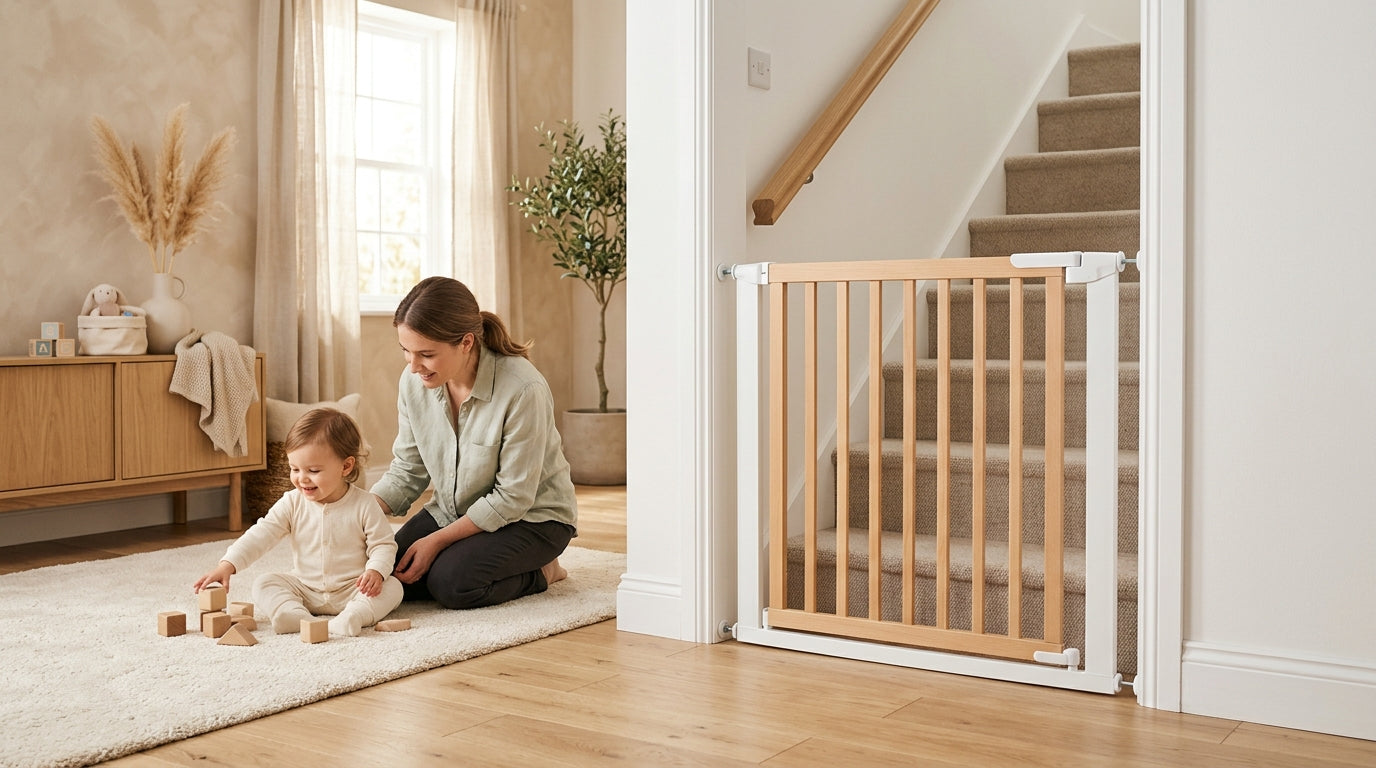
There I was, standing in aisle 14 of an Orlando Walmart at two in the morning while visiting my wife’s American family, holding what I believed to be a simple piece of plastic and mesh. I was completely unaware that this tension-mounted contraption was about to test the very foundations of my marriage. The twins had suddenly learned to crawl with terrifying, military-grade coordination, and our holiday rental was basically a multi-level death trap. I had stumbled into the brightly lit Walmart baby department in a jet-lagged haze, convinced that forty dollars and five minutes of manual labor would buy me peace of mind.
I was, of course, horribly wrong about absolutely everything.
You see, buying a baby gate feels like it should be an uncomplicated transaction, right up until you actually try to fit the wretched thing into a real, physical doorway that was built by a human being who apparently despised straight lines. My initial strategy was just grabbing the first box that promised a "tool-free installation," entirely failing to account for the fact that children are essentially tiny, destructive scientists who will immediately begin testing the structural integrity of your newly erected borders.
The skirting board conspiracy
I need to talk about skirting boards, or baseboards as my American in-laws call them, because they're the silent destroyers of parental sanity. You look at the box, and it cheerfully claims the gate fits any gap between thirty and thirty-eight inches. What the box conveniently fails to mention is that this measurement assumes your walls are perfectly flat, sheer drops from ceiling to floor.
When I finally got back to the house and attempted to wedge the gate at the bottom of the stairs, I discovered the tragic architectural reality of decorative wood trim. I tightened the top tension rods, which gripped the drywall beautifully, but the bottom rods collided violently with the thick, ornate skirting boards. The entire gate ended up leaning backward at a chaotic ten-degree angle, looking less like a safety device and more like modern art.
I spent the better part of an hour trying to jam folded bits of cardboard behind the top bumpers to even it out, sweating profusely while Baby G—the slightly larger and much more aggressive of my two daughters—sat on the rug, silently judging my handiwork while gnawing on her own foot. The manufacturer clearly designed this product in a sterile, featureless laboratory devoid of actual home architecture, leaving sleep-deprived fathers to furiously wedge old copies of magazines between the wall and the rubber stopper just to achieve a semblance of stability.
If you ever find an old wooden accordion-style gate at a car boot sale, just keep walking unless you actively enjoy the sound of pinched fingers and the aesthetic of a 1970s garden trellis.
Dr Evans ruins my weekend plans
I used to think you could just stick a pressure-mounted barrier anywhere you fancied, until our GP, Dr. Evans, casually mentioned during a routine vaccination appointment that putting one at the top of a staircase is essentially setting up a very slow, highly predictable trap. I vaguely remember her explaining something about the sheer kinetic force of a determined toddler leaning against a friction-based latch, though I was mostly distracted by trying to wipe Calpol off my jumper at the time.

She somehow managed to seamlessly weave the horror story of babies pushing these gates right down the stairs into a conversation about ear infections, which meant I had to spend my entire Sunday drilling permanent holes into our landing walls back in London. You might think the logical approach is to simply measure the gap, buy the hardware-mounted gate, and screw it in, but you’d be vastly underestimating the sheer logistical nightmare of finding a wall stud while a twin screams at your ankles and the drill bit snaps off at an awkward angle.
I think the gap between the vertical slats is supposed to be less than three inches, presumably so a toddler can’t wedge their skull through it like a stuck badger, though honestly by the time they're eight months old you're mostly just trying to keep them out of the dog's water bowl rather than worrying about the finer points of slat mathematics.
The throwing phase and other prison riots
Once you actually manage to secure a gate, a strange psychological shift happens in your house. You no longer live in an open-plan home; you live in a series of highly monitored security zones. And your children, realizing they're contained, will immediately invent new ways to express their displeasure across the barrier.
For us, this manifested as the Great Throwing Era. The twins would stand at the gate, gripping the bars like tiny inmates, and launch whatever they could find over the top. I’d love to say the Zebra Rattle Tooth Ring solved our teething miseries during these tense standoffs, but honestly, it’s just alright. The wooden ring is smooth and the black-and-white crochet is quite lovely, but because it doesn’t tether to anything, Baby G immediately figured out it was the perfect size to slip right between the slats of the baby gate and drop it down the stairs, where it remained out of reach for three days while I refused to step over the barricade to retrieve it.
What actually saved my sanity during this period of confinement was the Bamboo Baby Spoon and Fork Set. I bought these out of sheer desperation because the girls had taken to using our regular metal spoons to violently bash against the metal gate in a coordinated, rhythmic protest that felt borderline threatening. The bamboo is blissfully quiet when smashed against a safety latch, the silicone tips are soft enough that nobody gets injured during a scuffle, and they somehow manage to hold them without immediately turning them into projectiles.
Looking for ways to survive the chaotic feeding milestones without losing your mind? Explore our feeding collection for things that won't make a terrible clanging noise when bashed against furniture.
A quick word on pets and one-handed lies
While desperately scrolling through online reviews at an ungodly hour, I noticed a lot of models feature a small, built-in "pet door" so your cat can pass through while the baby remains contained. I bought one of these for our kitchen in London, completely failing to calculate the sheer elasticity of a nine-month-old child.

It turns out that if a mildly overweight tabby cat can squeeze through a plastic square, a highly motivated twin can absolutely wiggle her way through it, rendering the entire seventy-pound structure completely useless. I walked into the kitchen one morning to find one twin securely behind the gate, crying, and the other happily sitting in the dog bed on the forbidden side, looking incredibly pleased with herself. I ended up having to zip-tie the pet door permanently shut, which deeply offended the cat.
And don't even get me started on the bold marketing lie that's "one-handed operation." The box always shows a serene mother effortlessly gliding through the barrier with a sleeping infant cradled in her arm. In reality, opening one of these things requires you to simultaneously press a button, slide a latch, and lift the entire heavy metal door upwards to clear the bottom catch, an ergonomic nightmare that's physically impossible to execute while balancing a squirming toddler and a bag of dirty nappies.
You just end up awkwardly using your knee to prop up the bottom while trying to maneuver the latch with your elbow, until you inevitably misjudge the step-over height and brutally strike your shin against the bottom bar, silently mouthing swear words into the darkness.
Meals behind the barricade
Because the kitchen is now permanently gated off from the living room to prevent them from opening the oven, I end up passing meals over the barrier like a prison guard sliding trays through a slot. This has drastically altered our dining aesthetic.
If you're going to feed a child in a carpeted, gated "safe zone," you absolutely can't hand them a loose bowl. We use the Silicone Bear Suction Bowl only for this purpose, because it physically adheres to their little weaning table. I just press it down firmly, and it prevents them from upending a serving of pureed carrots onto the rug the second I turn around to lock the gate behind me. It doesn't solve the problem of them aggressively smearing the food into their own hair, but at least the bowl itself remains anchored to the furniture.
Eventually, the gates will come down. I'm told this happens around their second birthday, or whenever they figure out how to climb over it by stepping on a strategically placed stuffed animal, whichever comes first. Until then, I'll continue to trip over the bottom bar in the middle of the night, silently cursing the day I ever stepped foot into that Florida superstore.
Before you commit to a house full of barricades and complicated latches, make sure you seriously have the gear to keep them entertained while contained. Check out our sustainable baby essentials to stock up your newly secured living room.
The messy truth about securing your home (FAQ)
Can I just use a pressure-mounted gate at the top of the stairs if I tighten it really hard?
I wouldn't risk it, honestly. I thought the exact same thing, assuming my upper body strength could secure it permanently, but our GP terrified me out of it. Apparently, kids just lean all their weight on them repeatedly until the friction gives out, and they ride the whole contraption down the stairs like a horrific metal surfboard. Just get the drill out and put a few holes in the wall; you can patch the drywall when they leave for university.
How do I deal with wide skirting boards throwing off the installation?
You basically have three terrible choices: buy special Y-spindle adapters that cost entirely too much money, mount a block of wood to the wall above the baseboard to make the surface flush (which looks hideous), or just accept that your gate will sit at a slight, infuriating angle for the next two years. I mostly went with the angle, though I did buy wall-saver cups eventually which gave it a bit more grip on the uneven surface.
When do I seriously need to install these things?
I arrogantly assumed we had loads of time, right up until I found Baby G halfway up the bottom staircase trying to eat a piece of lint. You really want to put them up right before they start crawling, which is usually around six to eight months. If you wait until they're fully mobile, you'll be installing them in a sweaty panic while a tiny human repeatedly tries to climb up your leg.
Are the gates with the little pet doors genuinely safe?
In my bitter experience, absolutely not. Unless your baby has an unusually large head and your pets are incredibly tiny, those little flaps are basically an open invitation for a prison break. I watched my daughter slide through one like a heavily diapered octopus. If you've a cat, just install a normal gate and teach the cat to jump over it.
How long are we going to be trapped behind these things?
Most guidance suggests tearing them down when the kid turns two, or whenever they figure out how to defeat the latch mechanism. Given that my twins are currently working together—one distracting me while the other rattles the handle—I give it about three more weeks before they unionize and I just take the doors off the hinges entirely.




Share:
The Real Deal on Finding Walking Shoes for Babies
Why parents who try to watch baby driver get weird search results