

In the suffocatingly warm waiting room of our local NHS clinic, whilst desperately trying to balance a screaming twin on each knee, I received three entirely contradictory pieces of advice about infant growth within a single ten-minute span. Our health visitor confidently informed me that doubling birth weight by six months was the absolute, unshakeable golden rule, my mother-in-law texted to suggest they looked "a bit peaky" and probably needed more full-fat milk, and an elderly bloke who had wandered in looking for the chiropodist assured me that massive babies just mean stronger bones for the rugby pitch. None of this theoretical wisdom helped my immediate, pressing problem, which was that I was covered in an impressive amount of drool and my arms were genuinely close to detaching from their sockets.
I distinctly remember looking down at my girls—who at that moment felt roughly the mass of small, angry tractors—and wondering how on earth their growth trajectory compared to the rest of the animal kingdom. When you're running on exactly three hours of fractured sleep and half a lukewarm flat white, your brain latches onto very strange things. So, standing there swaying like a drunkard to keep them quiet, I looked it up on my phone. And let me tell you, when you finally Google the exact baby elephant weight, the number hits you right between the eyes like a cold, wet flannel: two hundred and sixty pounds at birth.
Two hundred and sixty pounds. That's the size of a fully grown male human who has had a few too many pints and Sunday roasts, sliding straight out of the womb and onto the African savanna.
The brutal mathematics of moving them from place to place
There's a specific, intense agony reserved for the modern parent, and it involves carrying a baby in one of those bucket-style car seats. The plastic handle is scientifically engineered to dig directly into the most sensitive nerve bundle in your forearm, while the seat itself swings wildly, smashing into your shins, doorframes, and occasionally, innocent bystanders.
Now, multiply that by two. I spend a significant portion of my week looking like a heavily burdened pack mule, lugging twin A and twin B from the flat, down the stairs, and into the boot of the car. The sheer density of a rapidly growing human infant is baffling. You feed them a few ounces of milk, and somehow they convert it into dark matter. By month six, hoisting them both at once required the kind of core engagement usually reserved for Olympic powerlifters, leaving me with weird, permanent bruises on my thighs and a lower back that sounds like a pepper grinder when I stand up.
Marsupials obviously figured out this carrying problem millennia ago with the built-in pouch system, but since I lack the pelvic floor strength for that kind of carrying capacity, we must simply suffer.
It was during one of these sweaty, shin-bruising transport missions that I started obsessively listing off pachyderm facts in my head just to distract myself from the pain. According to a wildlife documentary I half-watched at 4am while sterilising bottles, the life of a newborn baby elephant is a masterclass in extreme biology:
- Gestation lasts roughly 22 months, a horrifying statistic I casually mentioned to my wife, who responded with a look so chilling it could freeze a pint of Guinness.
- They're born standing up, which seems deeply unfair given that I spent the first three months of my girls' lives just aggressively supporting their wobbly, melon-heavy heads so they wouldn't accidentally snap their own necks.
- They gain about two to three pounds every single day in their first year, meaning my complaints about my twins outgrowing their sleepsuits every fortnight are mathematically pathetic by comparison.
- They drop from a decent height upon birth, but frankly, giraffes drop their babies six feet directly onto the hard dirt, which sounds like a massive safeguarding issue so we won't even go there.
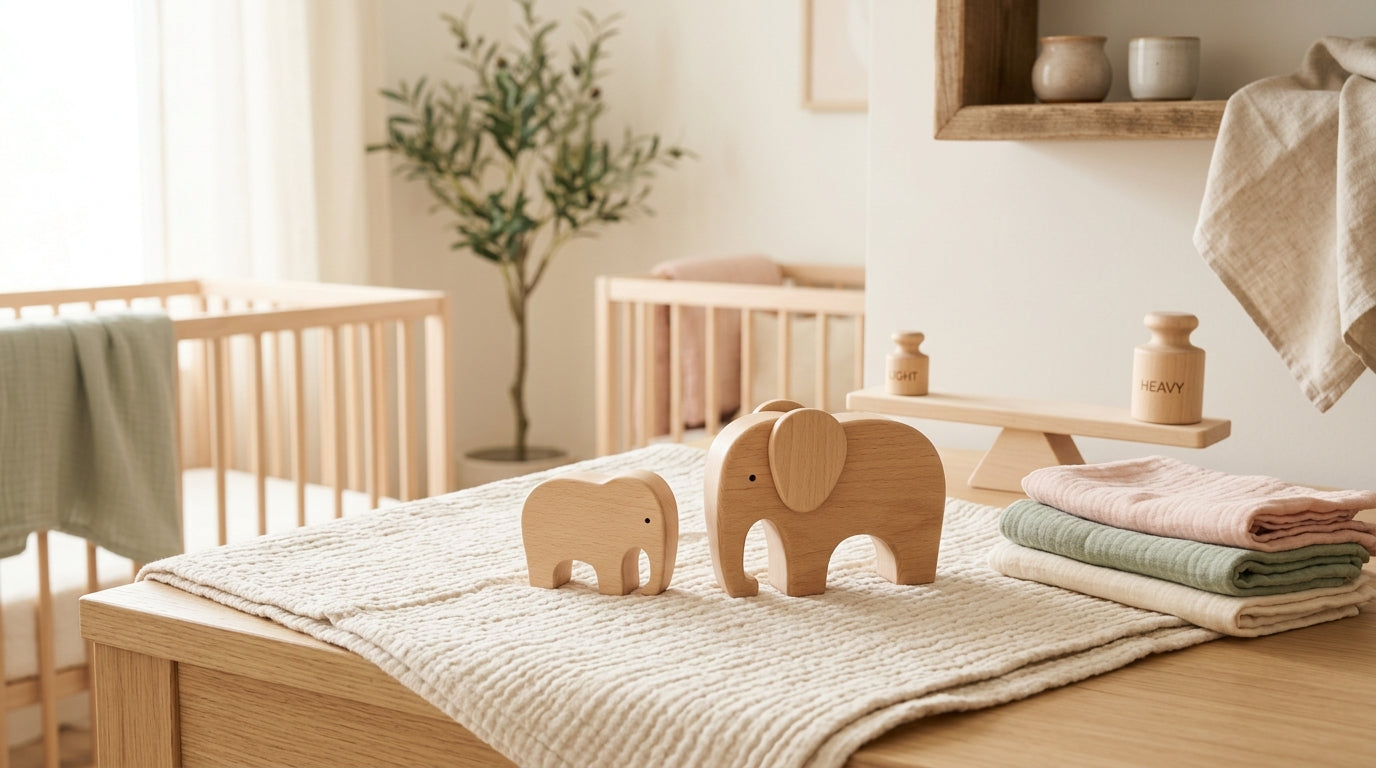
This obsession with giant wildlife eventually bled into our nursery decor. In a desperate bid to surround myself with things that were aesthetically pleasing and didn't require AA batteries, we acquired the Wooden Baby Gym Animals Set. I bought it specifically because it has a beautifully carved wooden elephant, and I felt a deep, spiritual kinship with the tired matriarchs of the savanna. It's genuinely brilliant. One of my twins will lie there for twenty minutes—an eternity in toddler time—just staring at the smooth wooden bird and elephant, trying to calculate how to fit the entire thing into her mouth. The other twin mostly uses it to practice her MMA kicks on the sturdy wooden A-frame. Unlike the gaudy plastic monstrosities my well-meaning relatives bought us, this gym is quiet, smells faintly of natural wood rather than off-gassing petroleum, and actually looks quite nice sitting in the middle of our perpetually destroyed living room.
If you're also trying to survive the sheer physical toll of entertaining rapidly growing infants without ruining the aesthetic of your home, you might want to browse Kianao's play gym collection before your arms actually give out completely.
Milk consumption that defies the laws of physics
Our GP casually mentioned at one of our checkups that babies will generally eat when they're hungry and stop when they're full, a piece of advice that sounds wonderfully logical until you're actually sitting in the dark, covered in spit-up, wondering where it all goes. A human baby knocks back about 24 to 36 ounces of milk a day. Multiply that by two for twins, and you're essentially running a small, highly demanding dairy processing plant out of your kitchen.

But a baby elephant? A baby elephant guzzles up to three gallons of milk a day. That's roughly twelve litres of liquid. The logistics of this are absolutely staggering to me. My wife spent the first four months of our daughters' lives strapped to a double breast pump, staring bleakly at the wall while the machine made a rhythmic, wheezing sound like a dying accordion. If she had to produce three gallons a day, I'm fairly certain she would have just walked into the sea and never returned.
The trunk situation and the desperate need to chew
There's a fascinating parallel between our species with oral fixation. I'm reasonably sure I read somewhere that a newborn elephant's trunk contains tens of thousands of muscles, and it takes them the better part of a year to figure out how to use the bloody thing. For the first few months, they just clumsily trip over it. But much like human infants who discover their own thumbs, an elephant calf will suck on its trunk for comfort, a self-soothing mechanism that's both incredibly endearing and highly relatable.

My twins don't have trunks, but they do have an insatiable need to shove every single object they encounter directly into their mouths, particularly when teething strikes. Teething is nature's way of punishing parents for surviving the newborn phase. Just as you start getting four consecutive hours of sleep, tiny, razor-sharp calcium daggers begin slicing through your child's gums, turning them into rabid, inconsolable beasts.
We tried a few things to reduce the chaos. We have the Bear Teething Rattle, which is... fine, I suppose. It's a perfectly pleasant crocheted bear attached to a wooden ring. It rattles politely. It looks nice on a shelf. But when the girls are truly in the thick of teething misery, they mostly just lob the bear at the cat and go back to aggressively gnawing on the television remote or the edge of the coffee table.
But the Panda Teether Silicone Baby Chew Toy? That thing is a tactical survival tool. When the upper incisors started breaching the gums and our flat sounded like a Victorian workhouse full of wailing orphans, this flat, textured silicone panda was the only thing that stopped the noise. It’s entirely made of food-grade silicone, which means when one of the girls inevitably spikes it onto the pavement outside Sainsbury's, I can just take it home and boil it to within an inch of its life. If you manage to wrangle it into the fridge between milk runs and screaming fits, handing it over cold might seriously buy you three to four minutes of uninterrupted silence, which in parenting time is practically a weekend spa retreat.
Why the village matters more than the milestones
Every parenting book ever written—most of which suggest you remain calm while being screamed at, which I find deeply unhelpful at 3am—bangs on about milestones. Are they rolling? Are they sitting? Are they reciting Shakespeare by month eight? It’s an exhausting metric that just makes you feel like you're constantly failing.
Elephant calves, driven by the rather urgent evolutionary need to not be eaten by lions, stand and walk within an hour of being born. Meanwhile, it took my daughters ten months to figure out how to drag themselves across the carpet like wounded commandos, usually in pursuit of a stray piece of dog kibble. But the most important thing elephants do right isn't walking early; it's the matriarchy.
Elephants have a fiercely protective 'allomothering' system. If a baby elephant cries, trips over its own trunk, or just looks a bit sad, every aunt, grandmother, and sister in the vicinity drops what they're doing and rushes over to form a protective wall of maternal support. It's the ultimate village.
If my baby cries in public, the bloke sitting opposite me on the Tube aggressively turns up his noise-cancelling headphones and stares at an advert for oat milk to avoid making eye contact. We humans are supposed to be social creatures, but we've somehow managed to isolate ourselves in tiny flats with our screaming infants, entirely cut off from the herd.
Raising twins has taught me that you can't do this alone, and trying to be a stoic island of parenting perfection is a quick route to a breakdown. You need your herd, even if your herd consists of a health visitor who thinks your babies are too small, a mother-in-law who thinks they're too thin, and a random man at the clinic who thinks they belong on a rugby pitch. You just nod, take the help where you can get it, and try not to think about how much easier this would all be if you had a prehensile trunk to hold the milk bottles.
Ready to upgrade your nursery with gear that won't give you a headache or shatter into plastic shards? Shop the full range of sustainable, quiet, and deeply soothing baby essentials at Kianao today.
Frequently Asked Questions (From One Tired Parent to Another)
Do human babies and elephants really share any milestones?
Honestly, my GP would probably laugh me out of the surgery for asking, but yes, sort of. Both humans and elephants start experimenting with solid food around the four to six-month mark. While my twins were aggressively smearing pureed carrots into their eyebrows, a baby elephant is usually picking up twigs and leaves, trying to figure out how chewing works without accidentally biting its own trunk off.
Is it normal for my baby to feel like they weigh a ton?
Absolutely. They don't seriously weigh 260 pounds, but when you're carrying them at an awkward angle while holding a changing bag, a pram, and a cold cup of coffee, the physics of dead weight makes a 15-pound infant feel like a sack of wet cement. Your lower back is not imagining the strain, and no, your core will never be the same.
Why does my baby suck on everything in sight?
It’s all about self-soothing and oral exploration. Just like an elephant calf sucks its trunk to calm down when the savanna gets a bit too chaotic, your baby shoves their fist, your keys, and the dog's tail into their mouth because their mouth is essentially their primary sensory organ right now. It's perfectly normal, though highly unhygienic.
How do you survive carrying twins everywhere?
You stop caring about what you look like, mostly. You invest in a very sturdy double pram, you accept that you'll sweat profusely whenever you leave the house, and you learn to politely but firmly ask strangers to hold doors open for you. Also, ibuprofen. Lots of ibuprofen for the inevitable joint pain.
Should I be worried if my baby isn't hitting physical milestones early?
Unless your doctor tells you there's a problem, try to ignore the competitive parents at baby sensory class. We're not a prey species that needs to outrun predators an hour after birth. It takes our babies a long time to learn how to walk because human brains are massive and our heads are heavy. They'll get there eventually, and once they do, you'll spend the next ten years wishing they would just sit still for five minutes.




Share:
Let's talk about the baby einstein aquarium and infant sleep