

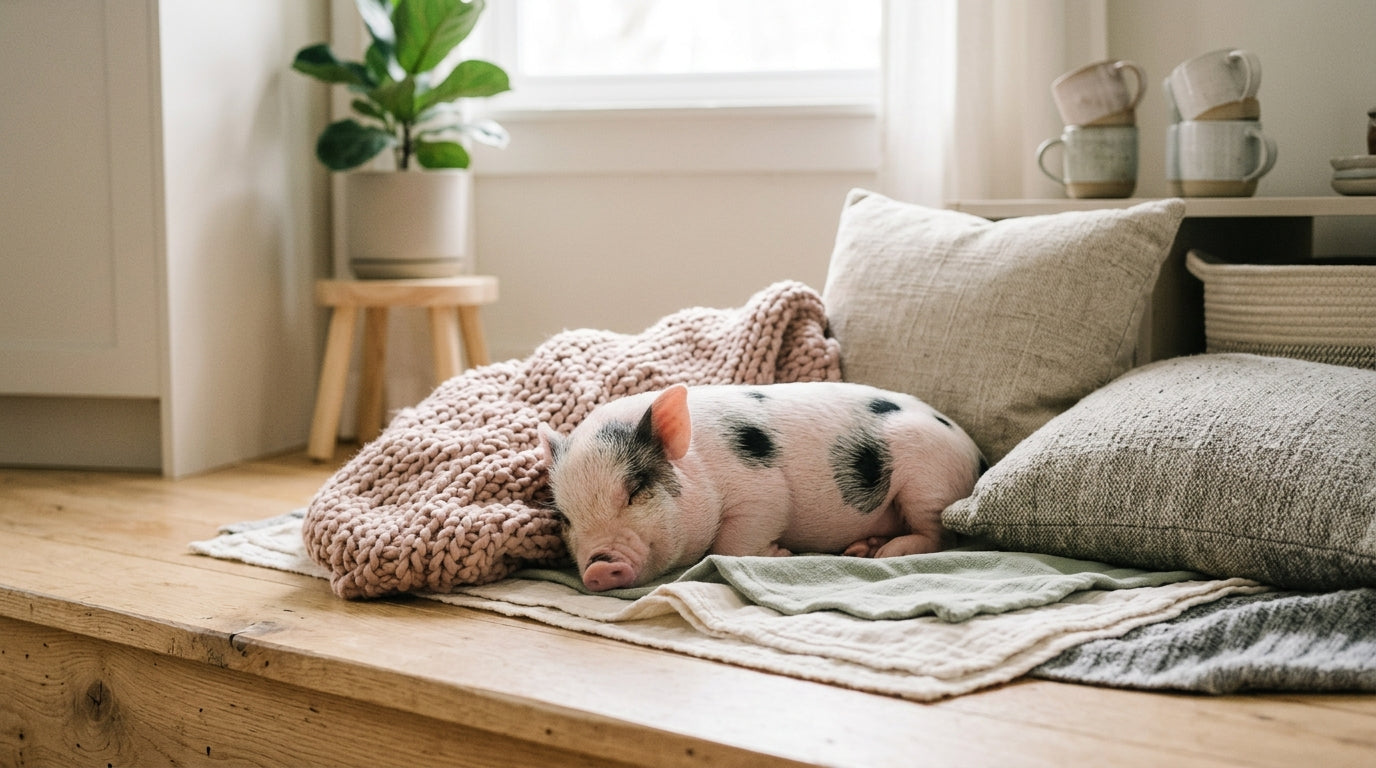
When we decided the twins needed to learn some sort of vague responsibility that didn't involve keeping me awake until 3am, the advice rolled in like a thick London fog. My mother suggested a golden retriever because they supposedly teach empathy. My former editor, a woman who survives entirely on black coffee and spite, suggested a cat because they require zero emotional input. And my brother-in-law—a man who once managed to kill a plastic fern—insisted we get a miniature swine.
He sat in my lounge, drinking my good beer, and explained that they're completely hypoallergenic, brilliant with toddlers, and stay the size of a tea kettle forever. It sounded suspiciously perfect, which is exactly how you know a piece of parenting advice is absolute rubbish.
I started looking into what it actually takes to raise one of these creatures in a domestic setting, and let me tell you, the reality is significantly more destructive than those curated Instagram accounts would have you believe. If you're currently browsing local breeders while your child screams for a snack, put the phone down and let me save you from yourself.
The great teacup deception
The first thing you need to understand is that the "teacup" or "micro" animal doesn't actually exist in nature, which is something I probably should have realized before I spent three hours researching how to litter-train farm livestock. Unethical breeders will sell you an underage animal—usually under six weeks old—and swear blind that its tiny stature is due to premium genetics rather than the fact that it's quite literally a premature infant.
Our local vet down the road, who usually just sighs when I bring in the girls' battered stuffed animals for "surgery," got surprisingly heated about this when I casually brought it up during a routine vaccination run. He muttered something about how these animals desperately need their mother's milk for the first 16 hours of life just to build any sort of functional immune system. From what I vaguely understand of agricultural science, separating them before they’ve had that specific colostrum basically guarantees a lifetime of massive veterinary bills and behavioral issues.
Also, taking them away from their mother too early means they miss out on learning proper herd manners. It turns out that a lonely, unweaned farm animal raised in a London flat doesn't grow up to be a grateful, Disney-esque sidekick. It grows up to be an aggressive, biting nightmare that terrorizes your skirting boards and holds your postman hostage. I already live with two toddlers who bite when they're overtired; I absolutely refuse to introduce a third.
Predators, prey, and my screaming daughters
Here's a fundamental flaw in mixing farm animals with small humans: dogs and cats are predators, meaning they generally understand the chaotic, forward-facing aggression of a toddler. Swine, however, are prey animals. Their entire biological makeup is wired to scan the horizon for things trying to eat them.
Think about how a two-year-old interacts with the world. They loom over things, shriek at a frequency that can shatter glass, and plunge their sticky hands downward to grab whatever catches their eye. To a prey animal, a toddler reaching down to pick them up perfectly mimics a bird of prey swooping in for the kill. I'm fairly certain Florence has the exact motor skills of a baby pigeon—you know how you never see baby pigeons in Trafalgar Square because they're likely hiding from everything loud and terrifying? That's exactly how a pet pig feels when a toddler approaches.
Instead of demanding your child suddenly develop the calm, meditative energy of a Buddhist monk, sit them on the floor and let the animal approach on its own terms while you hover nervously nearby ready to intervene.
Toddler-proofing for a creature that can outsmart you
I thought we had baby-proofed our flat quite well. We have latches on the bleach cabinet, foam bumpers on the coffee table corners, and a gate that stops the twins from marching into the kitchen to demand biscuits at dawn. But keeping a highly intelligent, food-motivated farm animal requires a level of security usually reserved for art museums.

If you think a two-year-old is persistent when they know where the chocolate digestives are hidden, wait until you meet an animal whose entire evolutionary purpose is rooting out buried truffles. Here's a brief, terrifying list of things a bored, hungry swine will actively destroy in your home:
- Your lower kitchen cabinets: They will figure out child locks faster than you can.
- Your flooring: Because linoleum apparently feels exactly like soft soil to a hoof.
- Any unattended nappy bin: I don't even want to elaborate on this one.
If you desperately want a porcine presence in your kitchen without the structural damage, I can't think the Silicone Baby Bowl with Divider in the Piglet Design highly enough. Ever watched your little one turn mealtime into an Olympic sport of flinging food? Those adorable chubby hands seem to have just one mission: send that bowl flying. Florence recently developed a habit of hurling her porridge at the wall the moment she decides she's full.
This bowl actually stays stuck to the high chair tray. The suction base is aggressively strong (I once nearly lifted the entire Ikea table trying to pry it off), and the little piglet ears make the girls giggle. It’s got two sections, which is brilliant because heaven forbid the mashed peas accidentally touch the sweet potato. The food-grade silicone goes straight into the dishwasher, surviving the boiling water completely unscathed. It's, frankly, the only version of this animal I'm willing to tolerate in my dining area.
The great hypoallergenic lie
Sure, they've hair instead of fur so they won't trigger your asthma, but they also can't control their own body heat so you'll spend your entire winter aggressively moisturizing their dry, flaky skin while trying to maintain your home at a tropical 75 degrees.
Acceptable alternatives to livestock
If your child is going through a massive farm animal phase, you don't really have to buy livestock. You can just buy things shaped like them. For instance, a beautifully crafted baby piggy bank is a fantastic way to satisfy their obsession while simultaneously teaching them that everything in London costs at least four quid.

We also have the Gentle Baby Building Block Set. It’s alright. They’re made of soft rubber and have little animal symbols and fruit pieces stamped on the sides. The marketing says they teach simple mathematical invoices and 3D color perception. My girls mostly just try to chew on the embossed grapes or throw them at each other's heads while I’m trying to make a cup of tea. They float in the bath, which is nice, but I wouldn't say they've turned my children into mathematical geniuses just yet.
If you want to spend your money on something that will seriously improve your daily life, look at the clothes you're putting on your kid. People obsess over the sensitive skin of hairless pets, but human babies are just as prone to random, furious rashes. I swear, Matilda once broke out in hives because I looked at her whilst wearing a wool jumper.
We switched heavily to the Organic Cotton Baby Bodysuit for both of them. It’s 95% organic cotton with just enough elastane so you aren't wrestling a stiff tube of fabric over a thrashing toddler's head. The envelope shoulders are brilliant for those catastrophic nappy leaks where you've to pull the whole garment downward instead of over their face (if you know, you know). It survives the 40-degree wash cycle endlessly without turning into a misshapen rag, and it lacks those scratchy synthetic tags that seem designed solely to torment infants.
You can check out more practical ways to dress your screaming offspring in Kianao's organic baby clothes collection.
Ultimately, raising children is chaotic enough. You're already negotiating with tiny dictators, cleaning mystery stains out of carpets, and operating on a sleep deficit that would break a normal human. You don't need to add hoof-trimming and tusk-filing to your Saturday morning routine. Buy the silicone bowls, get some soft bodysuits, and let the real farm animals stay on the farm.
Explore Kianao's full range of feeding accessories to find things that will honestly make your parenting life easier, rather than infinitely harder.
The messy realities of baby pigs (and the things that look like them)
Are those tiny teacup piglets real?
Not even slightly. Our vet basically laughed me out of the room when I asked. They're usually just severely underfed or extremely young regular farm animals that are going to grow into massive, heavy creatures that will eventually block your hallway and eat your skirting boards.
Is the Kianao silicone piglet bowl honestly going to stick to my wooden table?
Mostly, yes. If the surface is reasonably smooth and clean, that suction cup grips like a vice. If your table has deep rustic grooves in the wood, a determined toddler might eventually pry it up, but it definitely stops the casual, sweeping arm-swipes that usually send my daughters' dinners flying.
Why do I need to worry about colostrum with farm animals?
From what I gather from the local agricultural bloke, those first 16 hours of maternal milk are the only thing standing between the animal and total immune system failure. If a breeder is handing you a bottle and a tiny animal, they’ve likely robbed it of the one thing it seriously needed to survive.
Can I wash the organic cotton bodysuits on a hot cycle?
You can, but you probably shouldn't unless you want it to fit a doll. I throw ours in at 40°C with whatever non-bio detergent was on sale at Tesco, and line dry them on the radiator. They haven't shrunk yet, and the fabric stays incredibly soft even after Florence has rubbed mashed banana into the collar.
Are pet pigs really hypoallergenic?
Technically, I suppose. They don't shed fur. But they do shed massive amounts of dry skin unless you're practically basting them in lotion every day. I'd rather just vacuum up dog hair, to be perfectly honest.




Share:
Finding A Baby Pigeon In Your Backyard (And What To Do Next)
The Viral Baby Pelican Meme and What We Actually Learn from Seabirds