

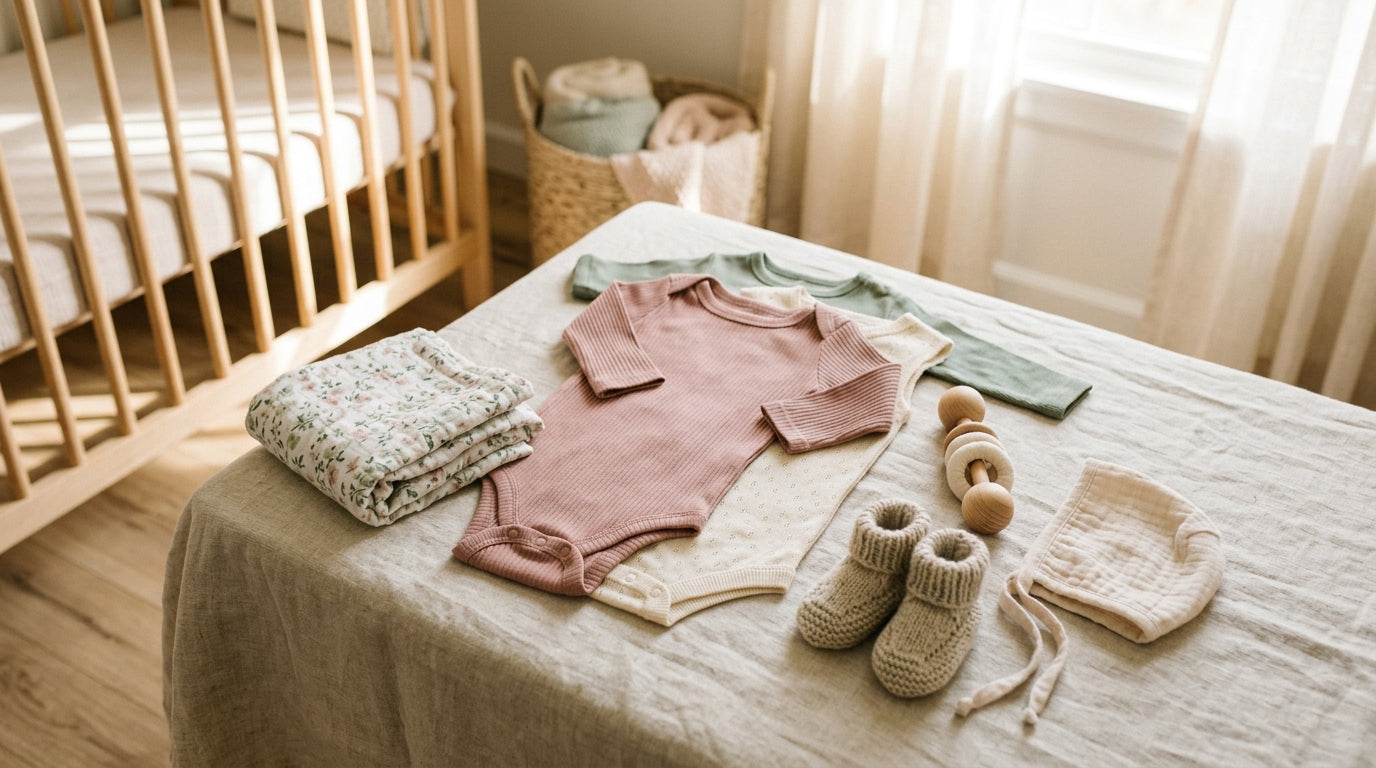
Before the twins were born, my mother insisted they needed tiny, stiff Victorian dresses with matching lace knickers, presumably just in case the Queen resurrected herself and invited our offspring to a formal garden party. My mate Dave, three pints deep at the local pub, leaned in and forcefully advised me to buy absolutely nothing at all because "they just live in a towel for six months anyway." Then, a completely unprompted stranger in the Sainsbury’s frozen aisle aggressively tapped my shoulder to inform me that any fabric other than hand-reared Scottish wool would give them instant hypothermia.
Sorting through this relentless barrage of contradictory nonsense to find actual baby girl clothes that won't make you want to weep into a cold cup of coffee is a genuine trial by fire. When our girls finally arrived, the reality of dressing a newborn baby hit us like a damp, milk-scented brick. You quickly realize that whatever aesthetic fantasies you harbored during the second trimester are immediately destroyed by the sheer, unyielding physics of a wriggling, furious infant who fundamentally objects to having her arms manipulated into sleeves.
The great sizing delusion and other textile lies
There's a specific kind of betrayal you feel when you proudly dress your four-day-old child in an outfit labeled "Newborn" only to realize it's cutting off circulation to her thighs. We bought an embarrassing amount of tiny little outfits, completely ignoring the fact that human genetics are wildly unpredictable. Twin A lived in newborn sizes for exactly a fortnight. Twin B, who apparently decided to absorb all available nutrients in utero, emerged with the broad shoulders of a tiny rugby player and went straight into zero-to-three months.
The standard newborn size theoretically fits babies up to around seven or eight pounds, which sounds perfectly reasonable until you realize that babies grow at the exact rate of bamboo in a tropical rainforest. You're far better off buying a minuscule handful of the tiny stuff and heavily front-loading your wardrobe budget into the slightly larger sizes, rolling up the sleeves if you've to, rather than watching thirty quid's worth of cotton become obsolete over a long weekend.
The three in the morning button rebellion
I'd like to take a moment to directly address whoever it was that decided metal press studs were a suitable fastening mechanism for infant sleepwear. I suspect it was someone who deeply hates parents.
At three in the morning, when you're functioning on exactly forty-two minutes of fragmented sleep, attempting to align fourteen identical metal snaps along the inner leg of a squirming baby in semi-darkness is a form of psychological torture. You start at the ankle, working your way up with trembling, sleep-deprived fingers, feeling quite smug about your progress. Then you reach the top and realize, with a cold rush of absolute despair, that you missed a button somewhere around the left knee and now have one extra flap of fabric and a baby whose legs are trapped in an asymmetrical fabric prison.
Zippers, specifically the ones that open from both the top and the bottom, are the only thing standing between you and a total mental breakdown. Don't buy the single-zipper ones that require you to expose your baby's entire chest to the freezing midnight air just to change a nappy. If an outfit requires an instruction manual or a degree in engineering to put on, aggressively throw it in the nearest bin.
What we actually put on their bodies
with building out their actual daily uniform, I've to be completely honest about the Flutter Sleeve Organic Cotton Baby Bodysuit. It's perfectly fine. My wife thinks the little ruffled shoulders are the most precious thing she’s ever seen, and yes, it does look terribly sweet in the photos we aggressively spam to the grandparents' WhatsApp group. But from a purely operational dad standpoint, when you're dealing with a nappy blowout that has somehow defied gravity, those flutter sleeves are just extra surface area for collateral damage. It's a lovely piece for a sunny afternoon in the park, but it's not the garment I reach for when I'm in the trenches.

The undisputed hero of our household, the garment that has seen us through the absolute worst of times, is the Long Sleeve Organic Cotton Baby Bodysuit. Twin A developed a rather spectacular case of baby acne around week three, and anything synthetic made her look like a boiled lobster. This organic cotton one breathes properly, but more importantly, it has those weird overlapping envelope folds on the shoulders.
If nobody has explained the envelope shoulder to you yet, brace yourself. Those folds aren't just for accommodating massive baby heads. When your baby girl commits a catastrophic code-brown diaper incident, you don't pull the bodysuit up over her head and smear the disaster through her hair. You pull the bodysuit down, over the shoulders and straight off the legs, effectively containing the biohazard. Discovering this trick literally altered the trajectory of my life.
The slightly terrifying truth about infant skin
I read somewhere deep in a midnight internet spiral that a newborn's skin is about thirty percent thinner than ours, which sounds like something out of a science fiction horror film. Our paediatrician vaguely nodded at me when I panicked about this during a routine weigh-in, muttering something about how they absorb whatever touches them much faster than we do.
Apparently, a lot of standard clothing is treated with things like formaldehyde just to keep it from wrinkling in the shipping container, which is brilliant for preserving laboratory specimens but perhaps less ideal for my daughters' faces. This is why buying organic cotton isn't just about me trying to look like a trendy, environmentally conscious North London dad at the playground. It actually stops them from breaking out in angry red rashes every time they sweat. Also, you must wash everything before they wear it for the first time. Literally everything. Don't trust factory-fresh fabric, no matter how soft it feels in the shop.
If you're currently panic-browsing the internet while your partner sleeps, worrying about whether you've enough of the right fabrics, you might want to quietly peruse our organic baby clothes collection before your sleep deprivation makes you accidentally buy a miniature leather jacket and matching combat boots.
Car seats and the puffy coat physics lesson
Our health visitor, a formidable woman named Brenda who terrified me in the best possible way, gave us a masterclass in why you never put a baby in a thick, puffy coat in the car. It has to do with crash physics, which I only marginally understand.

Basically, in an impact, all that fluffy winter padding instantly compresses to nothing. So the harness, which you thought was pulled tight, is suddenly incredibly loose, and the baby can literally fly out of the straps. It's horrifying to think about. Instead of thick snowsuits, you're supposed to dress them in thin, warm layers and drape a blanket over the top of the buckled harness if the car is freezing. A good long-sleeve organic cotton layer is exactly what you need for this, keeping them warm without turning them into a marshmallow that defeats the safety engineering of the seat.
A highly unscientific wardrobe checklist
If you strip away the marketing noise, a baby girl only needs a handful of highly functional items for the first few months. You need perhaps six or seven bodysuits, the ones with the aforementioned envelope shoulders. You need about the same number of sleepsuits with two-way zippers. A couple of cardigans are useful for when the British weather does whatever it usually does.
As they start getting slightly chubbier and more mobile, we leaned heavily on things like the Baby Shorts Organic Cotton Ribbed Retro Style. Twin B has thighs that look like packages of dinner rolls, and putting her in tight trousers was a struggle that usually ended in tears from both of us. These shorts have an elastic waist that doesn't pinch her stomach when she's trying to digest milk, and they make her look like a tiny 1970s marathon runner, which deeply amuses me.
How to ruin everything in the wash
We completely ruined a batch of clothes early on by using heavily fragranced fabric softener because we wanted the babies to smell like a meadow breeze. The paediatrician gently suggested we stop doing this immediately. Fabric softener coats the natural fibers in a sort of chemical slick, which ruins the breathability of the cotton and apparently degrades the flame resistance of the sleepwear.
Just dump their clothes in the machine with a standard, non-biological, unscented detergent. You don't need a special "baby" detergent that costs triple the price unless your doctor specifically tells you to buy one for severe eczema. Throw some wool dryer balls in the tumble dryer if you want things to be softer, but honestly, good organic cotton gets softer on its own anyway once you've washed the sick out of it a dozen times.
Before you get utterly overwhelmed by the sheer volume of tiny garments the internet tells you to purchase, just start with a few breathable, zipper-heavy basics. Go grab the Long Sleeve Bodysuit in a couple of sizes, practice your envelope-shoulder downward pull, and prepare yourself for the beautiful, messy chaos.
Frequently asked questions from the sleep deprived
How many newborn sizes should I actually buy?
Honestly, buy maybe three sleepsuits and three bodysuits in the actual "Newborn" size just so you've something to bring them home from the hospital in. Put the rest of your money into the 0-3 month category. If your baby is tiny, you just roll the sleeves up for a few weeks. If your baby is massive, you haven't wasted fifty quid on clothes they can only wear for a single Tuesday.
Why do people hate baby dresses so much?
Because they're a tactical nightmare. When a baby is lying on her back ninety percent of the day, a dress just bunches up around her armpits, creating a lumpy, uncomfortable wad of fabric. Then, when you pick her up, the dress rides up to her ears. They look adorable in photographs, but for actual day-to-day living, you'll quickly abandon them for a good ribbed cotton bodysuit.
Is organic cotton really doing anything or is it just marketing?
I was incredibly cynical about this until my daughter's skin broke out in angry bumps from a polyester-blend sleepsuit my aunt bought us. Because their skin is so wildly thin and underdeveloped, they really do react to the harsh chemical residues left on conventional cotton. Switching to organic genuinely cleared her skin up, which stopped her crying, which meant I finally got to sleep.
Can they just sleep in their day outfit?
If their day outfit is a soft, comfortable bodysuit or footie pajama without any hard buttons, bows, or scratchy bits, absolutely yes. The idea that a baby needs a designated "day wardrobe" and a separate "evening sleepwear" collection is a myth perpetuated by people who don't have to do the laundry. If she falls asleep in a clean cotton onesie, let her sleep.
What are those weird flaps on the shoulders of bodysuits for?
They're envelope folds, and they'll save your life. When the inevitable nappy blowout occurs, you don't pull the soiled garment up over the baby's head. You stretch the neck opening using those folds, pull the entire garment down over their shoulders, and slide it off their legs. It keeps the disaster completely away from their face and hair.




Share:
Is the Newton Baby Crib Mattress Really Worth Three Hundred Bucks?
Newborn Baby Eyesight: When Do Their Optical Sensors Boot Up?