

It was 3:14 in the morning, and I was staring at a fifteen-hundred-dollar spaceship of a smart sleeper that my colicky firstborn was currently screaming bloody murder inside of. That was the exact moment I realized the biggest myth in modern parenthood is that you can throw money at infant sleep and somehow buy yourself a full eight hours. You absolutely can't. The idea that you need a robotic, Wi-Fi-enabled bed to successfully keep a newborn alive and rested is a scam designed to prey on exhausted, hormone-crazed mothers at two in the morning.
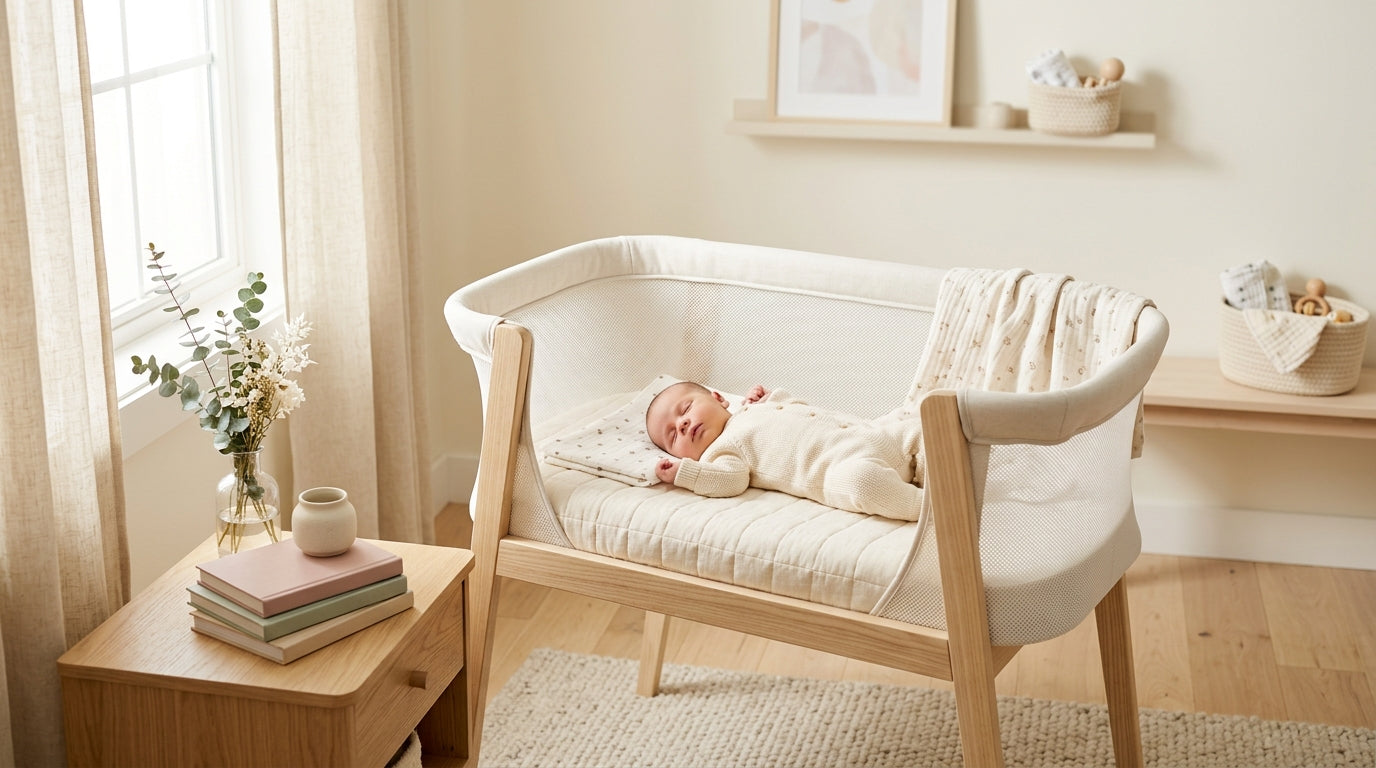
I learned my lesson the hard way, so by the time baby number two came around, I sold the spaceship on Facebook Marketplace and bought a baby delight bassinet instead. I'm just gonna be real with you—it’s basically just a fabric box on legs, and it was exactly what we needed. My mom always told me she just padded a dresser drawer with some folded quilts for me to sleep in back in the eighties, which I always rolled my eyes at, but honestly, dropping a hundred and fifty bucks on a simple bedside sleeper isn't that far off from her drawer theory. It turns out, simple actually works.
My pediatrician looked me right in the eye at our two-week checkup and told me to stop overcomplicating the sleep setup, explaining that as long as they're on a firm, flat surface close enough for me to hear them choke on spit-up, but on a separate mattress so I don't accidentally roll onto them, we were doing it right.
The straps are not optional
So let's talk about the big selling point of this thing: the drop-down side. The idea is you lower one wall of the bassinet, shove it up against your adult mattress, and boom—you've a co-sleeper where you can just reach over and drag the baby to your chest for a 2 AM feed without ever standing up. It sounds glorious when you still have your pregnancy belly and the thought of engaging your core makes you want to cry.
But here's the ugly truth that people gloss over. If you drop that side down, you absolutely must use the giant, annoying nylon straps they provide to anchor the bassinet frame underneath your heavy adult mattress. Don't just push it against your bed and call it a day. I used a hand-me-down bedside sleeper with my oldest son and thought the straps were just a suggestion for overly anxious people, and I woke up to find the bassinet had drifted three inches away from the bed, creating a massive gap that my kid was dangerously close to sliding into. Bless his heart, he was fine, but I lost a solid ten years off my life in pure panic. Anchor the darn thing. Just do it.
It has six height adjustments so you can make the mattresses flush, which is fine, whatever.
The MDF board situation
Now we need to talk about what’s actually inside the mattress of the standard models, because this is where my Southern budget-conscious brain fights with my crunchy-mom tendencies. The super popular Baby D models, like the Beside Me Dreamer, are cheap for a reason. Underneath that thin little waterproof pad is a piece of MDF—medium-density fiberboard.

Look, I'm not a scientist, and the exact way volatile organic compounds work is honestly beyond me, but from what I understand, MDF is glued together with stuff that can release formaldehyde into the air over time. I don't know how much off-gassing actually happens, but the thought of my tiny newborn smushing their face into a mattress supported by chemical glue for twelve hours a day makes my stomach hurt.
If you're going to get a baby delight bassinet, skip the standard cheap one and hunt down their Heirloom Willow or Aspen lines. They cost a little more, but they swap out the MDF and polyester for solid wood and organic cotton. It's one thousand percent worth the upgrade for the peace of mind alone. And since you'll be sitting next to this wooden beauty half the night nursing, you might as well be comfortable too. I basically lived under my Bamboo Baby Blanket in the Colorful Leaves Design during those night feeds. It’s wildly soft, the watercolor leaf print is gorgeous, and bamboo somehow magically keeps you warm without giving you those horrible postpartum night sweats.
The truth about that built in noise machine
If you end up with the Doze Deluxe version, it comes with this little electronic pod attached to the side that plays sounds and vibrates. Do me a favor and be very, very careful with that volume button.

I read some consumer testing reports that showed the maximum volume on these attachments can hit upwards of 56 decibels. My pediatrician explained it to me once, and my sleep-deprived brain barely grasped it, but basically, infant ear canals are so tiny that they act like little echo chambers, amplifying the sound frequencies way higher than what our adult ears hear. The absolute max they should be exposed to is 50 decibels. If you blast the white noise on high right next to their head, you're risking their hearing. Keep it on the lowest possible setting.
Honestly, half the time, electronic noise just agitated my third baby more. When she’d wake up fussing in the bassinet, instead of hitting the sound button, I'd just hand her a Bear Teething Rattle. This is seriously my absolute favorite thing I own from Kianao. It’s just a simple crochet bear on an untreated beechwood ring. No batteries, no flashing lights, no annoying robotic lullabies. She would just grip the wood, gnaw on the bear's ear for a few minutes, and calm herself down naturally. It’s brilliant.
If you're trying to weed the plastic battery-operated junk out of your house, building a stash of organic natural toys early on is the way to go.
The absolute max weight limit
Eventually, the bedside dream has to end. You can't keep them in a baby delight bassinet forever, no matter how much you dread the transition to the big crib in their own room. The rule is strictly twenty pounds, or five months of age, or the second they start trying to push up on their hands and knees—whichever of those happens first.
With my middle kid, she hit the milestone at four months because she suddenly decided to become a little gymnast. I'd wake up and she'd be sideways, mashed against the mesh walls. At least the mesh is completely breathable and machine washable, but it was definitely time to evict her.
To ease the transition to her room, I set up a Wooden Animals Play Gym Set on the floor right next to the bassinet during the day so she could get used to hanging out in that space while I folded laundry. It’s just okay—very minimalist with a little carved elephant and a wooden bird. It doesn't hold their attention for hours, but it’s a nice visual break from neon plastic toys, and it helped her get comfortable being slightly away from me.
Usually, right around the time they outgrow the bassinet, the serious teething hits, and their sleep goes to absolute trash anyway. You'll move them to the crib just in time for them to wake up screaming with swollen gums. When that happens, the Panda Teether is going to save your life. It’s made of food-grade silicone, you can toss it in the fridge to get it cold, and the little flat shape is incredibly easy for five-month-old hands to death-grip while they angrily chew the pain away.
So, skip the thousand-dollar robotic beds, grab a wooden bassinet, strap it securely to your mattress, and keep the noise machine low. It’s messy, it’s exhausting, but keeping it simple is the only way you'll survive the fourth trimester.
If you're ready to ditch the toxic plastics and set up a nursery that honestly breathes, go check out Kianao’s organic cotton collection before your baby arrives.
The questions y'all keep asking me about this
Do I seriously have to use the anchor straps?
Yes, you absolutely do. I know they're a massive pain to thread under a king-size mattress, especially if you've a heavy foam bed, but if you've the side wall zipped down for co-sleeping, one weird bump from your hip can push the bassinet away. The straps are the only thing stopping your baby from falling into the gap between the beds. Don't risk it.
Is the mattress supposed to be this hard?
I get this question all the time from moms who think the pad feels like sleeping on a piece of cardboard. It's supposed to feel like that. My doctor told me a soft mattress is a major suffocation hazard for newborns because they lack the neck strength to move if their nose sinks into plush fabric. It feels uncomfortable to us, but for a baby, flat and firm is exactly what keeps their airways open.
Can I wash the fabric parts if there's a blowout?
Yep, the whole fabric cover unzips and pulls off the metal frame. I wash mine on a cold, gentle cycle and let it air dry so it doesn't shrink. Just make sure you buy a couple of the brand-specific waterproof sheets to layer over the mattress pad, because nothing is worse than stripping the whole frame at three in the morning.
What's the real difference between the Dreamer and the Heirloom models?
The Dreamer is the cheap one you see everywhere, but it uses an MDF particle board under the mattress and synthetic polyester fabrics. The Heirloom models (like the Willow) cost a bit more but use solid wood construction and organic cotton fabrics. If you're trying to avoid unnecessary chemicals and formaldehyde off-gassing in your nursery, the Heirloom is the only one you should buy.
When do I've to stop using it?
The second your baby hits 20 lbs, turns 5 months old, or starts pushing up on their hands and knees. My babies always hit the mobility milestone way before the weight limit. Once they can pull themselves up or roll aggressively, the shallow walls of the bassinet become a tipping hazard, and it's time to move them to a full-size crib.




Share:
Surviving That First Ridiculous Baby Day Out Into The Wild
How to Bring a Baby Home to Your Dog Without Losing Your Mind