

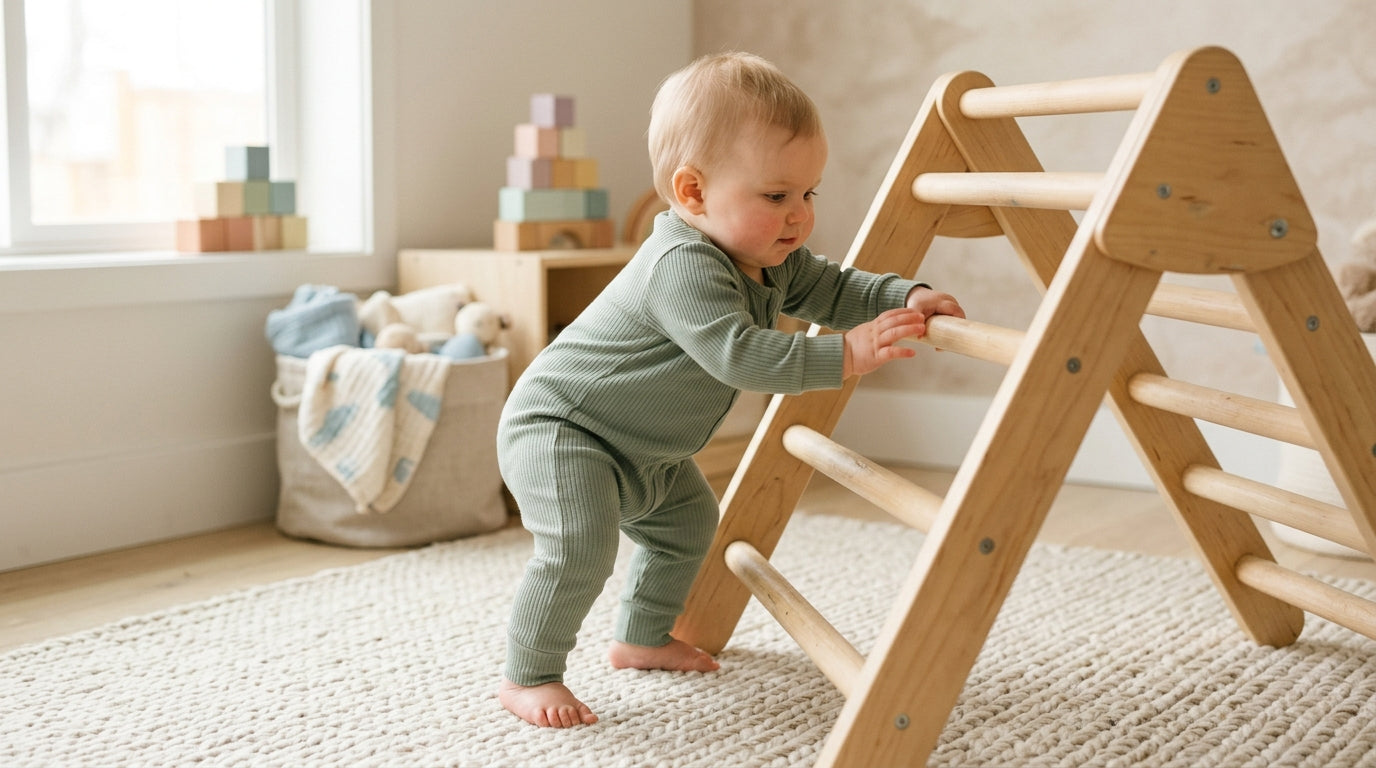
I was wearing my favorite black leggings—the ones with the questionable yogurt stain on the left knee that I'd just sort of given up on washing out entirely—and holding my third cup of lukewarm coffee. It was a Tuesday at like, 4 PM. The witching hour. Leo was eight months old at the time, and he was violently attacking the television console. And then, out of nowhere, he just hauled his entire squishy body upward, grabbed the edge of the wood, and locked his knees. He looked back at me with this wild, drunk-dictator expression on his face.
My husband cheered. I cheered. We took a blurry photo.
And then Leo realized he was trapped. He turned into a rigid, screaming plank of wood because he had absolutely no idea how to get back down to the floor, and I spilled my coffee trying to dive across the rug to save him before he face-planted into the corner of the PlayStation. Welcome to the pulling-to-stand phase, folks.
There's this massive, completely unhinged myth in the parenting world that pulling to stand is this cute, linear milestone where your baby just pops up like a delicate little spring daisy and suddenly they're a toddler. That's a lie. It's not the beginning of walking. It's just a completely different circle of hell where they've discovered they can see the top of the coffee table but haven't figured out gravity yet.
The weird arm-wrestling phase
When you're furiously Googling late at night wondering when do babies actually figure this out, you're probably picturing them using their legs. But they don't. At least, not at first. My doctor, Dr. Miller—who has seen me cry in her office more times than I'd like to admit—explained this to me when Maya was going through it a few years later.
Apparently, they start by basically muscling their way up using entirely upper body strength. They look like tiny, aggressive CrossFit athletes doing pull-ups on your furniture. They just grip the edge of whatever is nearby—the couch, your pant leg, the unfortunate family dog—and yank their dead-weight lower half off the floor. It's all arms.
Dr. Miller said this usually happens anywhere between seven and twelve months, which is such a stupidly huge window. Leo was up and screaming at the coffee table by eight months, but Maya? Maya was perfectly content sitting on her butt inspecting lint on the rug until she was nearly ten months old. Every kid is just on their own bizarre timeline. Some adventurous babies try it right at the half-year mark, while others sit back and observe the chaos before participating.
Anyway, the point is, they use their arms first. It takes them a while to figure out the whole "half-kneel" thing where they put one foot flat and push up with their thigh muscles. Until then, they're just dangling themselves from the edge of the couch by their knuckles.
The three in the morning crib hostage situation
Getting up is honestly only ten percent of the problem. The real nightmare is getting down.
There's a deeply unfair biological glitch in human development. Learning to lower yourself back to the ground requires an eccentric muscle contraction. Which is a really fancy way of saying they've to lengthen their muscle while it's still under tension, and baby brains literally can't compute this at first. So they stand up, lock their knees, and panic.
This is why, for about three exhausting weeks, you'll be summoned to the nursery at 3 AM. You'll walk in, and there's your sweet little babie, standing in the dark, gripping the crib rail like they're in a tiny prison, screaming bloody murder because they're tired but they don't know how to sit down to sleep. You have to physically go in there, un-pry their little death grip from the wood, and fold them in half so they can lay down. It's maddening. My husband and I used to play rock-paper-scissors in the dark to see who had to go do the crib-fold.
I read somewhere that you're supposed to teach them to squat during the day to prevent the night wakings. You know, by placing a toy on a low surface so they've to bend their knees to get it. I tried this. I spent hours putting toys on diaper boxes. Leo just stared at me, straight-legged, and cried until I handed him the toy. But eventually, they do figure it out. You just have to survive the sleep deprivation until their brain connects the dots.
The tree falling reflex
Oh god, the falling.

There's this thing called the parachute reflex, which is the instinct to throw your hands out to catch yourself when you tip over. Dr. Miller told me this usually develops around eight or nine months, which is great, except a lot of babies start pulling up before they've this reflex. So they don't catch themselves. They just tip over backward like a felled tree, completely stiff, straight onto the back of their heads.
It's terrifying. You basically have to shadow them constantly. Just put down all the rugs you own and hover behind them like an anxious goalkeeper.
Stuff that actually keeps them upright
So how do you actually get through this without losing your mind? Well, first of all, ditch the shoes. The grandparent generation loves to yell at us for letting our babies be barefoot because they think the kid will catch a cold through their toes or whatever, but barefoot is vastly superior.
They need the sensory feedback from the ground to grip and balance. Shoes just turn their feet into numb little blocks. If it's cold, just turn up the heat, or put them in something soft. When Maya was practicing her endless standing routines, she lived in her organic cotton flutter sleeve bodysuit because it was stretchy enough that she could awkwardly haul her legs up without the fabric restricting her hips, and we kept her entirely barefoot indoors.
You also need heavy, sturdy things they can pull up on that won't flip over and crush them. We really ended up getting this wooden rainbow play gym when Leo was little. I originally thought it was just going to be for him to lay under and swat at the little hanging animal toys—which he did, and it's beautiful and not a plastic eyesore—but because the A-frame is really solid wood, once he hit that eight-month mark, he started using it to pull himself up. He'd grab the wooden leg, yank himself to a stand, and then hold on for dear life while swatting at the elephant toy. I loved it because it was one of the few things in the living room that wouldn't tip over when he put his entire body weight on it.
I'd highly think looking for sturdy wooden toys or low activity tables rather than anything flimsy.
Speaking of things that help, if you're looking for gear that really supports your little one's chaotic motor milestones without ruining your living room aesthetic, definitely browse through Kianao's baby gear collection. It's all sustainable, gorgeous, and designed for real-life messiness.
The great walker debate
We need to talk about sit-in walkers. You know, the plastic donut things with wheels where you plop the kid in the middle and they zoom around the kitchen crashing into the cabinets? My mother-in-law was obsessed with buying us one.

Dr. Miller practically gave me a stern lecture about these before I even brought it up. The American Academy of Pediatrics hates them with a burning passion. Not only are they wildly dangerous if you've stairs, but they really delay walking. They force babies to stand in an unnatural position on their tiptoes, which completely messes up their hip and core development.
If you want to get them something, get a push-walker. Something heavy they can stand behind and push. They control the speed, and it forces them to honestly use their own balance rather than just hanging by their crotch in a plastic sling.
The panic of the lowered crib
The very first time your kid pulls up to stand, you're going to feel this rush of pride, followed immediately by sheer panic as you realize you haven't baby-proofed a single thing at that height.
Suddenly, the dog's water bowl is a swimming pool. The remotes are chew toys. The dirt in the potted plant is a snack. You have to rush into the nursery and lower the crib mattress immediately, which is a horrible job that always ends with pinched fingers and swearing, but you've to do it before they figure out how to vault themselves over the railing.
Mealtimes change, too. Once they can stand, they hate sitting in the highchair. They want to be upright constantly. I tried doing the whole low-weaning table thing with Maya, which was cute in theory but a disaster in practice. I bought this silicone walrus plate because it had a massive suction base, thinking she wouldn't be able to throw her food while standing at the little table. The plate itself is really great—the suction is insanely strong, and it's super easy to throw in the dishwasher—but she just ended up standing there, scooping the peas OUT of the perfectly sectioned little walrus face, and dropping them onto the floor individually. So, you know, gear helps, but kids are still going to be kids.
This whole phase is just a giant exercise in patience and letting go of control. You'll spend weeks hovering, catching, and folding your baby back in half. You'll drink too much coffee and spend way too much time staring at their feet. But eventually, the wobbles stop. The knees bend. They figure out how to plop back down on their diaper, and suddenly, they're cruising along the sofa, totally ignoring you.
It's exhausting, and it's messy, but it's also kind of magical to watch them realize just how much of the world they can finally reach.
If you're in the thick of this little babi phase right now, stock up on the coffee and make sure you've got the right setup. Check out Kianao's organic essentials for clothing and gear that genuinely moves with your baby, not against them, while they figure out this whole standing thing.
Do I need to put shoes on my baby when they start standing?
No! Really, please don't. Unless you're outside on hot pavement or sharp rocks, keep those tiny feet bare. Babies need to feel the floor to understand balance and spatial awareness. The sensory feedback from their bare feet tells their brain how to shift their weight. Shoes, especially hard-soled ones, just confuse them and make it harder for them to grip. Let them be barefoot monkeys.
Why is my baby standing up in the crib and crying instead of sleeping?
Because they're stuck! It's the most annoying phase ever. They have the muscle strength to pull themselves up, but their brains haven't figured out how to relax those leg muscles to sit back down. So they stand there, gripping the rail, exhausted and panicking. You'll just have to go in and gently bend their knees for them to help them lie down. I promise it usually only lasts a few weeks before they figure out the mechanics of squatting.
Is it normal if my 10-month-old isn't pulling up yet?
Totally normal. My doctor reminded me constantly that the "normal" range is huge—like, anywhere from 7 to 12 months. Some babies are super eager to get vertical, while others (like my daughter) are perfectly happy scooting on their butts for months. If you hit the 12-month mark and they aren't even trying to put weight on their legs when you hold them, that's when you should bring it up with your doctor.
Can I help them practice standing?
You can, but don't force it. The best thing I did was just scatter highly motivating items (like the TV remote or my car keys, honestly) on low surfaces like the couch cushions to encourage them to reach up. If you hold their hands to help them stand, keep your hands low, like at their chest or waist level. If you hold their arms way up above their head, it throws off their center of gravity and they can't use their core muscles properly.
Are activity centers and walkers safe?
Sit-in walkers are a huge nope. The AAP strongly advises against them because they cause massive injuries and seriously delay independent walking by forcing babies to stand weirdly on their tiptoes. Stationary activity centers (where they stand in one spot) are okay for like, 15 minutes while you make a sandwich, but don't leave them in there all day. The floor is always the best place for them to practice natural movement.




Share:
Who Determines the Sex of the Baby? The Honest Truth
When do babies start clapping: a letter to my panicked past self