

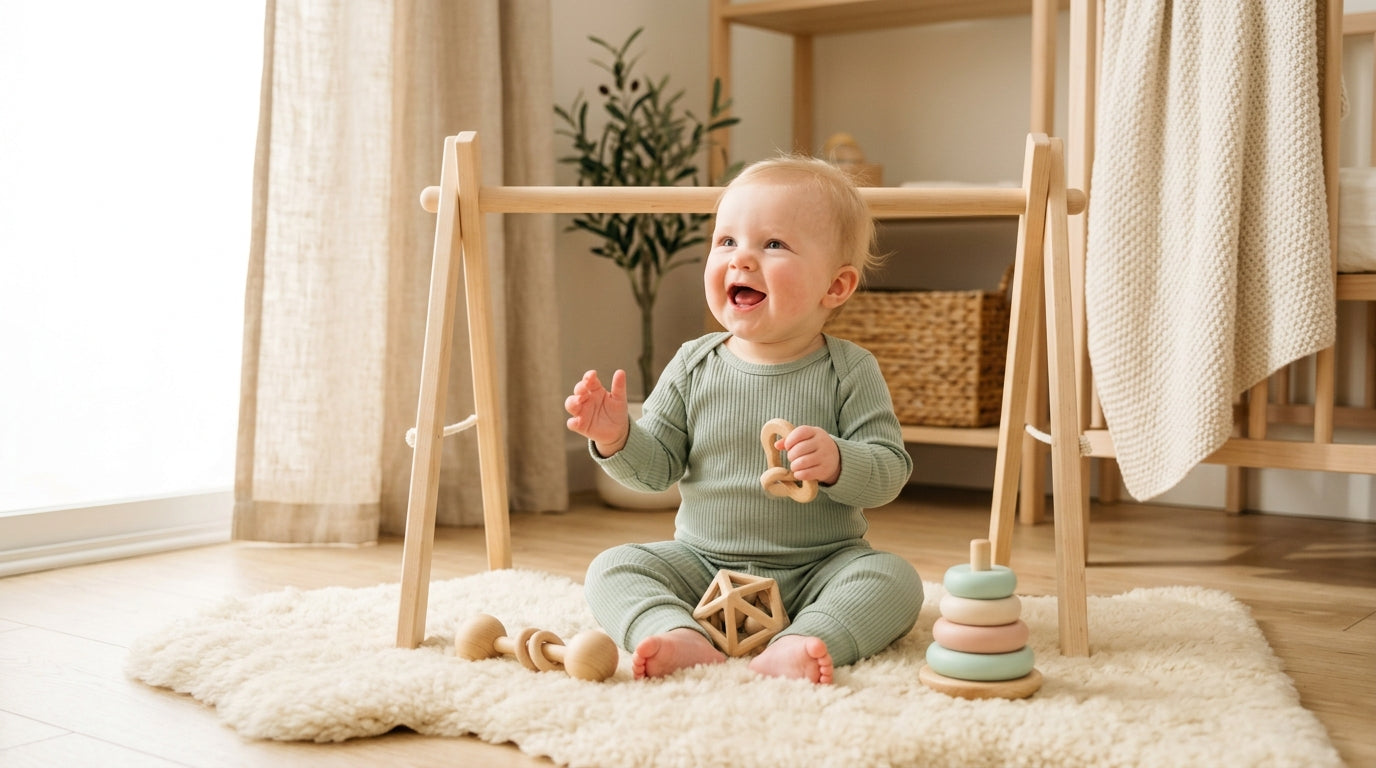
There I was, sitting cross-legged on my living room rug surrounded by a mountain of unsorted laundry, aggressively waving black-and-white flashcards in my firstborn’s face. Leo was about four months old at the time, staring at me with the blankest expression you’ve ever seen, slowly letting a giant string of drool escape the corner of his mouth. I remember frantically typing things like "when do babie" and "babi milestones" into my phone with one thumb because I was holding a bottle in my other hand, absolutely convinced I had already failed him as a mother.
My Instagram feed was full of these beige-wearing supermoms whose infants were apparently reciting poetry and speaking fluent Mandarin by week sixteen, while my kid’s greatest communicative achievement was passing gas loud enough to wake the dog. I got so wound up about the timeline that I forgot babies are actual tiny humans, not robots you program with a USB drive. I'm just gonna be real with you—I made myself absolutely miserable trying to force a milestone that was going to happen on its own time anyway.

Instead of turning every single wake window into a high-stakes vocabulary exam that makes both of you want to cry, the best thing you can probably do is just lay on the floor and make weird animal noises at your kid until one of you laughs. My own mom used to tell me that babies talk when they've something worth saying, which is the kind of unhelpful country wisdom that used to make me roll my eyes so hard I saw my brain, but bless her heart, she wasn't entirely wrong.
The Noisy Timeline My Doctor Gave Me
When I finally broke down and dragged Leo to the doctor because he wasn't having deep philosophical conversations with me, she literally laughed out loud—kindly, but still. She sat me down and explained that speech is a messy process and there isn't an alarm clock that goes off in a baby's head telling them it's time to speak. According to her, the whole progression happens in clumsy stages that overlap, disappear for a week, and then come back right when you're trying to sleep.
From what I loosely understand from that appointment, right around that four to six-month mark is when you get what the medical folks call marginal sounds. For us, this meant Leo sounded less like a human and more like an angry pterodactyl. It’s a lot of squeals, blowing aggressive raspberries, and testing out pitches that will absolutely shatter a wine glass. You'll think they're screaming in pain, but nope, they're just thrilled that their vocal cords can make that much noise.
Then somewhere in the six to ten-month window, you usually hit the classic repetitive stuff. This is the "ba-ba-ba" and "da-da-da" phase. My husband walked around for three weeks with his chest puffed out because he thought Leo was saying "Daddy," and I didn't have the heart to tell him that our son also looked at the toaster and called it "da-da." It's just the easiest sound for their little mouths to make.
By the time they crawl past the ten-month mark, it turns into full-blown conversational gibberish. My middle daughter, Maya, used to stand in her crib in the morning and deliver a ten-minute lecture to her stuffed animals in a completely made-up alien language. She had the hand gestures, the pauses, the eye contact—everything except actual English words. My doctor said this means their brains are picking up the rhythm of how we communicate, even if the vocabulary isn't there yet.
Teething Toys and Mouth Gymnastics
Here's a piece of information that absolutely blew my mind when my doctor mentioned it. The muscles a baby uses to chew on solid foods and gnaw on toys are the exact same muscles they use to form complex sounds. So when they're desperately chewing on everything in sight, they aren't just trying to soothe their angry little gums; they're basically doing CrossFit for their mouth.

I learned this the hard way because I used to try to take toys out of Leo's mouth constantly, thinking it was a bad habit. Once I realized it was actually helping him build the jaw strength he needed to eventually tell me "no" five thousand times a day, I started leaning hard into good teething gear. I run a small business from my dining room table, so I'm incredibly budget-conscious, but this is one area where I actually drop a few dollars.
My absolute holy grail product is Kianao's Bunny Teething Rattle Wooden Ring Sensory Toy. I think it runs around eighteen dollars or so, which isn't pocket change, but let me tell you, it's worth its weight in gold. It has this natural beechwood ring that's totally untreated, so I don't panic about weird chemicals when my youngest goes to town on it. The crochet bunny head has these long floppy ears that she loves to manipulate with her tongue and lips. Honestly, I swear fighting with those crochet bunny ears helped her figure out how to make the "ma" sound. Plus, it survives a hand-washing in the sink after it inevitably gets dropped on the grocery store floor.
Now, I'll say I also bought the Squirrel Teether Silicone Baby Gum Soother, and I'm just gonna be real with you—it's just okay. It’s about fifteen dollars and the mint green color is super aesthetic, but the shape of the squirrel is a little awkward for really tiny, uncoordinated hands. My youngest liked it fine, but it felt a little slippery once it was coated in a thick layer of baby drool, and it slipped out of her grip and into the depths of the car seat way too often. It’s fine to have in a pinch, but I wouldn't call it a lifesaver.
If you prefer silicone over wood, the Llama Teether Silicone Soothing Gum Soother was a much bigger hit in our house. It has this heart cutout right in the middle that is a perfect little handle for baby fists. I used to pop it in the fridge for twenty minutes while I folded a load of towels, and handing that cold llama over to a cranky, teething infant was like casting a magic spell for twenty minutes of peace. The heavy chewing action they get on the textured silicone is exactly what doctors mean when they say chewing prepares the mouth for talking.
If your house is currently drowning in bright plastic junk that lights up and plays the same song on a loop until you want to move to another state, you might want to switch some of it out for things that actually help their development. You can browse through our teething toys collection to find stuff that's safe, sustainable, and won't give you a massive headache.
Everyday Tricks to Get Them Talking
You don't need an expensive curriculum or a degree in early childhood education to help your kids figure out their voices. As a former teacher, I can tell you that the best learning happens when everyone is just relaxed and going about their normal day.

The most works well thing I ever did was just become a massive copycat. If my daughter was sitting on her playmat and said "ba-ba," I'd stop what I was doing, make aggressive eye contact, smile like a lunatic, and say "ba-ba!" right back to her. It feels incredibly silly, especially if the UPS guy is dropping off Etsy supplies and hears you through the screen door, but it teaches them that communication is a two-way street. They make a noise, they get a reaction. It's the foundation of every conversation they'll ever have.
I also turned into a running narrator for my own boring life. I'd talk to my babies while I loaded the dishwasher, explaining that the cups go on the top rack and the plates go on the bottom. I told them what I was doing while I wrestled them into clean diapers. You just want to flood their little sponge brains with as much varied language as possible. They need to see your mouth moving to understand how sounds are formed, so get down on their level during tummy time and let them watch your lips.
When to Really Worry About the Quiet
I know I joke a lot about being anxious over milestones, but I also know that mother's intuition is a very real, very heavy thing. There's a huge difference between a baby who's just taking their sweet time and a baby who might need a little extra help.
My doctor told me that if we hit the seven to nine-month mark and there were absolutely no consonant-vowel combinations happening—no "ba-ba", no "da-da"—that was the time to have a serious conversation, not a time to wait and see. Older generations love to tell you things like, "Oh, boys are just lazy, bless their heart, he'll talk when he's ready." Ignore that. It's always better to get an evaluation and be told everything is perfectly fine than to miss a window for early intervention.
Sometimes the issue is incredibly simple. A friend of mine was terrified her son had a major developmental delay because he was dead silent at ten months old. Turns out, the poor kid just had a massive buildup of fluid in his ears from a string of mild colds. To him, the whole world sounded like he was underwater. They got a quick procedure for ear tubes, and within two weeks, he was babbling so much she was begging for five minutes of silence.
Other warning signs my doctor told me to watch for included a lack of eye contact, not turning their head toward loud noises when they were tiny, or not responding to their own name as they got closer to their first birthday. If your gut is telling you something is off, don't let anyone make you feel crazy for booking a doctor's appointment. You're your kid's only advocate.
honestly, raising these tiny humans is exhausting, sticky, and completely unpredictable. You can do all the right things, buy all the right wooden toys, and narrate your laundry folding until your voice gives out, and they're still going to do things on their own weird timeline. Give yourself some grace, put the flashcards in the recycling bin, and just enjoy the weird pterodactyl noises while they last.
If you want to support your baby's sensory and motor skills without compromising on the materials they're putting in their mouth, take a look at our organic baby toys collection before you head out.
A Few More Messy Questions
-
Is it normal if my baby only makes vowel sounds and no consonants?
If they're under six months old, my doctor said that's totally normal. They're just figuring out their volume knob and breath control. If they're pushing eight or nine months and still only making "ahhh" and "eeee" sounds without any "b" or "d" or "m" mixed in, that's definitely worth a phone call to your doctor just to get their ears and mouth muscles checked out.
-
Does using a pacifier all day delay their speech?
I'm not a speech therapist, but my doctor gently suggested we limit the pacifier to sleep times once my kids hit about six months. It kind of makes sense—if their mouth is constantly plugged up with silicone, they physically can't practice making those new babbling sounds. Plus, it can change how their tongue rests in their mouth. We slowly started hiding them during the day, which involved a lot of whining, but it did get them talking more.
-
Why do they babble non-stop one week and then go totally quiet the next?
Because babies love to mess with our sanity. Seriously though, I noticed with all three of my kids that they would get super quiet right before they mastered a different physical milestone. When Leo was figuring out how to crawl, he stopped making noises entirely for about two weeks. It was like his brain only had enough battery power to focus on moving his legs, and the speech center had to go into power-saving mode. Once he got the crawling down, the noise came back twice as loud.
-
Does screen time honestly hurt their language development?
Look, I'm not going to sit here and pretend my kids have never watched a cartoon so I could take a shower. But the pediatricians are pretty firm that passive screen time doesn't teach them how to talk, no matter what the educational apps claim. They learn by watching a real human face react to them. A screen can't smile back when they say "ba-ba," so it doesn't give them that social reward that makes them want to keep trying.
-
My mother-in-law says my baby should be saying real words by 9 months. Is that true?
Bless her heart, but she's remembering history through rose-colored glasses. Most medical guidelines don't expect a true, meaningful first word (like saying "mama" and specifically meaning you, not just making the sound randomly) until right around their first birthday, and even then, the timeline is super flexible. Let her compare notes with the neighbors; you just focus on your kid's actual doctor.




Share:
When Do Babies Start Cooing? A Real Mom's Guide to Early Sounds
The Middle-of-the-Night Panic Search For Your Baby's First Tooth