

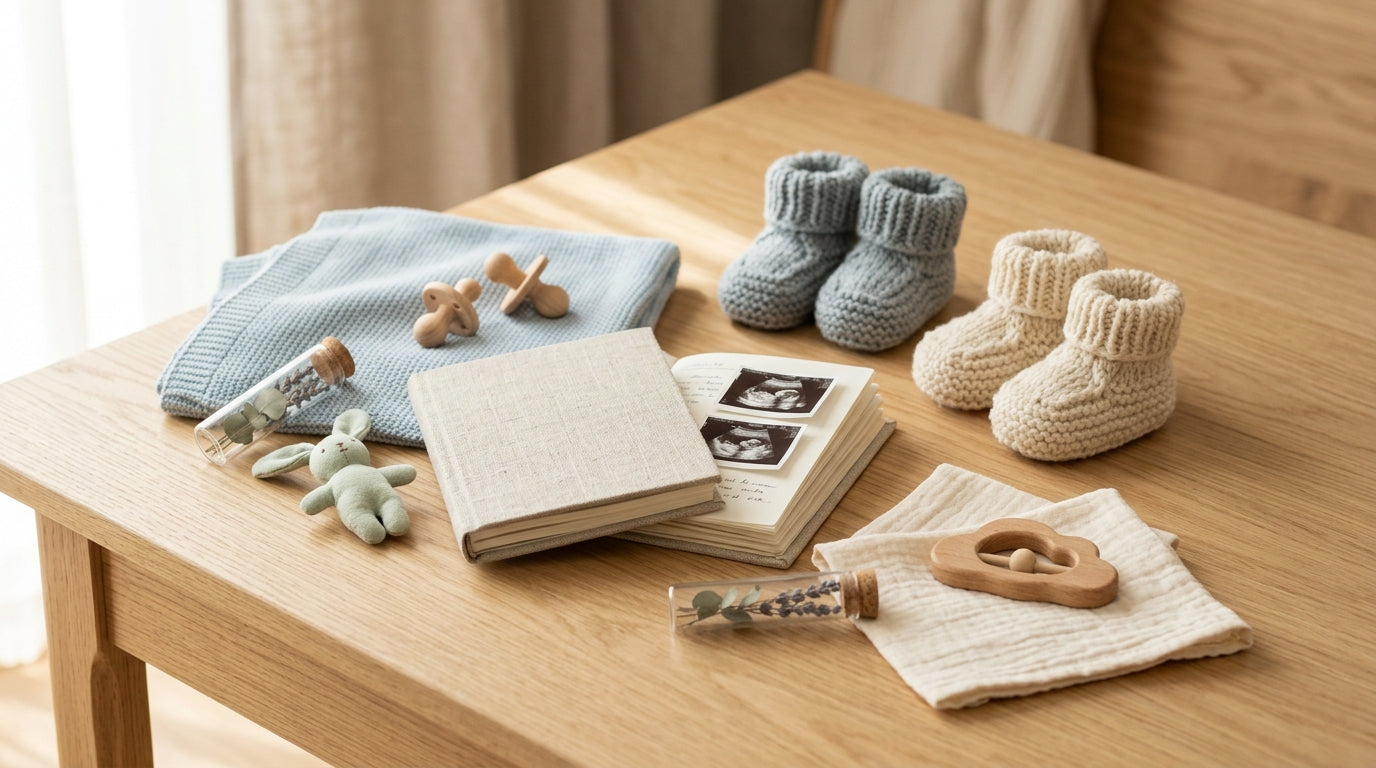
I was literally holding my phone up to the ultrasound monitor at week twelve, trying to overlay a digital protractor app onto the blurry gray static on the screen. "If the angle of the genital tubercle is greater than 30 degrees, the algorithm says it's a boy," I whispered to my wife, who was currently covered in cold conductive gel. She gently pushed my phone down and apologized to the extremely tired medical technician. Apparently, trying to debug a fetus using Reddit's "nub theory" during a routine medical appointment is highly frowned upon.
The biggest myth we had walked into that clinic with was thinking that a baby's physical sex was just an on-off switch that got flipped on day one. We figured the hardware was fully assembled by week twelve and just needed to scale up in size. I spent an embarrassing amount of time furiously googling in which week baby gender is developed while sitting in the clinic parking lot, trying to map out a precise Gantt chart for my kid's anatomical milestones.
The reality, as our pediatrician later explained while looking at my very intense spreadsheet with mild concern, is entirely different. The source code is committed at conception, but the user interface takes months to render. Trying to speedrun the biological timeline will just make you crazy, so you're better off ignoring the nub theory forums and just waiting for the blood test while you stockpile green and gray baby gear.
Source code versus the compiled build
Before we had a name for him, we just called the fetus Baby G—short for Baby Gender-TBD—because we were so tired of referring to our child as a pronounless entity. I assumed that because his genetic destiny was locked in from the jump, the physical evidence would be obvious almost immediately.
My pediatrician, Dr. Lin, drew a weird, lopsided diagram on the whiteboard to explain that genetic determination and physical development are two entirely separate patches in the biological firmware update. The sex is technically determined the exact millisecond the sperm meets the egg. If the sperm carries an X chromosome, the source code says female. If it carries a Y chromosome, the source code says male. The data is there. The genetic payload is delivered.
But the actual physical rendering of that baby gender? That process is agonizingly slow. You can have the code in the repository, but the app hasn't been built yet. Your baby is basically sitting in early access beta for the first two months.
The default operating system
From what I understand of Dr. Lin's whiteboard scribbles, every single baby starts with the exact same base chassis. For the first six weeks, male and female embryos are physically indistinguishable from one another. They operate on a default bipotential template, which sounds like a fancy electric vehicle platform but is actually just biology's way of reusing code.
During this phase, there's a structure called the genital ridge. It has the potential to become either male or female hardware. I spent an unreasonable amount of mental energy obsessing over the fact that we all start with this identical, ambiguous architecture. It felt like finding out that every smartphone, regardless of the brand on the case, uses the exact same motherboard for the first quarter of the assembly line.
The genetic script execution
Around week seven or eight, the system finally reads the genetic script. If there's a Y chromosome present, a specific line of code called the SRY gene executes. This gene basically sends a system-wide ping that triggers testosterone production, which commands the genital ridge to start forming male anatomy.

If there's no Y chromosome, there's no SRY ping. The system just continues along its default pathway, and the female reproductive system begins to form. It's wild to me that the entire physical divergence of human sexes essentially comes down to a single biological if/then statement executing at week seven.
The messy hardware rendering phase
This brings me back to my humiliating moment with the digital protractor app in the clinic.
Weeks nine through fourteen are when the physical differentiation actually happens rapidly, but it's notoriously buggy to look at from the outside. By week twelve, both male and female fetuses have a little bump called a genital tubercle. The internet forums convinced me that I could accurately predict the gender by measuring the exact angle of this bump relative to the baby's spine. I had read a study claiming some high accuracy rate, and I was ready to bet our entire nursery color scheme on my ability to read a grainy, low-res ultrasound output.
I was so confident. I spent three full paragraphs of a text message explaining my geometric proof to my mother-in-law. I was entirely wrong. Our technician pointed out that I wasn't even measuring the tubercle; I had spent five minutes calculating the trajectory of the umbilical cord. Also, Dr. Lin mentioned later that the external hardware for both sexes looks incredibly similar until at least week fourteen, and technicians misidentify slowly developing females all the time.
Apparently, old wives' tales about carrying high or craving salty foods are equally useless garbage metrics.
My pivot to neutral inventory management
Because we had to wait half the pregnancy to get a confirmed visual of the anatomy, I had to completely restructure our procurement strategy. You can only delay buying must-have baby gear for so long before the anxiety overrides your desire for a color-coordinated pink or blue room.

I bought the Colorful Leaves Bamboo Baby Blanket right around week fourteen when I finally accepted my ultrasound math was hot garbage and we needed things we could actually use regardless of the outcome. To be completely honest, I bought it because I liked the data on bamboo fibers—specifically their moisture-wicking properties and temperature regulation. I really logged my son's room temperature (usually hovering around 71.2 degrees) and mapped his sleep cycles in a spreadsheet during his first month, and this blanket reliably kept him from overheating. It's ridiculously soft, the watercolor leaf pattern is incredibly calming, and it has survived about a hundred chaotic trips through our washing machine without losing its structural integrity.
Around the same time, I bulk-ordered a stack of the Sleeveless Organic Cotton Baby Bodysuits in plain, undyed white. They're perfectly fine. I mean, they're bodysuits. They function well as unobtrusive base layers and the stretch around the neckline makes them easy to yank over a screaming infant's head. But honestly, babies are basically biological stain factories, and pristine white cotton is no match for a week-three diaper blowout. They did the job while we waited on the gender reveal, but they aren't exactly family heirlooms.
My wife, who has much better aesthetic sense than I do, preferred the Organic Cotton Baby Blanket with the Calming Gray Whale Pattern. It ended up being the blanket we packed in the hospital bag. The double-layer GOTS-certified organic cotton felt safer against his newborn skin than the synthetic stuff we were gifted, and the gray ocean theme looked great in photos before we knew what we were having.
If you're stuck in that weird limbo waiting for the anatomy scan, you can always check out Kianao's organic baby essentials to build out a nursery that works for literally any genetic outcome.
The non-invasive blood test patch
We eventually opted for the NIPT (Non-Invasive Prenatal Testing) around week eleven. From a data engineering perspective, this blew my mind.
The pediatrician explained that the mother's blood genuinely hosts tiny, fragmented pieces of the baby's DNA. They can draw a standard blood sample from the mom and scan it for the presence of a Y chromosome. If they detect a Y chromosome in the mother's blood, you're having a boy. If they don't, you're having a girl.
Here's my understanding of the general timeline of sex determination and development:
- Day 1 (Conception): Genetic sex is committed to the database (XX or XY).
- Weeks 1 to 6: The base bipotential template is installed. Embryos look identical.
- Weeks 7 to 8: The SRY gene executes (if male) and triggers testosterone.
- Weeks 9 to 14: The physical hardware begins to form and diverge, though it looks highly ambiguous on standard monitors.
- Week 10 and up: NIPT blood tests can parse the DNA fragments for a Y chromosome.
- Weeks 18 to 22: The anatomy scan provides a clear visual rendering (if the baby cooperates).
Even after the blood test confirmed we were having a boy, I still didn't fully believe the data until the 20-week anatomy scan. And even then, he had his legs crossed for the first forty minutes of the appointment, forcing the technician to poke my wife's stomach with the wand until he finally shifted his position.
Before you fall down a Reddit rabbit hole trying to analyze grainy ultrasound photos at 2 AM, maybe just step away from the screen and browse our gender-neutral baby blankets instead.
Messy Dad FAQs
-
Can ultrasound techs really guess the gender at 12 weeks?
My tech basically laughed me out of the room when I asked. Dr. Lin said the "nub theory" is maybe 87% accurate in the absolute best-case scenarios with perfect angles and high-end equipment. In reality, the external hardware looks so similar at that stage that they frequently mistake the umbilical cord for male anatomy, or misidentify a developing boy as a girl. Don't paint the nursery based on a 12-week guess. -
How does the NIPT blood test know the gender?
Apparently, your baby sheds tiny fragments of DNA directly into the mother's bloodstream. The lab runs a script on the mom's blood to look for a Y chromosome. Since women don't naturally have Y chromosomes, if one shows up in the sample, it belongs to the baby, meaning it's a boy. It's incredibly accurate, but I still spent an hour reading about false positives because I've severe trust issues with biological data. -
Are those home urine gender predictor tests accurate?
Our pediatrician looked at me like I was an idiot when I asked if we should buy one from the pharmacy. Urine doesn't contain the baby's DNA or sex hormones. Those tests are basically chemical magic 8-balls. You have exactly a 50/50 shot of them being right, which means they're completely useless for actual data collection. -
Why do we've to wait until 20 weeks for the anatomy scan?
Because the rendering process is slow. Even though the genetics are set at conception, and the physical divergence starts around week nine, it takes until weeks 18 through 22 for the physical structures to grow large enough and distinct enough for a technician to reliably identify them on a grainy monitor. And even then, your kid might just cross their ankles and hide the evidence anyway.




Share:
Confessions of dressing my toddler in the teenage dirtbag trend
Raising a Modern Indian Baby Without Losing Your Absolute Mind