

I'm sitting on the sand at Oak Street Beach with a three-month-old who looks like a poorly powdered donut. The wind is whipping off Lake Michigan. I'm holding a tube of thick white zinc oxide paste, trying to coat my child's tiny limbs while the sand acts like an abrasive scrub. He is screaming. I'm sweating through my shirt. Despite being a registered pediatric nurse, I've somehow let internet paranoia about UV rays override my clinical training, and now my kid is covered in a heavy mineral crust he doesn't even need.
Listen, the anxiety around infant sun exposure is real, but the way we handle it's usually a disaster. You read one article about cumulative skin damage and suddenly you're ready to dip your child in a vat of SPF fifty. But dealing with a baby's developing skin is a delicate game of triage. You have to balance the risk of a burn against the very real danger of overheating them with heavy creams and thick layers.
Let me tell you what I did wrong that day by the lake, and what my pediatrician gently reminded me of when I called her in a panic later.
The six month waiting period
There's a golden rule in pediatric dermatology that somehow gets lost in the summer marketing rush. If your baby is under six months old, you shouldn't be slathering them in any kind of UV blocking lotion. Their epidermis is barely finished baking. It's incredibly thin, highly permeable, and completely unprepared to metabolize foreign substances.
My pediatrician looked tired when I confessed my beach mistake. She explained that babies under six months old don't sweat efficiently. When you coat them in a thick layer of mineral paste, you trap their body heat. They can't control their temperature. I've seen a thousand cases of infant heat exhaustion in the ER, and I can tell you it's far scarier than a mild pink hue on a forearm. Our understanding of dermal absorption is always shifting, but the general consensus is that keeping heavy creams off newborns is the safest bet.
So you keep them in the shade. You rely on the canopy of your stroller, UV tents, and strategic timing. You stay inside when the sun is directly overhead. My mom just tells me to keep them indoors entirely until October, which is very helpful advice, yaar, when you've been trapped in a city condo with a crying infant for four straight days.
When you do venture out, clothing is your actual barrier. But here's the catch. You can't put them in thick, dark fabrics or they'll roast. This is exactly why I rely so heavily on the Organic Cotton Baby Bodysuit Sleeveless Infant Onesie. I know a sleeveless garment sounds counterintuitive when you're trying to hide from the sun. But when you're parked under a heavy canvas beach umbrella in eighty-five degree heat, you need a fabric that actually breathes. The organic cotton pulls the sweat away without giving them that angry red heat rash synthetic blends are famous for. I keep them in the shade and drape a very lightweight muslin swaddle over their lower half if the light shifts. It's about managing airflow just as much as light exposure.
Chemical versus mineral barriers
Once your kid crosses the half-year mark, their skin matures enough to handle topical blocks. This is when the real headache begins, because the drugstore aisle is a chaotic mess of marketing claims.
Chemical blocks work by acting like tiny sponges. They sink into the skin, absorb the UV rays, and process them. To do this, the ingredients have to enter the bloodstream. I'm not a toxicologist, but seeing words like oxybenzone on a label makes me nervous when I'm dealing with a seven-month-old's tiny circulatory system. The data is always murky, but animal studies have hinted at mild hormonal interference with some of these chemicals. I prefer to just avoid the unknown.
Mineral formulas are the physical bouncers at the club. They rely on zinc oxide or titanium dioxide. They sit right on top of the skin and deflect the light away. Yes, they're incredibly annoying to rub in. Yes, your baby will look a little bit pale and ghostly. But they work the second you put them on, whereas chemical formulas require you to wait twenty minutes before sun exposure. If you know a single parent who can keep a toddler still for twenty minutes while a chemical lotion absorbs, I'd like to meet them and study their sorcery.
The baby marketing illusion
Don't fall for the pastel packaging. The word "baby" printed in a cute font on a tube of lotion means absolutely nothing medically. It just means the manufacturer is charging you four dollars more.

Consumer testing usually shows that infant-specific sunblocks are nearly identical to the sensitive skin formulas marketed to adults. You just need to look for a broad-spectrum, mineral-based option with an SPF of at least thirty. If it says non-nano zinc, that's even better. It implies the particles are too large to seep through the skin barrier or mess with the coral reefs. I just buy one large tube of mineral block for the whole family and save myself the mental load of organizing separate skincare routines.
Application is an absolute nightmare
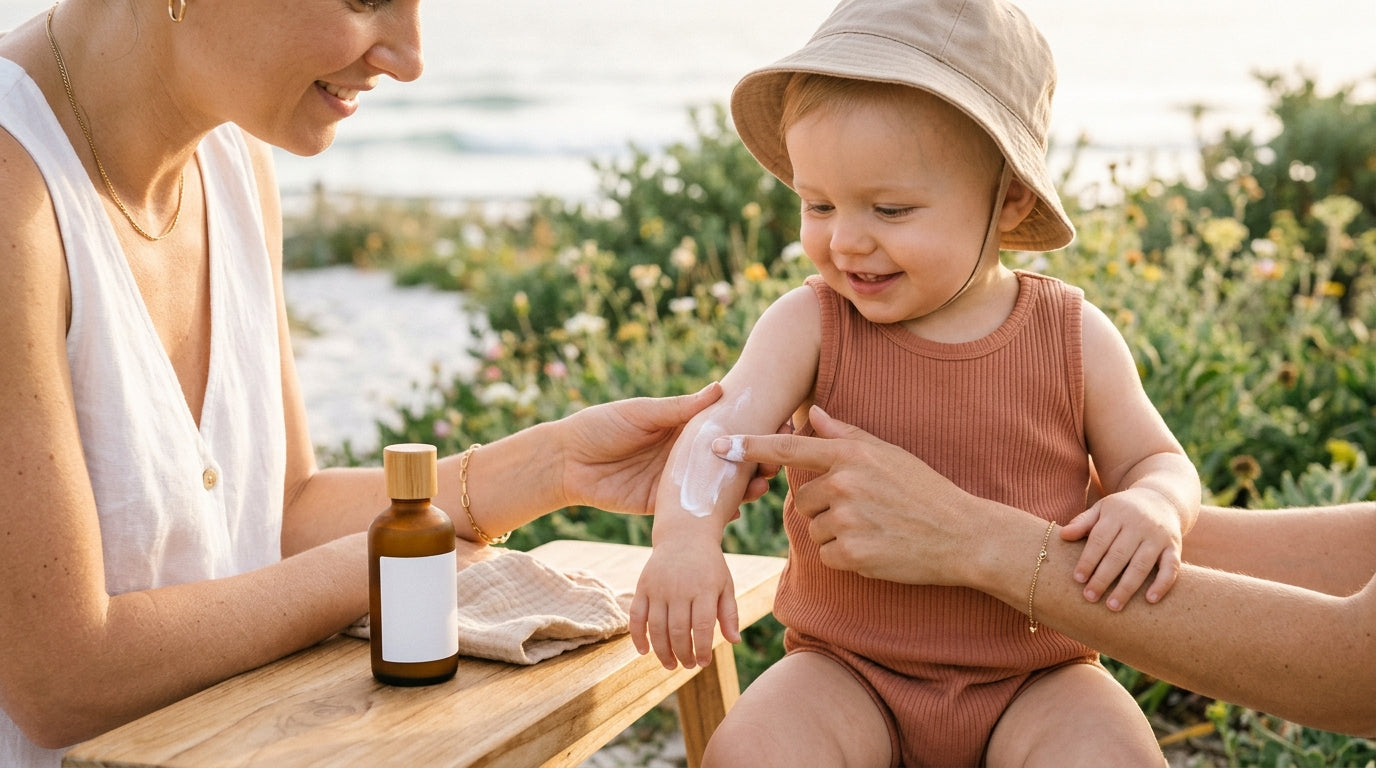
Nobody uses enough of this stuff. We're all stingy with it because it's expensive and feels like spackle. In the clinic, we talk about the teaspoon rule. You need a teaspoon for the face and neck, and a teaspoon for each limb. You will feel like you're icing a cake.
Whatever you do, avoid the aerosol sprays. The wind takes half the product away before it even reaches your kid. What's worse is the inhalation risk. I've watched kids walk into urgent care wheezing because a well-meaning parent sprayed them down in a breezy parking lot, sending a cloud of chemical particulate straight into their tiny lungs. If you're stuck with a spray bottle, spray the cold liquid into your own palms first, rub your hands together, and then wipe it onto their skin.
Reapplication is the part we all conveniently forget. You have to do it every two hours, or the minute they finish splashing in a plastic pool. They don't make waterproof blocks anymore, just water-resistant ones. The friction of a towel wipes half of it off anyway.
Usually, I'm trying to reapply this thick paste while my kid is actively losing his mind over a new tooth coming in. I've learned to hand him the Panda Teether Silicone Baby Bamboo Chew Toy before I even open the tube. It buys me maybe forty seconds of relative stillness. The flat shape means it doesn't get instantly coated in the zinc on my hands if I'm careful, and he can gnaw his aggression out on the textured silicone ears while I frantically smear white paste across his nose.
If you're trying to figure out how to dress your kid for the heat without totally exposing them, take a minute to browse our summer clothing collection to find layers that prioritize airflow over synthetic bulk.
Clothing gaps and sneaky burns
You think you've done everything right. You've applied the paste. You've got the stroller canopy down. But UV rays are sneaky. They bounce. Up to fifteen percent of UV light reflects right off dry sand, and water is even worse. You can be sitting under an opaque umbrella and still catch reflected damage on an overcast day.

This means you've to be hyper-aware of how your baby's clothing shifts when they move. I've a complicated relationship with certain seasonal styles because of this. Take the Flutter Sleeve Organic Cotton Baby Bodysuit. The organic cotton itself is brilliant for sensitive skin, and the design is undeniably beautiful. But from a purely clinical sun-safety perspective, those little ruffled sleeves create a false sense of security. They flutter up and leave the delicate shoulder caps completely exposed to bounced light. If we're going to a shaded indoor event, it's perfect. If we're spending three hours at the park, it's a liability, and I find myself constantly checking to make sure I've reapplied zinc right under the ruffle.
The removal process
Getting the mineral barrier off honestly is its own special kind of torture. Zinc oxide is designed to repel water. If you just stick your kid in a normal bath with standard baby wash, the water will bead right off their skin and the white film will remain.
I used to scrub my kid's arms with a washcloth until his skin was angry and red. Then an older nurse took pity on me and explained basic chemistry. Like dissolves like. You need an oil-based cleanser or even just plain coconut oil from your kitchen. You rub the oil onto their dry skin before the bath. It breaks down the zinc. Then you wipe it away gently and put them in the tub to wash the oil off. It saves so much crying at bedtime.
Before you pack your bag for the park tomorrow, make sure you've the right breathable layers to keep them comfortable when you're hiding in the shade. Browse our organic basics to build a safe foundation for summer.
Messy questions about infant sun safety
When can I safely ignore the six-month rule?
Listen, life happens. If you're stuck at an outdoor wedding with no shade and a four-month-old, a little bit of mineral block on the back of their hands and their face is vastly preferable to a blistering burn. The AAP even says this is fine in a pinch. Just don't coat their entire trunk in it. Wash it off the second you get indoors.
What do I actually do if my baby gets a sunburn?
You panic for a minute, and then you treat it like a thermal injury. Cool compresses are your best friend. A lukewarm bath helps pull the heat out of the skin. If your baby is under a year old and gets a sunburn, you really should call your pediatrician's answering service. We worry about dehydration and systemic fever with infants. Don't put any weird home remedies on it, just stick to plain aloe if they're old enough.
How do I keep a hat on a kid who hates hats?
You probably won't. It's a battle of wills that you'll lose fifty percent of the time. Look for hats with soft velcro chin straps instead of ties, because ties just irritate their neck folds. Sometimes if I put the hat on right as we walk out the door, the distraction of the outside world makes him forget it's on his head. Sometimes he just rips it off and throws it in a puddle.
Is the sun damage really that bad if they just get a little pink?
Skin damage is cumulative. Every little hit adds up over a lifetime. Pediatric dermatologists talk about how just one blistering burn in childhood doubles the risk of melanoma later on. A little pink isn't a death sentence, but it's a clear sign their skin has sustained trauma. Don't beat yourself up if it happens, just figure out where the gap in your defense was and fix it for tomorrow.
Are chemical formulas really that dangerous?
The honest answer is we don't entirely know. The FDA has admitted they need more data on how systemic absorption of things like oxybenzone affects the body long-term. I don't think using a chemical block once at a pool party is going to ruin your child's life. But when I've the choice, I'll always pick the mineral option that sits on top of the skin rather than the one that enters the bloodstream.




Share:
How a Single Bunny Blanket Took Our Entire Family Hostage
The Truth About Newborn Onesies (And How Many You Actually Need)