

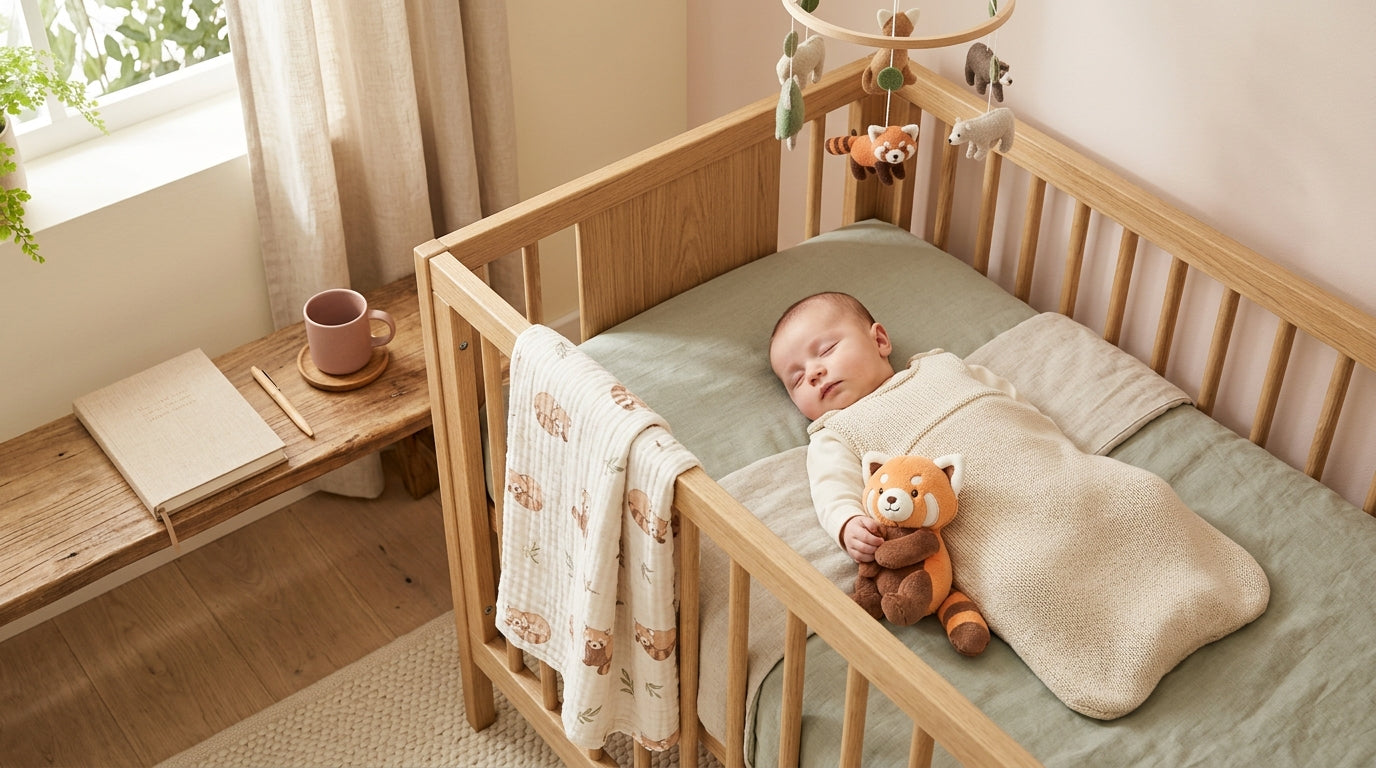
Dear Priya from six months ago. You're currently sitting on the peeling linoleum of the nursery floor at three in the morning, staring at a pile of unwashed swaddles and frantically googling the birth weight of exotic animals. You think knowing that a newborn red panda weighs the exact same as a standard bar of soap will somehow give you perspective on the eight-pound human currently trying to latch onto your collarbone. It won't. But I'm writing this to you anyway, because you need to stop sanitizing the breast pump parts for the fourth time today and just breathe, yaar.
You're obsessed with these animals right now because the internet told you they're the perfect gender-neutral nursery theme. You're buying the prints and the sheets and the little wooden wall hangings. I get it. But you're missing the actual point of how these animals survive their early days.
Listen to how red pandas handle their babies. The cubs are born totally blind, completely deaf, and weigh maybe four ounces. They don't even have the decency to be born with that beautiful auburn fur. They come out looking like grey, moldy lint rollers to blend into the shadows of their tree dens. My doctor mentioned once that human newborns basically only see blurry shadows for the first few weeks anyway, but at least our kid occasionally opened her eyes to glare at us. The grey lint roller phase is real for both species.
The multiple nest situation
I need to talk about the nursery for a minute. The animal kingdom has this figured out in a way that the modern maternal-industrial complex completely ignores. A mother red panda doesn't buy a smart crib with a monthly subscription fee. She builds a nest out of twigs and damp moss. But here's the kicker. She builds three or four of them. She constantly moves her blind little babi from tree hollow to tree hollow to keep predators guessing.
You spent three months agonizing over the exact shade of sage green for one room. You had a minor breakdown over the rug pile height. And we're told to make this one perfect sanctuary, as if a human infant will care about coordinated wainscoting. I've worked the pediatric ward for years, and I can tell you that a newborn's primary requirement is just you breathing nearby. But no, you had to have the perfect imported curtains. You could have just piled up some clean laundry in the living room and called it a secondary den.
Actually, the laundry pile is where that sweet babie sleeps best now anyway. The red panda moves her cub because of snow leopards. I move our toddler from the crib to the floor mattress because she figures out how to wedge her ankle between the slats at two in the morning. Same triage, different predators. We're all just dragging our offspring from one semi-safe surface to another hoping nobody gets eaten or bruised.
The four month dark room strategy
My doctor swears that the fourth trimester is basically just us pretending the baby is still inside us. Red pandas actually do this right. The cubs stay hidden in a dark den for a full three or four months. The mom just curls her bushy tail around the cub like a built-in organic blanket and refuses to perceive the outside world.
I wish someone had prescribed me ninety days of uninterrupted darkness. Instead, I had my mother-in-law showing up with tupperware and random neighbors asking if I was going to bounce back while I was still wearing mesh hospital underwear. My mother tried to implement the traditional Indian forty days of confinement, feeding me ghee-soaked panjiri and telling me not to leave the bed. I fought her on it because I wanted to prove I was fine. I wasn't fine. I should have taken the forty days and demanded ninety more. Be a red panda, Priya. Stay in the dark hole.
The built in organic blanket
Red pandas have these massive bushy tails that they just wrap around their bodies to stay warm in the freezing Himalayan mountains. They don't have to mess with velcro or zippers in the middle of the night.
I can't tell you how many hours I've wasted trying to swaddle our kid. My attending nurse during my first clinical rotation showed me the perfect hospital swaddle with those stiff cotton blankets. I thought I was an absolute expert. But the hospital blankets are different from what we buy. When you try it at home with a slippery cloth at two in the morning, the baby just breaks free like a miniature escape artist. You will eventually give up on the restrictive swaddle and just buy a sleep sack, which is the closest thing humans have to a bushy tail.
Bamboo and silicone habits
Around three months, these cubs start mimicking their mothers and chewing on bamboo twigs. This is about the same time our kid decided her gums were an active war zone. I've seen a thousand teething babies in the clinic, drooling through their shirts and running low-grade fevers, but it hits differently when it's your own kid screaming at the bedroom wall.

I eventually bought that Panda Teether you put on the secret internet wishlist. I usually hate hyper-specific animal toys, but this one actually works in a practical sense. The flat bamboo-textured part gets right back to where the molars will eventually erupt and ruin our lives. She chewed on it relentlessly while staring at the ceiling fan for an hour. It survived the dishwasher every single night without degrading into sticky mush. It was my favorite piece of plastic-free sanity during month four.
You also registered for that Wooden Panda Play Gym because you saw it on a blog. It's fine. It looks highly aesthetic in the living room, and the minimalist wooden frame doesn't make my eyes bleed like the neon plastic battery-operated ones do. But let's be brutally honest, she only batted at the crocheted star for about twelve minutes a day before demanding to be held again. It's a nice place to park her while you drink lukewarm coffee, but don't expect it to magically babysit her for an afternoon.
The false thumb and the death grip
Did you know these animals have a modified wrist bone that acts like a false thumb just to grip bamboo stalks. They evolved an entire extra piece of anatomy just to hold their food. Meanwhile, human babies are born with a palmar grasp reflex so strong they can practically hang from a pull-up bar.
My attending at the hospital used to joke that newborns could survive falling out of a tree if they just managed to grab a branch on the way down. I didn't find it funny at the time. But now, watching our toddler latch onto my gold necklace with the grip strength of an industrial vise, I understand the mechanics. They're designed to hold on to the mother. When she grips your finger in the middle of the night, it's not just a sweet bonding moment. It's biological desperation. She is making sure her primary food source doesn't wander off. It hurts your cuticles, but it's deeply good.
The transition to solid twigs
Let's talk about weaning, since we're on the subject of eating bamboo. The mother panda nurses her cub for several months before they start chewing on solid food. I think they're fully weaned by five or eight months.
Meanwhile, we get inundated with conflicting advice about baby-led weaning versus purees. One doctor says wait until six months, while another says start rice cereal at four months if they stare at your dinner plate. My doctor vaguely gestured at a developmental chart and said to just try a mashed avocado when she seemed interested.
I spent hours steaming sweet potatoes and mashing them to the exact consistency of mortar, only for her to spit it directly into my eye. The red panda mother just hands her kid a dirty twig and calls it a day. I deeply respect that level of low-effort parenting.
The danger of small things
People watch animated movies and think red pandas are just plush toys you can hug. They're not pets. They're wild animals with razor-sharp claws that carry zoonotic diseases. There are fewer than ten thousand left in the wild because humans ruin everything with deforestation. Anyway.

It reminds me of how people treat human toddlers. Everyone sees the chubby cheeks and the little outfits, but they forget these are feral creatures running on pure instinct and spite. I've seen toddlers in the emergency room with RSV who could take down a small adult if they wanted to. They bite, they scratch, and they carry daycare illnesses that will humble you in twenty-four hours. Treat them with the cautious respect of a wild animal.
The timeline for the red fur
The cubs don't even get their iconic red coat until they're about fifty days old. You spent so much time worrying about whether her hair was going to be thick and dark like ours or if she would stay a bald little potato forever. My doctor told me not to even look at the hair for the first six months because it all falls out and changes texture anyway.
You also spent entirely too much time buying those stiff, aesthetic linen outfits that look like tiny pioneer costumes. I finally bought a few of the sleeveless organic cotton bodysuits and that's practically all she wears now. They're stretchy enough that I don't feel like I'm breaking her arms to get them on, and the material genuinely breathes when she's sweating through her third nap of the day. They do the job without irritating her skin.
Just throw away the stiff pioneer costumes and let the schedule burn while you sleep on the rug in yesterday's clothes and ignore your mother-in-law complaining about the dust.
If you need a distraction from the midnight anxiety, maybe browse some soft organic baby clothes that won't cause a rash when she's having a sensory meltdown.
Final thoughts from the future
So put down the phone. Stop looking up the gestation period of Himalayan mammals. Your kid is going to be fine. You're going to be chronically tired, but fine. The grey lint roller phase passes. The biting phase passes. You just have to survive the dark denning period first.
When you finally emerge from your bedroom and feel like rejoining society, you can find the things that genuinely helped us survive those early days in the Kianao baby care collection.
You probably still have questions rattling around in your sleep-deprived brain. Here's what I wish I could tell you directly.
Why do red pandas move their cubs and should I move my baby around
I used to think the crib was a sterile, permanent drop zone for a child. But red pandas move their cubs constantly to avoid snow leopards. You don't have snow leopards in Chicago, but you do have a baby who suddenly decides the bassinet is made of hot lava. I move her from the crib to the floor mattress to the middle of our bed depending on the hour and my level of desperation. Do whatever gets you another forty minutes of unbroken sleep.
Is it normal that my newborn looks a bit grey and weird
Red panda cubs are born looking like grey lint rollers to camouflage in the dark. Human babies are born looking like bruised potatoes because they just got squeezed through a birth canal. My doctor always says the skull bones overlap during birth, which is why her head looked a bit like a cone for a week. They all look weird at first. Stop staring at her features and take a nap.
When does the teething phase honestly stop
I've seen a thousand of these cases in the clinic and I still don't know the exact timeline. Red pandas chew bamboo at three months. Our kid started gnawing on my knuckles at four months and didn't stop for half a year. You just buy a mountain of silicone teethers and wait it out.
Should I try the dark room strategy for my newborn
Yes. Lock the door. Red panda mothers hide in a tree hollow for ninety days. We're expected to take our newborns to a brunch place at week three. It's absurd. Tell everyone you're busy recovering and just sit in the dark with the baby. Your nervous system will thank you.




Share:
Searching For The Real Love Baby Connection At Eleven Months
My honest nurse review of those famous Korean bulk baby wipes