

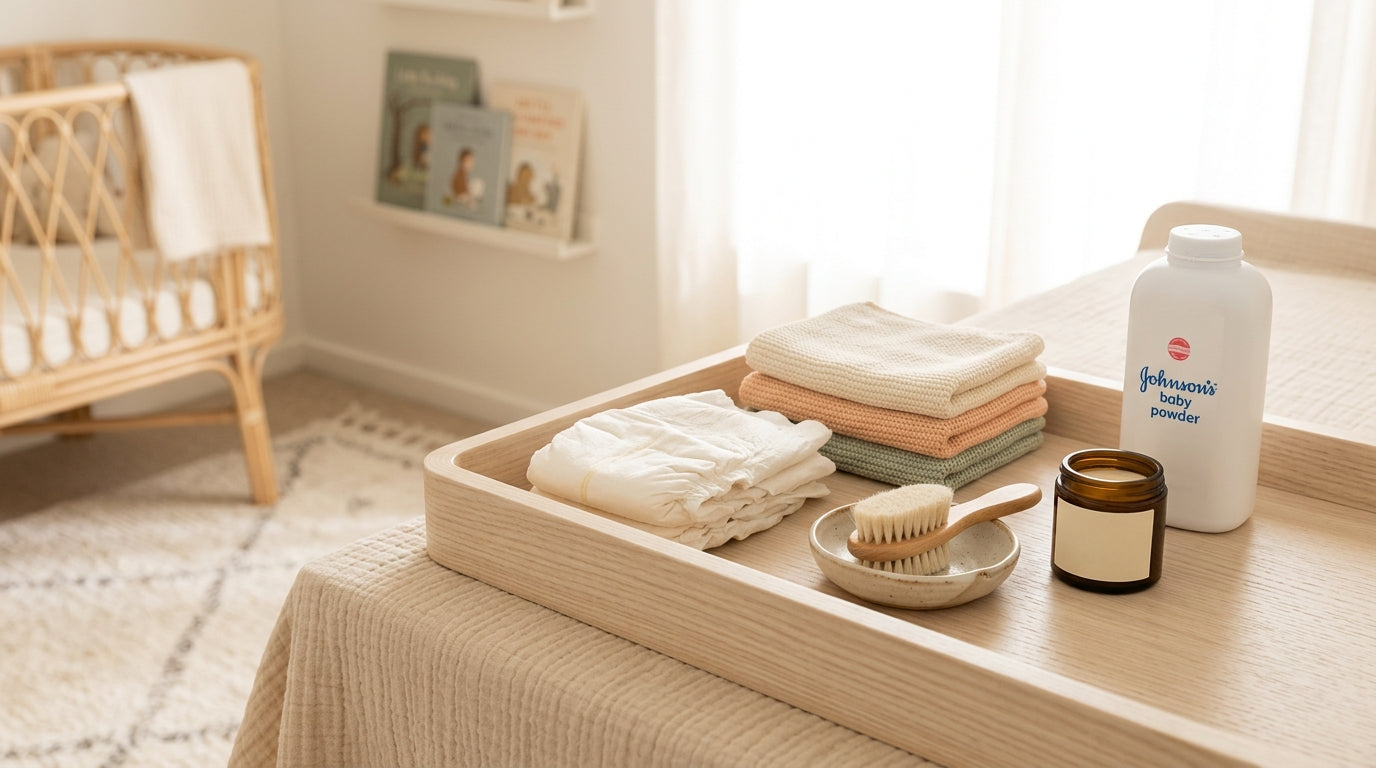
It’s 3:14 AM on a Tuesday. The heating in our London flat is making that ominous clanking sound that usually precedes a massive repair bill, and Florence (Twin A, currently the undisputed heavyweight champion of dramatic screaming) has decided her nappy is lined with actual battery acid. I'm operating on a sleep deficit so deep that earlier that evening I had genuinely tried to unlock the front door with a fish finger. In a desperate bid to soothe her rather spectacular red rash, I blindly reach into the chaotic depths of the bathroom cabinet and extract a relic.
It’s a white plastic bottle with pink lettering, left behind by my mother-in-law during a visit in what I can only assume was late 2019. I flip the lid. I give it a firm, sleep-addled squeeze. What happens next defies all known laws of physics.
A localized weather system of fine, aggressively floral-scented white dust erupts into the dimly lit nursery. I breathe in, instantly choking on what tastes exactly like a 1990s maternity ward, while Florence stops crying out of sheer confusion. She just stares at me in the dark as the powder gently settles on her eyelashes, the changing table, and a five-foot radius of the carpet that we literally just paid a man named Steve to steam clean. I'm standing there, a thirty-something man coated in a thin layer of white residue, wondering how an entire generation of parents survived this daily dusting ritual without developing black lung.
And more importantly, I suddenly find myself wondering what exactly I’ve just blanketed my unsuspecting child in.
The physics of fine white dust
Let's talk about the absolute absurdity of using fine particulate matter in a nursery setting. Whoever decided that the ultimate solution to a wet baby was to douse them in a substance that instantly transforms into a cement-like paste upon contact with moisture clearly never had to wrestle a writhing toddler at four in the morning. **The dust simply never settles.** You wipe it, it smears. You vacuum it, the exhaust shoots it right back into the air. My flat smelled like that classic johnson's baby nostalgia trip for three straight weeks.
I spent days finding tiny white drifts of the stuff in the crevices of the skirting boards, on the cat, in my own morning tea. I genuinely believe that if archeologists excavate our flat in a thousand years, they won’t find my extensive collection of unread parenting books (page 47 suggests you "breathe through the frustration," which I found deeply unhelpful while covered in human waste), but they'll absolutely find a perfectly preserved, fossilized layer of vintage talc under the floorboards.
As for the actual necessity of using it to keep a baby dry? It's utter nonsense. We're living in an era where modern nappies are engineered with the kind of hyper-absorbent polymer technology that NASA probably uses to capture asteroid moisture. Honestly, modern nappies are practically spacesuits; they don't even need this stuff.
Late night search history panics
After the great dust bowl incident, I did what any rational, anxiety-riddled millennial parent does: I took to my phone while aggressively rocking a baby back to sleep. My search history from that night is a tragic mess of half-typed panics: baby po, baby p, is it normal for twins to hold grudges, and finally, a deep dive into the history of talcum powder. It was a terrible mistake.
I tumbled down a bleak internet rabbit hole of class-action lawsuits, corporate memos from the seventies, and medical terms that you really don't want to be reading while trying to maintain your dignity. From what I can gather through my highly unscientific panic-reading, the classic powder we all grew up with was made of talc. Talc is mined from the earth. Asbestos is also mined from the earth. Apparently, they're geological neighbors in the ground, and sometimes they mingle. This is absolutely not what you want happening in a product destined for your child's most sensitive, rash-prone bits.
The big corporate machine recently stopped selling the old talc stuff globally, pivoting instead to cornstarch. I actually bought a bottle of the new cornstarch version just to see the difference, and honestly, it still makes a massive cloud. It's a slightly heavier, soup-thickening kind of cloud, but a cloud nonetheless. And according to my rudimentary, panicked grasp of respiratory health, babies probably shouldn't be breathing in aerosolized baking ingredients any more than they should be breathing in crushed minerals. It just feels like we’re replacing one highly airborne problem with another slightly more culinary airborne problem.
What the doctor actually told me
I brought up the whole powder situation at our next NHS health visitor appointment, clutching a crumpled list of questions and looking wildly under-slept. My GP, a wonderfully stoic woman who has seen it all and suffers no fools, looked at me like I’d just suggested bathing the twins in cheap gin.

She explained that babies don't actually need powder of any kind because breathing in fine dust is a universally terrible idea for tiny, developing lungs, so instead of shaking clouds of powder around the room like a manic baker you should just use a thick barrier cream and accept the fact that your dark t-shirts will be permanently stained white.
She also pointed out that keeping a baby's skin clear has much more to do with what you dress them in than what you sprinkle on them. Which brings me to the reality of my second twin, Alice.
Dressing them in things that seriously help
Alice inherited my wildly sensitive, prone-to-random-blotches skin. We had to overhaul our entire nursery wardrobe because synthetic fabrics were basically acting like little plastic greenhouses, trapping sweat and friction until she looked like she'd been dragged through a bramble bush. We eventually threw out half her clothes and started exclusively using the Organic Cotton Baby Bodysuit from Kianao.
I'm not exaggerating when I say this single item of clothing restored a fraction of my sanity. It’s sleeveless, which is brilliant because wrestling tiny, uncooperative, flailing arms into sleeves is a form of torture that should be outlawed. The organic cotton is stupidly soft, but more importantly, it really breathes. It allows the air to circulate, meaning the moisture gets out naturally, and I don't have to consider dusting my child like a Victoria sponge cake to keep her dry.
It also washes incredibly well, which is vital when you're dealing with the sheer, ungodly volume of laundry that two small humans generate. When Alice is wearing her organic cotton gear, the air gets in, the sweat evaporates, and the dreaded rash stays away.
Need something to genuinely help with your little one's sensitive skin while you handle the messy business of nappy changes? Explore Kianao's organic clothing and accessories before you completely lose your mind.
The distraction techniques
Of course, preventing the rash with breathable clothes is only half the battle. The other half is the physical wrestling match required to genuinely apply the thick, white barrier cream my GP recommended. You try holding down a toddler who possesses the core strength of an Olympic gymnast while simultaneously trying to smear zinc oxide on their rear end. It's impossible.

We eventually had to find ways to distract them. I usually hand them the Panda Teether Silicone Baby Bamboo Chew Toy. I'll be honest, this thing is just okay. It works for what it's. Alice likes to gnaw aggressively on the panda's ears when her molars are coming in, and I deeply appreciate that I can just chuck it in the dishwasher when it inevitably gets dropped onto a sticky café floor. It’s a bit heavy, and I frequently find it wedged deep between the sofa cushions completely covered in dog hair. But when she properly loses her mind over teething pain right in the middle of a nappy change, it’s a decent enough distraction to keep her hands occupied so she doesn't try to grab the tub of nappy cream.
What really works much better to keep them pinned down is lying them flat under the Wooden Baby Gym. We bought this when they were about three months old, and it has miraculously survived their violent transition into toddlerhood. It’s made of natural wood, which tricks me into feeling like a successful, aesthetically pleasing parent even when the rest of the living room looks like a bomb went off in a Mothercare.
They used to just lie there peacefully and stare at the little hanging geometric shapes. Now, they actively try to dismantle the structure with brute force. But the brilliant thing is that it keeps them flat on their backs for exactly the forty-five seconds I need to clean them up, dry them off, and apply a safe, non-inhalable cream.
The hairdryer incident
Let’s take a moment to discuss the sheer physical toll of the modern nappy change without the aid of our grandmother's favorite drying powder. Because you absolutely can't trap moisture under a thick layer of barrier cream (that just marinates the rash), the skin has to be bone dry first.
I now find myself using a hairdryer.
Yeah, you read that correctly. On the lowest, coolest setting. I'm a grown, thirty-something man standing in a dimly lit London nursery at two in the morning, waving a Dyson Supersonic at a toddler’s backside to make sure completely dry skin before applying an organic calendula balm. Is it ridiculous? Absolutely. Does it prevent the rash from returning? Mostly. Do my neighbors think I'm running a very strange, highly vocal 24-hour salon? I can only imagine.
But this is what modern parenting seriously looks like when you peel back the sepia-toned Instagram filters. It’s making bizarre, slightly unhinged calculations at all hours of the night. It’s realizing that the convenient products our parents used on us with reckless abandon are now the subject of late-night documentary exposés. It’s trying to do better, but usually just ending up covered in different, slightly more expensive types of goo.
We do our best. We read the labels, we panic-Google the ingredients, we throw away the vintage plastic bottles hiding in the back of the cabinet, and we buy breathable fabrics. And then we just hope they don't figure out how to take off their own nappies while we're sleeping.
Ready to ditch the questionable dust and upgrade to breathable essentials that won't require a hazmat suit? Shop the organic cotton collection at Kianao.
The Messy, Honest FAQs
Do I really need to throw away my old baby powder?
If it's an old bottle that's been sitting in the back of a cabinet since before 2020, yes, absolutely bin it. The older talc-based formulas are exactly what sparked the massive wave of health concerns and lawsuits regarding asbestos contamination. Don't use it on the baby, don't use it on yourself, and definitely don't keep it around for nostalgia. Just securely bag it and throw it in the bin. Your lungs (and your baby's lungs) will thank you.
What's genuinely in the new Johnson's formula?
The brand completely pulled talc from their global lineup recently and swapped it out for cornstarch. If you buy a new bottle today, you're essentially buying heavily perfumed, finely milled cornstarch with some added aloe and vitamin E. While it's free of the asbestos-contamination risks connected to mined talc, it still creates a massive, powdery cloud when you squeeze the bottle. And medically speaking, doctors still don't want your baby inhaling any kind of airborne particulate, whether it belongs in a mine or in a bakery.
How do you genuinely dry a baby without powder?
Patience, mostly. And occasionally gentle air. After using a wipe, I gently pat the area completely dry with a soft, clean cotton cloth (never rub, unless you want them to scream). If the rash is really bad, I'll literally let them lie there without a nappy on for a few minutes to air dry naturally, or I employ my ridiculous cool-setting hairdryer technique. Only once the skin is totally dry to the touch do I apply a thick, zinc-based barrier cream.
Can cornstarch powder cause other issues?
Aside from the inhalation risk, which is bad enough, cornstarch can seriously feed certain types of nappy rashes. If your little one happens to have a yeast-based nappy rash (Candida), throwing cornstarch on it's basically like throwing a pizza party for the yeast. It’s a carbohydrate, and the yeast will feast on it, making the angry red rash significantly worse. Stick to breathable organic clothes and simple barrier balms.
What's the best way to handle a severe nappy rash?
If it looks like angry red blisters or isn't going away after a few days of normal barrier cream, you need to call your GP. I spent three days trying to fix what I thought was normal friction rash on Florence, only to find out she needed a specific antifungal cream from the pharmacy. Stop using wipes entirely (they sting like mad on a raw rash), use cotton wool with plain warm water to clean them, dry them thoroughly, and let them have as much nappy-free time as your carpets can financially withstand.




Share:
The Truth About Johnson's Baby Lotion and Millennial Guilt
Josh and Aubree Jones Named Their Baby Disney (And I Get It)