

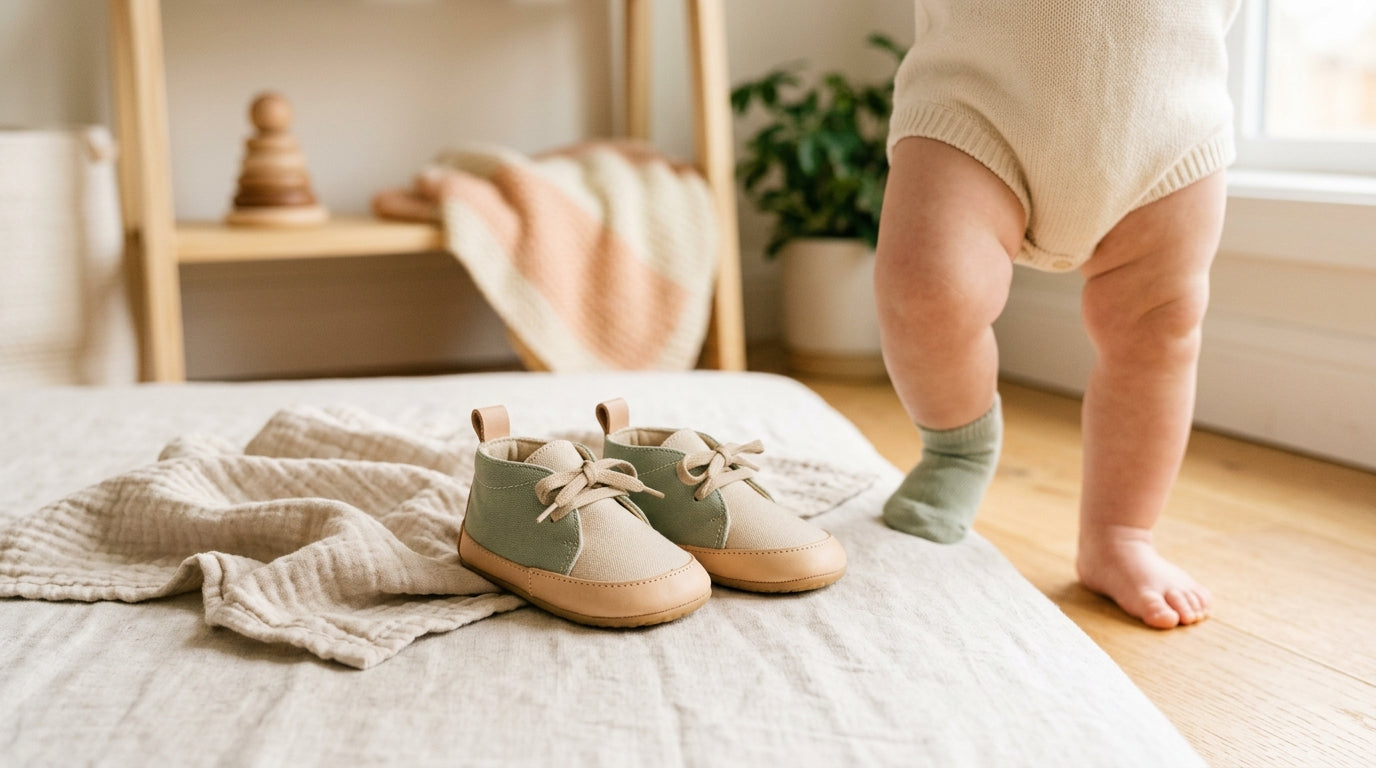
I was standing in the middle of the Target shoe aisle with my oldest—who's now four and still an absolute terror, bless his heart—when I realized I had three completely different voices echoing in my head about what to put on his feet. My mom had called me that morning to remind me that he needed "stiff, hard-bottom boots for proper ankle support," because apparently if you don't brace a toddler's leg like they've suffered a ski injury, their ankles will just roll over and snap. Then there was the random lady at H-E-B who chased me down by the avocados to tell me I needed to buy those shoes that squeak with every step so I'd "always know where he's." And finally, my sister-in-law, who lives on a commune somewhere in Oregon, texted me a manifesto about how footwear is a foot prison and he should only ever walk barefoot on damp moss.
I was so tired, y'all. I was just trying to figure out what to put on my kid's feet so the daycare wouldn't send him home, and I ended up going down a late-night internet rabbit hole. I was searching through forums where half the posts were tagged with these weird, sleepy aesthetic hashtags like #babi and #babie, and I'm just sitting there in my laundry pile thinking, we can't even spell babies right anymore because we're all so collectively exhausted.
So, I gave up on the internet and just asked Dr. Sarah, my doctor, at his 12-month well-check. And I'm going to share exactly what she told me, filtered through my own messy experience with three kids, because navigating this stuff is expensive and annoying, and I refuse to let y'all buy shoes that are going to ruin your kid's feet or your budget.
The barefoot reality nobody talks about
I'm just gonna be real with you: my sister-in-law and her damp moss were actually closer to the truth than my mom was. According to Dr. Sarah, the absolute best thing for a new walker's foot is nothing at all.
From what she explained to me, when babies are born, their feet are basically just squishy little blobs of cartilage and fat. They don't even have real hardened bones in there yet, which honestly creeps me out a little if I think about it too much. When they walk barefoot, they're constantly receiving little sensory signals from the floor that tell their brain how to balance, and they use their toes to grip the carpet or the hardwood. Putting a rigid shoe on a baby who's just learning to pull up is like putting thick winter gloves on someone who's trying to learn how to play the piano. It just doesn't work.
With my middle kid, she started her whole standing journey by hauling her entire body weight up on the side of her Rainbow Play Gym Set. It's this gorgeous wooden A-frame gym that I originally got because I hated looking at the giant plastic, flashing light-up monstrosity I had for my oldest. Anyway, she would stand there barefoot, gripping the floor with her toes like a little monkey, batting at the hanging elephant toy. If I had put her in stiff shoes right then, she would have just toppled backward like a felled tree.
So, inside the house? Keep them barefoot. Save your money.
When you actually need to buy shoes
Now, as much as I'd love to let my kids run feral and barefoot 24/7, I live in rural Texas. We have sticker burrs the size of golf balls in our yard, fire ants that wait in ambush, and pavement that gets hot enough to fry an egg by 10 AM in July. Plus, daycare regulations exist, and they frown upon you dropping off a barefoot child.
You really only need to introduce footwear when your kid is walking independently outside, going to daycare, or walking around public spaces where you don't trust the floor (which, for me, is literally any public restroom or restaurant). But when you do finally have to buy them, you've to know what to look for, because the market is flooded with garbage.
Here are the features that actually matter when you're shopping for a new walker:
- The totally flat sole: There should be zero heel elevation. The heel and the toe need to be on the exact same level. Sometimes a tiny little upward curve at the very tip of the toes is okay, because it keeps them from tripping over their own feet quite as much, but otherwise, flat as a pancake.
- A toe box shaped like a piece of pizza: Babies' feet are naturally wider at the toes and narrower at the heel. If the shoe is pointy or shaped like an adult dress shoe, it's going to squish their toes together and mess up their balance.
- Velcro or elastic closures only: Don't buy shoes with real laces unless you genuinely enjoy wrestling a sweaty, screaming alligator while trying to tie a double knot. Just don't do it.
The taco test (and why I'm mildly obsessed with it)
Let's talk about the sole flexibility, because this is the hill I'll die on. The next time you're at the store holding a tiny, adorable pair of miniature high-top sneakers, I want you to try to fold them in half. Bring the heel and the toe together. If you can't easily bend that shoe in half like a cheap gas station taco with just one hand, put it back on the shelf.

I learned this the hard way with my oldest. I bought him these expensive, heavy leather boots because they looked so cute with his little flannel shirts. I put them on him, and he instantly forgot how to bend his knees. He walked like Frankenstein's monster for about ten minutes, tripped over a rug, busted his lip, and then refused to walk again for a week. The sole was basically made of concrete. New walkers drag their feet, they crawl halfway across the room before standing up again, and they squat constantly. They need a shoe that folds and twists with them.
This taco test is my ultimate filter. If it doesn't bend, it doesn't go on my kid's foot. Period. I don't care if it's on clearance for three dollars.
And listen, I know those little rubber clogs with the holes in them are super popular right now, but please don't put a new walker in them unless you actively enjoy watching your toddler face-plant onto the driveway every three feet.
What seriously goes on my kids' feet
It took a lot of trial and error, but I finally found a rotation of things that work for us without requiring a second mortgage. When I need actual shoes for outside or daycare, I usually grab the Baby Sneakers Non-Slip Soft Sole First Shoes from Kianao. I'm normally highly suspicious of baby sneakers because they usually fail my taco test miserably, but these are completely different.
The sole is incredibly soft and pliable—you can fold them right in half. They have that wider toe shape so my kids' chunky little cheese-block feet genuinely fit inside without being squished. The absolute best part, though, is that they look like they've classic laces, but they're seriously elastic. You just stretch the tongue open, shove the foot in, and you're done. No tying required. I'll say they run a tiny bit roomy, which was great for my kids because they all inherited my wide feet, but if your kid has super narrow feet, you might have to pull the elastic a little tighter. We get the brown ones because they hide the Texas dirt best.
Soft interjection: If you're currently in the trenches trying to find clothes and gear that won't irritate your kid, take a breath and check out Kianao's collection of soft-sole shoes. It's curated to honestly support their development, not hinder it.
Dressing for the crawling-to-walking transition
One thing people don't warn you about when your kid starts pulling up and taking steps is how hard it's on their clothes. They're constantly up and down, dragging their knees on the floor, scooching, falling, and getting back up. If you put them in stiff jeans or rigid overalls, they're going to be miserable.

During this phase, I pretty much just live by the Organic Cotton Baby Bodysuit. The fabric has about 5% elastane in it, which doesn't sound like much, but it means the whole thing stretches perfectly when they squat down to pick up a cheerio off the floor, and it doesn't get that awful, stretched-out bacon-neck look after two washes. Plus, the organic cotton is so much better for their skin when they're sweating through their afternoon playground session. I pair these with some stretchy leggings and the soft-sole sneakers, and that's basically the uniform for a year.
The flat feet panic and sizing reality
If you look at your toddler's foot and panic because it looks like a flat little pancake with toes, don't rush to a pediatric orthopedic specialist just yet. I remember staring at my daughter's feet thinking her arches had collapsed. Dr. Sarah laughed and told me they just have these big fat pads exactly where their arches are supposed to be. Real arches apparently don't even show up until they're like two or three years old. So, skip the shoes that advertise "arch support." They don't need it, and it probably just hurts them.
As for sizing, brace your wallet. From what I've loosely gathered from buying shoes constantly, a toddler's foot grows about a half size every two or three months. You have to check their toes constantly. The rule of thumb I use is trying to press my own thumb down between their big toe and the end of the shoe. If there isn't about a thumb's width of space, the shoes are too small, and they'll end up with curled toes and blisters.
Parenting is just an endless string of outgrowing things. You buy the shoes, they wear them three times, and suddenly their toes are jammed at the top. It's frustrating, but keeping their feet healthy is way more important than getting your money's worth out of a pair of shoes.
If you're ready to stop stressing and just grab the essentials that seriously work for this messy, beautiful stage of early walking, shop Kianao's complete baby collection here.
My messy, real-life FAQ on toddler feet
Should my kid be wearing shoes inside the house to help them learn to walk?
Heavens no. Unless you live in a house with a floor made of broken glass or ice, keep them barefoot inside. Bare feet help them grip the floor and figure out their balance way faster than any shoe will. Grip socks are fine if your floors are super slippery hardwood, but otherwise, let those toes be free.
What if my mother-in-law buys them stiff, expensive dress shoes for a holiday?
Put them on for exactly five minutes to take the family photo, say "thank you so much, they're beautiful," and then immediately take them off the second she turns her back so your kid can seriously crawl around the living room without screaming. I've done this more times than I can count.
How do I genuinely know the shoe is too small if they can't talk yet?
If you've to shove their foot into the shoe like Cinderella's stepsister, it's too small. You should also check their feet when you take the shoes off—if you see red, angry indentations or blisters on their heels or pinky toes, chuck those shoes in the donation bin immediately.
Are high-top, hard-bottom boots better for ankle support?
This is a total myth that our parents' generation loved. Babies don't need their ankles immobilized. They need to move their ankles to build the muscles that naturally support them. Stiff boots just act like a cast and prevent those important muscles from getting stronger.
Is it okay to buy these shoes secondhand to save money?
I'm the queen of budget shopping, but this is one area where I hesitate. If a shoe has been worn a lot by another kid, it has molded to that specific kid's foot shape and their walking pattern. For their primary, everyday outside shoes, I usually just bite the bullet and buy new ones so my kid's foot can shape the shoe naturally.




Share:
Dear Past Me: The 2 AM Google Spiral About Vitamin K Babies
How One Cheap Walmart Baby Gate Almost Ruined My Entire Weekend