

At 3:14 AM on a rainy Tuesday, I was standing over a pot of violently boiling water with a pair of silicone salad tongs, trying to fish out a breast pump flange without melting my fingerprints off. My wife was in the other room, exhausted, logging our baby’s feeding data into an app while I played a high-stakes game of operation with hot plastic. Apparently, the biggest lie they tell you before you leave the hospital is that you don't need any special gear to sanitize infant feeding equipment because the old-school boiling method works just fine.
The internet forums, mostly populated by people who clearly don't have morning standup meetings to lead, swore by the stove method. They claimed it was more natural, more minimalist, and saved counter space in your kitchen. But after exactly four days of trying to debug our nighttime routine, I realized that boiling baby gear is a fundamentally broken system. It takes twenty minutes to heat the water, you've to stand there watching it so the bottle nipples don't stick to the bottom and melt, and then you're left with a pile of scalding, dripping wet plastic.
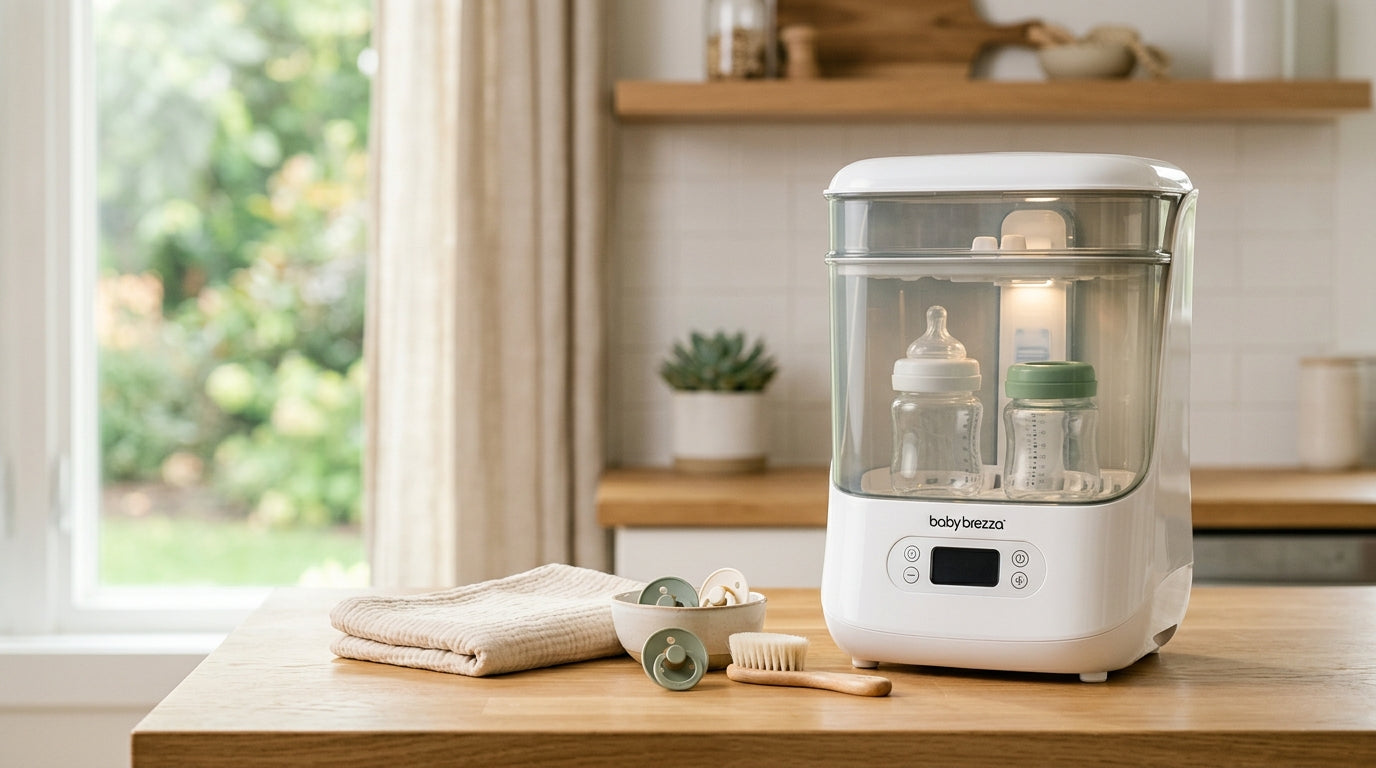
That was the exact morning I surrendered and bought a dedicated countertop machine. We ended up with the Baby Brezza model, which looks a bit like a miniature server tower sitting next to our coffee maker. I’ve spent the last eleven months running this machine multiple times a day, trying to figure out if it's actually keeping my kid safe or just acting as a very expensive drying rack.
Dr. Lin's firewall explanation
I didn't originally understand why we needed to sterilize anything at all. In my mind, soap and hot water have been the gold standard for human hygiene since the dawn of indoor plumbing. But at our two-week checkup, our pediatrician, Dr. Lin, looked at my sleep-deprived face and patiently explained that we couldn't treat milk bottles like coffee mugs.
She told us that since babies under three months haven't completely downloaded their immune system updates yet, their internal firewalls are incredibly weak. Apparently, breastmilk and formula leave behind this invisible microfilm of fat and protein. If you just wash it normally and let it sit in a warm kitchen, that microscopic residue turns into a luxury resort for bacteria. She mentioned that these bugs can cause thrush or massive stomach crashes, which sounded terrifying enough that I didn't ask her for the specific scientific names of the pathogens. From what my frantic parking-lot googling told me, the steam cycle in a sterilizer blasts the equipment at a high enough temperature to wipe out the invisible stuff that normal dish soap leaves behind.
Microwave steam bags also exist for this exact purpose, but melting your knuckles on superheated plastic pouches every evening is a terrible user experience that gets old incredibly fast.
The true enemy is the drying phase
Here's something nobody warns you about when you become a parent: you'll spend an absurd percentage of your waking life thinking about moisture. This is why I've to rant about the concept of air-drying baby bottles, because it's an absolute logistical nightmare.

Let's say you successfully boil a bottle, or wash it in screaming hot water. You take it out with your tongs. Now it's completely sterile, but it's also completely wet. Water is clinging to the inside of the bottle because of surface tension. So you put it upside down on one of those cute plastic grass patches on your counter. Eight hours later, you pick it up, and the inside is still covered in condensation. Because the bottle is essentially a sealed dome with one tiny exit, there's zero airflow. The physics just don't allow it to dry.
So what do you do? You get desperate. You grab a paper towel and jam it inside to wipe it dry, immediately introducing whatever lint and kitchen dust was floating around your Portland apartment straight into the sterile environment you just worked so hard to create. Or you use a dish towel, which has probably been used to wipe down the counter, basically undoing the entire sterilization process. It's an endless, maddening loop of cross-contamination.
This is where the machine actually earned its place in my house. After it blasts everything with steam, a fan kicks on. Apparently, the Baby Brezza unit has a replaceable HEPA filter—which I think stands for high-efficiency particulate air, though honestly, it could be magic—that blows clean, dry air through the bottles for forty-five minutes. You press one button, walk away, and when you come back, the bottles are bone dry and ready to be filled. That drying cycle alone is worth whatever they charge for the machine.
If you're currently in the phase where your kitchen counters are covered in damp bottle parts and you need some actual organization, you might want to look at a wooden play gym or other ways to keep your baby distracted while you desperately try to hand-dry everything.
Feeding hardware and teething accessories
Now that my son is eleven months old, his risk of a major system crash from a milk-borne bacteria is significantly lower. He routinely licks the sliding glass door and occasionally tries to sample soil from our houseplants. But we still use the appliance every single day, mostly because we've repurposed it for his solid food hardware and teething gear.
We're deep into the baby-led weaning phase, which mostly consists of him painting his highchair with mashed sweet potatoes. We use this Silicone Baby Spoon and Fork Set, which I genuinely love. The material is soft enough that he doesn't injure his own gums when he aggressively misses his mouth, and they've this ergonomic shape that his chubby little hands can actually grip. Best of all, they don't melt. After a meal, I wash the mashed peas off them and toss them straight into the steam basket.
The teething toys are a slightly different story. I bought this Baby Teething Toy Cactus Silicone a few months ago because I thought the design was funny. Honestly? It's just okay. The silicone is totally safe and durable, but the pot-shaped base is a little clunky for him to hold for long stretches, so he usually chews on it for three minutes and then abandons it under the sofa where it immediately collects dog hair.
But the Llama Teether Silicone Soothing Gum Soother with Heart Design is his absolute favorite piece of hardware right now. It has this little heart cutout in the middle that acts like a built-in handle, so his tiny fingers hook into it like a carabiner. We have two of them in rotation. Whenever he manages to launch one out of the stroller and onto the sidewalk, I just bring it home, wash the street dirt off with soap, and throw it into the sterilizer. Knowing the machine is blasting away whatever Portland sidewalk germs hitched a ride on his llama gives me a weird sense of peace.
Hardware maintenance and the distilled water debate
Of course, no piece of tech is without its bugs. If you buy one of these, you've to understand that the heating plate at the bottom is essentially a magnet for mineral buildup.

When we first got it, I was just dumping regular tap water into the reservoir because I didn't read the manual. Within two weeks, the stainless steel plate looked like the inside of a cave, covered in this crusty brown and white calcification. I panicked, thinking I had ruined the heating element. I learned the hard way that if you use hard tap water and ignore the buildup, you'll eventually end up scrubbing calcified minerals with an old toothbrush while your baby screams for milk in the background. Your best bet is to just buy gallons of distilled water and run a mix of white vinegar and water through the machine every few weeks to dissolve the scale.
When do we genuinely power this thing down
According to Dr. Lin, healthy, full-term babies over three or four months old don't strictly need daily sterilization for their bottles, assuming you've a dishwasher with a heavy-duty heated dry cycle.
So logically, at eleven months, we should probably box the machine up and put it in the garage. But I can't bring myself to do it. It has become such an ingrained part of our nightly shutdown routine. Wash the bottles, load the basket, pour the water, press the button, and go to sleep. It is a contained storage unit for all his pacifiers and spoons, keeping them away from our counter-surfing golden retriever. Until he's drinking whole milk out of a regular cup, I think the tower stays.
Ready to upgrade your feeding and teething hardware? Browse our complete collection of sustainable baby essentials to find safe, silicone tools that can withstand whatever your baby (or your appliances) throw at them.
My slightly chaotic FAQ about this machine
Do I still have to wash the bottles first?
Yeah, and this was a huge disappointment to me initially. A sterilizer is not a dishwasher. If you put a bottle with milk residue into the machine, it'll essentially bake the milk onto the plastic and smell awful. You have to scrub everything with hot soapy water first. The machine just handles the invisible germs and the drying.
Can I just use tap water if I've a good filter?
I tried using filtered water from our fridge, and it still scaled up the heating plate within a week. Unless you've a heavy-duty reverse osmosis system in your house, just go buy the ninety-cent gallons of distilled water from the grocery store. It saves you from having to do the vinegar soak all the time.
Is it going to take up my entire kitchen counter?
It's tall rather than wide. It has the footprint of maybe a large toaster, but it goes straight up. You need to make sure you've enough clearance under your upper cabinets to seriously lift the lid off, or you'll find yourself sliding it out across the counter every time you need to load a bottle.
Does the drying fan make a lot of noise?
It sounds exactly like a laptop fan spinning up when you've too many browser tabs open. It's a low, white-noise hum. It doesn't bother us at all, but if your kitchen is directly next to your baby's crib and your walls are paper thin, you might notice it running for that 45-minute cycle.
How do I know when it's time to descale it?
The machine genuinely has a little warning light that pops on, but honestly, you'll see it. The shiny metal circle at the bottom turns into a crusty, chalky mess. Just pour some plain white vinegar in there, let it sit for a while, and it wipes right off. Don't scrape it with a knife, I tried that and immediately regretted scratching the metal.




Share:
Baby Brent Newborn Myths: The Truth About Surviving the First Year
The Baby Brezza Formula Reality Check for Sleep-Deprived Dads