

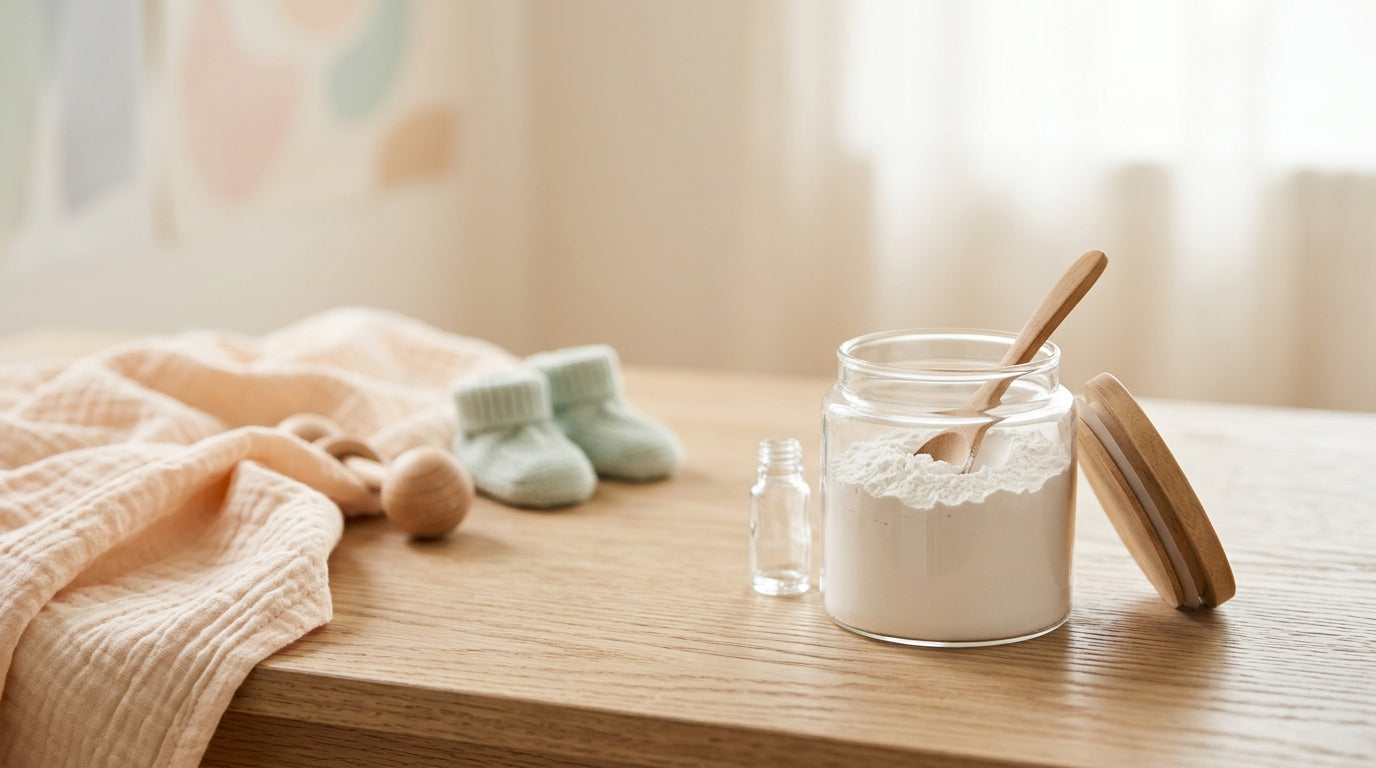
I'm currently staring at a pristine, vintage-looking white bottle that my mother-in-law managed to smuggle into our London flat like highly illegal contraband. She placed it next to the nappies with a conspiratorial wink, whispering that the twins "needed to smell proper." That proper smell, deeply ingrained in the collective psyche of anyone born before 1995, is the unmistakable, barbershop-esque scent of classic johnson baby powder. It's the scent of nostalgia, of clean nurseries, and, as it turns out, of a massive, multi-decade medical controversy that I was completely oblivious to until I actually had to keep two human beings alive.
For some inexplicable reason, society long ago decided that the pinnacle of infant hygiene involved dusting a tiny, squirming newborn until they resembled a heavily floured baking surface. The grand myth of modern parenting is that babies are naturally damp, porous creatures who require constant desiccation. I bought into this completely during our first week home from the hospital, enthusiastically shaking white clouds over the twins' changing mat while sleep-deprived and terrified. It wasn't until I found myself violently sneezing into a muslin cloth, watching a fine white mist settle permanently over our dark hardwood skirting boards, that I started to question the physics of what we were actually doing.
Breathing in a miniature indoor sandstorm
Here's a universal truth about any kind of loose powder: it absolutely refuses to stay where you put it. You aim for a very specific, slightly chafed thigh roll, and somehow the powder instantly colonises the curtains, your trousers, the cat, and the air you're actively breathing.
From my rather fragmented understanding of the medical advice our lovely (and deeply tired) NHS health visitor shared, creating an airborne dust event right next to a baby's face is a remarkably poor strategy. She explained that infant lungs are incredibly fragile, and inhaling fine particulate matter can cause them serious respiratory grief. She didn't use the word 'grief', obviously, she probably used a terrifying Latin term, but the underlying message I took away was that breathing in cosmetic dust is a brilliant way to end up in the A&E waiting room at three in the morning.
I found it utterly baffling that for seventy years, well-meaning parents have been essentially crop-dusting their offspring. You wouldn't empty a vacuum bag over a crib, yet somehow, because it comes in a charming plastic bottle and smells like fresh laundry, we collectively agreed to just coat the air in particulate matter.
Mining for trouble in the geological lottery
If you've watched the news at any point in the last five years, you've probably seen the massive legal headache surrounding traditional johnson and johnson baby powder. Apparently, talc is a naturally occurring mineral mined from the earth, and Mother Nature, in her infinite dark comedy, often decided to put talc deposits right next to asbestos deposits. It sounds like an incredibly poor zoning decision by the universe, resulting in cross-contamination that has fueled thousands of lawsuits.

Now, the brand completely withdrew talc from the shelves, replacing it with cornstarch, which honestly just makes me feel less like I'm exposing my daughters to industrial mining byproducts and more like I'm prepping them to be deep-fried in a lovely tempura batter.
Cornstarch is perfectly fine if you're thickening a gravy, but as a skincare solution, it just seems to mix with nappy moisture to create a bizarre, paste-like mortar that requires industrial scrubbing to remove.
Ditching the dust for breathable fabrics
When we finally accepted that you can't powder a baby into submission, we realised the actual trick to preventing red, angry skin wasn't applying a topical chalk, but rather just letting the poor kids breathe. If you trap a baby in a synthetic, polyester blend and then seal them in a heavily padded nappy, they're going to sweat, and no amount of sprinkled starch is going to save you.
This is where I get incredibly passionate about what we actually put on their bodies. Out of everything we own for the girls, my absolute favourite item is the Kianao Sleeveless Organic Cotton Baby Bodysuit. I realise it sounds absurd to have strong emotional ties to an infant garment, but when you're dealing with twin eczema flare-ups, you cling to whatever works.
These bodysuits really allow air to circulate. They're made with organic cotton that's so ridiculously soft it makes my own adult clothing feel like burlap sacking. When Margo had a terrible patch of angry skin around her neck (exacerbated, ironically, by a previous dusting of powder that had turned into an irritating plaster), we binned the powder and just kept her in these sleeveless suits. The natural fibres did what the powder couldn't: they let the moisture escape naturally. Plus, they've this incredibly forgiving stretchy neck hole that somehow accommodates my daughters' 90th-percentile noggins without forcing me to pop their ears off during the dressing process.
If you're currently staring at a mountain of synthetic, heat-trapping baby garments and wondering why your child is constantly fussy and speckled with red dots, I highly think having a poke around Kianao's organic clothing collection before you resort to aggressively flouring them.
When powder meets excessive drool
There's a specific ring of parental purgatory that occurs when teething begins. The sheer volume of saliva a six-month-old can produce defies all known laws of hydration. They become tiny, leaking faucets. If you happen to have baby powder anywhere near a teething baby's neck rolls, the resulting mixture of drool and dust creates a kind of papier-mâché that sets like concrete.

To keep the drool somewhat contained, we had to find things for them to chew on that weren't their own heavily-saliva-soaked fists. We picked up the Panda Teether, and it's perfectly fine. It doesn't sing, it doesn't flash blinding lights, it's just a solid, food-grade silicone panda that they can gnaw on relentlessly. It's durable enough that they haven't destroyed it, and I can just chuck it in the dishwasher when it gets too grim. It keeps their mouths busy, which theoretically reduces the drool spillage onto their clothes, though honestly, at this age, everything is just a mitigation strategy rather than a cure.
The barrier cream revolution
So if we aren't using a cloud of white dust to protect their bottoms, what on earth do we use? Our paediatrician, looking at me with the deep pity reserved for first-time fathers of twins, suggested I abandon the powder aisle entirely and buy the thickest zinc oxide barrier cream I could legally acquire.
A good barrier cream doesn't try to absorb moisture after the fact; it actively repels it from the skin in the first place. Applying it, however, is akin to trying to butter a very angry, thrashing salmon. You need them to lie perfectly still so you don't accidentally smear white zinc paste all over the nursery walls.
Our saving grace for this daily wrestling match has been the Rainbow Play Gym. I slide it over the changing mat, and for exactly forty-five seconds, the wooden elephant and the colourful geometric shapes completely short-circuit their desire to roll over and crawl away. It's aesthetically pleasing, doesn't require batteries, and buys me the exact window of time I need to apply a proper, safe layer of barrier cream without resorting to a baby powder dust storm.
Ultimately, the era of the powdered infant is thankfully drawing to a close. We know too much now. We know about the lungs, we know about the mining, and we know that smearing a thick, protective cream on baby skin is just vastly superior to pretending they're about to be popped into a bakery oven.
I still haven't thrown away that contraband bottle my mother-in-law brought over. I keep it on a high shelf, far out of reach, mostly as a historical artefact. Sometimes I'll look at it and remember a simpler time when parents just shook a cloud of highly questionable minerals into the air and hoped for the best. Then I grab a proper barrier cream, wrestle a wriggling twin into an organic cotton bodysuit, and get on with my day.
Ready to upgrade your nursery from the dusty habits of the past? Take a moment to explore Kianao's safe, sustainable baby products that really support healthy skin.
Questions you might desperately Google at 2 AM
Is any baby powder really safe to use?
According to every medical professional who has patiently sighed at my questions, the issue isn't just the ingredients, it's the fact that it's a powder. Whether it's talc, cornstarch, or crushed angel wings, if it's airborne, your baby can breathe it into their tiny lungs. If you absolutely insist on using a cornstarch version because your grandmother is hovering over your shoulder, shake it into your own hands far away from the baby's face, then pat it on.
Did the classic johnson baby powder really cause cancer?
The lawyers have been arguing this for years to the tune of billions of dollars. The core issue was that talc and asbestos like to hang out together in the ground, and separating them perfectly is apparently quite tricky. The company insists their talc was safe, but they also pulled it globally and replaced it with cornstarch. Read into that whatever you like while you aggressively apply a liquid lotion instead.
How do I treat a terrible nappy rash if I can't use powder?
Air, my friend. Glorious, free air. Leave the nappy off for a bit (prepare for collateral damage on your carpets). When you do wrap them back up, use a massively thick layer of cream containing zinc oxide. It acts like a waterproof shield. Powder just absorbs liquid until it becomes a damp clump, whereas a barrier cream stops the liquid from ever touching the skin.
What about powdering their neck folds?
Don't do this. I repeat, don't put powder in a chubby baby neck fold. The sweat and drool will mix with the powder to create a hardened crust that's a nightmare to wash out and will likely cause more redness. Just keep the folds clean with a damp cloth, dry them thoroughly by patting them with a towel, and dress them in breathable organic cotton.




Share:
Raising a Jimbo Boss Baby: Firmware Updates for Heavy Infants
A letter to myself about Johnson and Johnson baby shampoo