

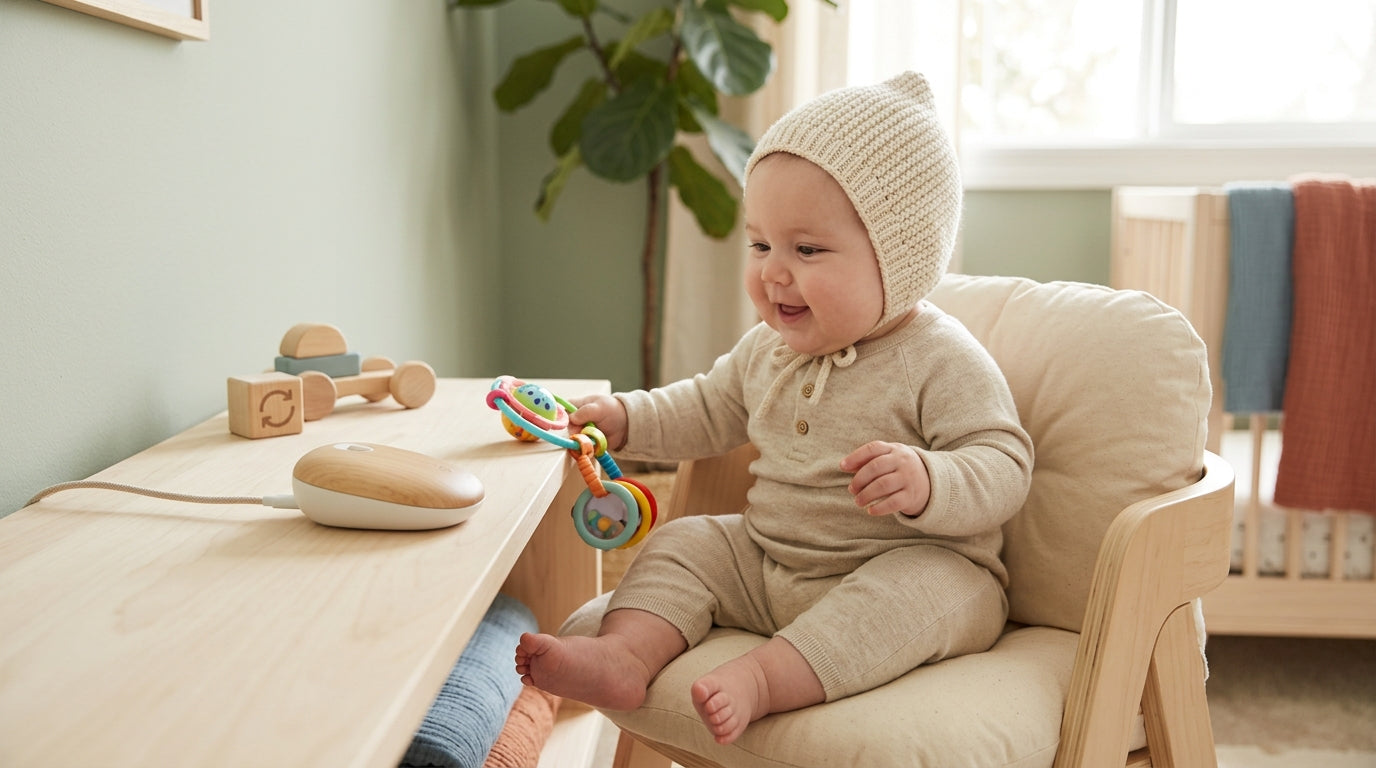
The blue line on the pediatrician’s monitor shot up into the top right quadrant like a server load graph during a DDoS attack. I adjusted my glasses. My wife shifted in her chair. Our 11-month-old son sat on the examination table, casually chewing on his own foot, completely unaware that he had just registered in the 98th percentile for weight. The nurse blinked at the screen. My wife leaned over, squeezed his massive, deeply creased thigh, and whispered that we had somehow birthed Jimbo from that animated movie with the corporate infants. You know the one. The absolute unit of a baby who is the muscle.
I laughed, but my lower back twinged in agreement.
Before this kid deployed into production, I operated under a very specific set of assumptions about fatherhood. I believed babies were delicate, featherweight things. Like carrying a slightly warm loaf of sourdough bread. I believed we would dress him in rigid, aesthetic linen overalls, and he would sit quietly on a beige rug playing with unpainted wooden spheres. I believed I'd never, under any circumstances, allow a screen to illuminate his pristine retinas until he was at least in middle school.
Post-deployment reality is a completely different operating system.
My son is not a loaf of sourdough. He is a dense, volatile object of sheer mass. He is a project manager who can't speak but constantly demands status updates on his snacks. And apparently, when you've an infant who's built like a miniature linebacker, you've to throw out half the user manual and write your own documentation.
The data logs on sheer toddler density
I track everything. I've an app where I log every ounce of milk, every diaper change, and the exact ambient temperature of his nursery (which must remain at 69.4 degrees Fahrenheit or the entire system crashes). But nothing prepared me for the sheer physics of a high-percentile baby.
Dr. Aris, our pediatrician, casually mentioned that babies come in all shapes and that his growth curve is totally healthy as long as it’s consistent. From what I can gather through her rushed explanation and my 3 AM subreddit deep-dives, a massive baby isn't inherently an anomaly. They just require different structural support.
Because thing is nobody tells you about having a big kid: they outgrow their hardware faster than you can order replacements.
We burned through newborn clothes in about fourteen seconds. By month four, he was hulking out of six-month pajamas like a tiny, angry superhero. The problem with standard baby clothes is that they assume babies scale linearly. They don't. My son got wider, thicker, and much more aggressive about his leg room. Rigid fabrics turn into straitjackets on him, which leads to screaming, which leads to me sweating through my shirt while trying to debug a zipper.

The only thing that has every time worked without triggering a meltdown is the Sleeveless Organic Cotton Baby Bodysuit. I don't usually care about apparel, but this thing is my favorite piece of parenting hardware. It has 5% elastane woven into the organic cotton. That sounds like a marketing bullet point, but in practice, it means the fabric actually stretches when my son does his daily power-squats.
A few weeks ago, I was on a Slack huddle with my engineering team when the baby had a catastrophic diaper failure. The kind that requires a full system wipe. Because this bodysuit has those weird envelope-style shoulders, I didn't have to pull the biohazard over his head—I just stretched the whole thing down his massive torso and off his legs in one swift motion while keeping myself unmuted. It was a flawless execution. If everything in my life stretched like that elastane, I’d have half my current gray hairs.
Screen time and corporate cartoon diplomacy
Let's talk about the screens. The original blueprint was zero digital media. Pure analog childhood.
Then came the Tuesday when both my wife and I had overlapping Zoom presentations, the dog threw up on the rug, and our 11-month-old decided that the kitchen cabinets were his mortal enemies. Desperation is the mother of compromised principles.
My wife fired up the iPad and put on the cartoon with the baby in the suit. For twenty minutes, our son sat paralyzed in awe of this animated, bossy infant who kind of looked like him. It was twenty minutes of pure, uninterrupted silence. I fixed a database error, my wife finished her call, and we survived.
I felt incredibly guilty until our next doctor's appointment. Dr. Aris said the official academy of whatever recommends no screens before 18 months, but she also kind of shrugged and suggested that if we're going to fail at that metric, we should at least try co-viewing.
Apparently, if you just sit there and talk to them about what's happening on the screen, it mitigates some of the brain-melting effects. So instead of banishing the iPad entirely and pretending we live in the 1800s, I just sit on the floor with him and pause the video to explain the inherent flaws in corporate middle-management while he drools on my knee.
Offline mode and throwing rubber geometry
To offset the occasional cartoon binge, we try to force offline mode as much as possible. My wife bought the Gentle Baby Building Block Set to encourage his "fine motor skills."

Honestly? They're just okay.
The product description claims they teach logical thinking and mathematical concepts. My reality is that my son just aggressively gnaws on the blue block with the number four on it. He doesn't stack them. He doesn't build towers. He mostly just carries one around in his meaty little fist and occasionally chucks it at my forehead when I'm not looking. They're soft rubber, so they don't leave a bruise when they impact my skull, which is a net positive. They also float in the bathtub, which briefly distracts him from trying to drink the soapy water. But if you're expecting these to turn your heavy toddler into a sudden architectural genius, you might want to lower your expectations to "he will chew on the fruit patterns."
Back pain and the physics of dense toddlers
I need to talk about the car seat.
Nobody warned me about the sheer, undeniable torque required to lift a 98th percentile child into a crossover SUV. You're essentially taking a twenty-something-pound sack of writhing, unpredictable mass, holding it at arm's length away from your core, and trying to thread it through a narrow metal doorway without smashing its head.
It defies all known ergonomic safety protocols. I’ve read OSHA manuals for warehouse workers that only forbid the kind of lifting parents do twelve times a day. If I lifted servers the way I've to lift my son into his high chair, HR would put me on disability. I've had to start doing actual deadlifts in the garage just to maintain the baseline structural integrity of my lower lumbar region.
Baby-proofing our sharp mid-century coffee table took two seconds because I just picked the table up, put it in the garage, and surrendered to the void.
But the car seat? The car seat is a daily battle of physics. He arches his back, doing that stiff-as-a-board plank thing that toddlers do when they realize they've free will, and suddenly I'm wrestling a very small, very dense Olympic gymnast. It’s exhausting. We try to distract him by tossing a bunch of sustainable baby toys into the back seat, hoping something shiny will break his concentration so I can buckle the five-point harness.
Debugging the teething protocol
Take all of that mass, all of that bossy toddler attitude, and introduce teething. It's a system-wide failure.

When our little project manager gets a tooth coming in, his demands become completely irrational. He wants to be held, but also put down. He wants a cracker, but when you hand it to him, he looks at it like you just insulted his ancestors and throws it at the dog.
We went through about six different chew toys before finding one that actually halted the error codes. The Panda Teether Silicone Baby Bamboo Chew Toy is surprisingly works well. My wife loves the aesthetic of it, but I just care about the data: when he has this thing in his mouth, he stops yelling at me.
The silicone is thick enough that his bizarrely strong jaws don't destroy it, and it has this flat shape that he can actually hold onto without dropping it every five seconds. I started putting it in the refrigerator (not the freezer, apparently that damages their gums, which is just another random fact I had to Google at midnight). Handing a cold silicone panda to a furious, heavy baby is like hitting a hard reset switch on his mood. It buys us at least thirty minutes of peace.
Version control for my sanity
Parenthood is mostly just realizing that your initial theories were garbage and rapidly patching your code to fit the new reality.
I used to think a perfect parent never used screens, only bought wooden toys, and had a baby that perfectly rode the 50th percentile line. Now I know that a good parent is just someone who survives the 98th percentile weigh-in, stretches a cotton bodysuit over a blowout without crying, and knows exactly how long to freeze a panda teether to stop a meltdown.
If your baby is also built like a tiny corporate enforcer and you're tired of them hulking out of their outfits, you should probably upgrade your hardware. Grab some gear that seriously stretches and forgives your mistakes.
Dad’s Troubleshooting Guide for Big Babies
Is it bad if my baby is off the growth charts?
From what my pediatrician told me while I was quietly hyperventilating, the specific number doesn't matter as much as the curve. If your baby has always been a 90th+ percentile unit, and they keep growing along that same trajectory, they're just doing their thing. The doctors only seem to care if the data spikes or drops out of nowhere. But yeah, definitely ask your doctor instead of trusting a programmer.
How much screen time is genuinely okay?
The official manuals say zero before 18 months, which is hilarious to anyone who has ever tried to cook dinner with an angry toddler attached to their shin. Our workaround is co-viewing. If we've to put a cartoon on, we try to sit there and actively point at things and talk to him about it. Apparently, making it interactive is slightly better for their brain development than just using the iPad as a digital pacifier.
Why is my 11-month-old suddenly so bossy?
I thought it was just mine, but apparently this is a known feature of the 11-to-12-month firmware update. They suddenly realize they're separate entities from you, and they test the boundaries of the system. My son yells when I don't give him my coffee mug. Validating his anger ("I know you want the hot bean water, but it'll hurt you") instead of just saying "no" seems to cause fewer catastrophic meltdowns.
Are organic clothes worth it for big babies?
Honestly, I only care about the elastane. The fact that our favorite bodysuit is organic cotton is great for his skin (he used to get these weird red patches from cheap polyester), but the real selling point for a huge baby is the stretch. You need fabric that moves with their sheer mass, otherwise you're wrestling them into clothes every morning and nobody has the energy for that.
How do you survive teething with a heavy baby?
You cycle through distractions and lean heavily on chilled silicone. Carrying a 25-pound angry baby while they scream in your ear will break your spirit, so you've to redirect their mouth. Keep two or three good teethers in rotation in the fridge. When they throw one on the floor in a fit of rage, you just deploy the backup.




Share:
Why The Gossip About Jayson Tatum's Family Misses The Real Point
My chaotic journey with johnson and johnson baby powder