

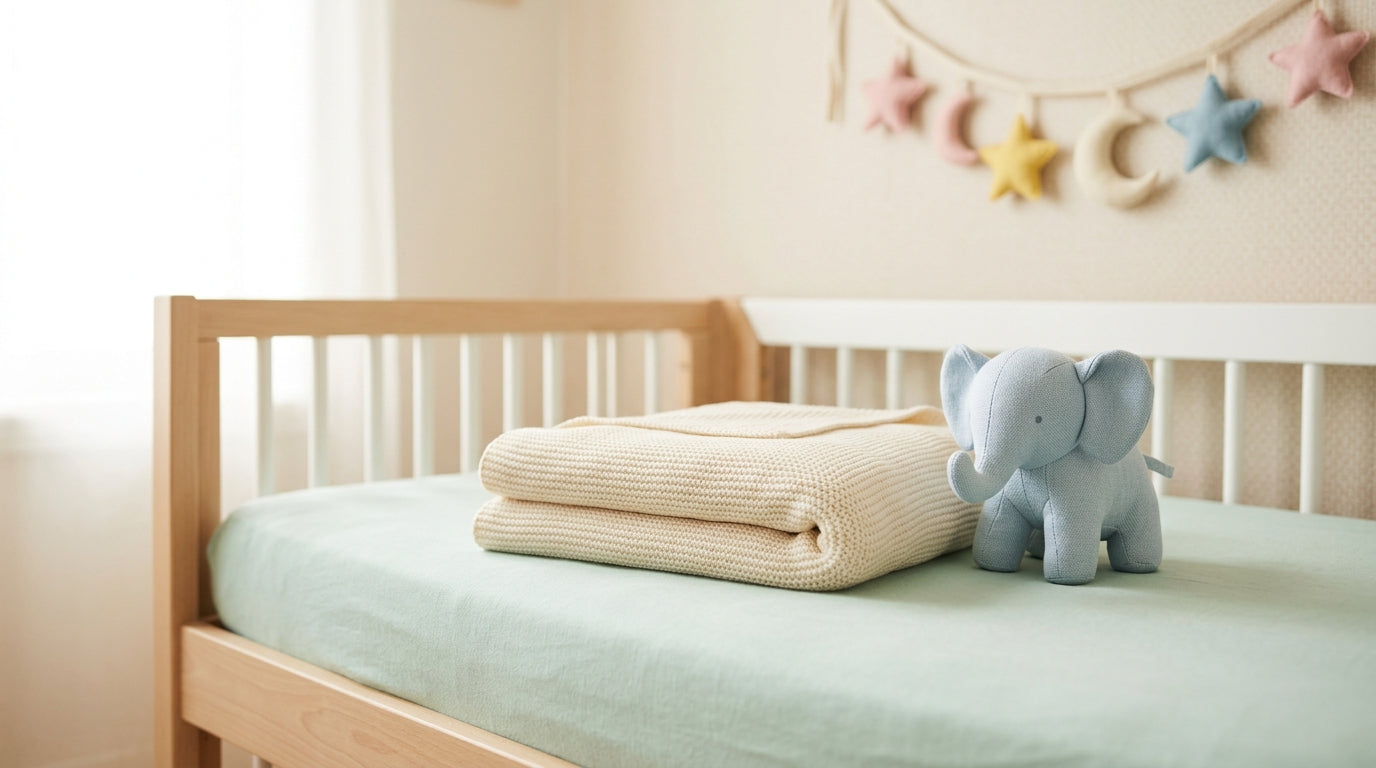
There's a massive disconnect between the baby gear you think you need before the kid arrives and the reality of keeping a tiny human alive. Before our son Leo was born, my mental image of fatherhood involved a lot of peaceful sleeping infants tucked under beautifully monogrammed fabrics. We received exactly six personalized baby blankets at our shower, each embroidered with his name in varying fonts ranging from "corporate signature" to "Disney princess." I folded them neatly into his dresser, assuming we'd just pop one over him at night like a tiny adult.
Then we had our first pediatrician appointment, and I realized I knew absolutely nothing about basic hardware maintenance for a newborn.
Dr. Aris, who has the exhausted but patient demeanor of a senior systems administrator, took one look at my tired face and asked where Leo was sleeping. When I casually mentioned we were figuring out which of our custom baby blankets he preferred for his bassinet, the doctor looked at me like I had just suggested feeding the kid double espressos. Apparently, loose fabrics in a crib are basically a critical error for the first year of life because babies have zero concept of how to pull things off their own faces.
So there we were with a stack of expensive, customized textiles and a baby who, according to doctors and my wife's frantic late-night Googling, was legally required to sleep in an empty, barren box.
The bizarre reality of infant temperature control
I like data, so I bought a digital room thermometer for the nursery. I figured if I just kept the room at exactly 69.4 degrees Fahrenheit, Leo's system would run optimally. But human biology is basically spaghetti code, and babies apparently ship with a completely broken internal thermostat.
I spent an embarrassing amount of time researching the thermal conductivity of different materials after noticing Leo would wake up from his stroller naps completely drenched in sweat. This leads me to my absolute least favorite invention in the history of consumer goods: synthetic fleece.
I don't understand why anyone manufactures a baby blanket out of polyester fleece. It's essentially wearable plastic that traps every ounce of body heat and moisture against a baby's highly reactive skin. We were gifted this one incredibly soft, neon blue fleece thing with his initials on it, and using it was like wrapping the kid in saran wrap. I’m pretty sure it created its own microclimate of humidity and static electricity, because every time I picked him up after using it in the car seat, we'd both get shocked. Plus, I read somewhere on a terrifying parenting forum that synthetic fibers shed microplastics right into the air they breathe, which sent my anxiety into overdrive.
It just feels completely illogical to take a creature that already struggles to control its own baseline temperature and insulate it with petroleum-based fabrics that belong in a camping store, not a nursery. The amount of weird rashes and red spots Leo developed just from being wrapped in that fleece throw for a twenty-minute walk to the coffee shop was enough to make me permanently banish it to the trunk of my car for roadside emergencies.
Silk is apparently nice but I'm not dry-cleaning something that gets vomited on daily.
Repurposing the custom stash
Once you accept that a baby blanket isn't actually for sleeping, you've to figure out what to do with them so the relatives who bought them don't get offended when they visit. It turns out they're mostly utility tools for various forms of domestic troubleshooting.

My wife instituted this weird but supposedly good protocol where she slept with Leo's customized organic cotton swaddle wrapped around her own neck for a week before he was born. The idea was to download her scent profile into the fabric. I thought it sounded like pseudoscience, but when we finally brought him home and laid him on that specific piece of cloth for tummy time, he actually stopped screaming for three consecutive minutes. I don't know if the scent transfer is real or if it was just a coincidence, but I wasn't about to argue with the results.
We basically use them as protective tarps now. When you've an 11-month-old, the floor is lava, but the lava is made of dog hair, mystery crumbs, and whatever he dropped from his high chair. Throwing a customized blanket down creates a sterile quarantine zone for him to roll around on.
This is where our setup gets a little mixed. We have the Basic Play Gym Frame without Hanging Toys from Kianao. My wife bought it because she loves that ultra-minimalist, Scandinavian aesthetic. If I'm being entirely honest, it's just a wooden rack. It's literally an empty A-frame sitting in our living room until you figure out what to tie to it. I've used it to drape a blanket over to make a little shade tent when the afternoon sun hits the rug, which works fine, but the baby mostly just stares at the bare wood wondering where the actual entertainment is.
Eventually we upgraded his distraction level with the Fishs Play Gym Set, which is actually brilliant. It has these natural wooden fish rings that swing around, and it gives him something to aggressively attack while I try to quickly change his diaper on the blanket underneath him. The wood is smooth enough that I don't panic when he inevitably tries to eat the fish, and it buys me about four minutes of peace, which is roughly three minutes and fifty seconds longer than I usually get.
The clothing to blanket ratio
Because of the whole "no blankets in the crib" rule, you've to learn how to dress them in layers that mimic the warmth of a blanket without the suffocation risk. This involves endless zipper calculations.
When we do venture outside in the Portland drizzle, the stroller becomes a complicated nesting doll situation. We strap him in, then tuck one of the baby blankets tightly around his waist and legs, making sure it can't ride up near his face. This is where you realize that the clothes underneath matter way more than the blanket on top.
I'm highly particular about the Baby Pants Organic Cotton Retro Jogger. We use cloth diapers half the time—a decision I still question when I'm running the washing machine at 2 AM—and cloth diapers give babies an incredibly bulky rear end. Most standard pants fit him like compression tights, but these joggers have a drop-crotch that accommodates the massive diaper without cutting off his circulation. The elastic cuffs at the bottom are also surprisingly functional because they stop the pant legs from riding up when I'm trying to tuck a blanket around his squirming legs in the stroller. If you combine those breathable pants with a solid organic cotton blanket over the lap, his temperature stays stable and he doesn't wake up sweating.
The math of fabric ownership
I've tracked our laundry data over the past eleven months, and the throughput is staggering. A single baby can generate more laundry than a moderately busy restaurant.

If you're buying customized items for your kid or someone else's, you need to understand the rule of three. You need one item currently in use, one item actively covered in biological waste in the laundry basket, and one clean backup waiting in the closet. If you only have one special baby blanket with the kid's name on it, and they get emotionally attached to it, you're setting yourself up for a catastrophic system failure when that item inevitably gets covered in mashed sweet potatoes and has to go in the wash for two hours.
You also have to look at the dimensions. A newborn receiving blanket is usually a small square, maybe thirty by thirty inches. That works great when they're the size of a loaf of bread. But Leo is eleven months old now and elongating rapidly. Those tiny newborn squares barely cover his leg at this point. If you're spending money on something customized that you want to keep around, you might as well get a larger toddler size from the beginning so they can genuinely use it in their bed once they pass the one-year mark and the pediatrician finally clears them to sleep with loose bedding.
Accepting the chaos of the nursery
My wife still occasionally corrects me on my folding technique when I put the blankets away, as if there's a right way to store a square piece of fabric that's just going to get thrown on the floor in twenty minutes anyway. I've stopped trying to make the nursery look like an Instagram post and started treating it like a functional basecamp.
We keep the customized organic cotton ones in heavy rotation because they seriously absorb the endless amounts of drool Leo produces now that he's teething, and they wash easily without losing their shape or looking like matted dog fur. The rest of the highly synthetic, overly decorated custom baby blankets we received are currently sitting in a vacuum-sealed bag in the attic, waiting for the day I've the energy to figure out what to do with them.
Parenthood is mostly just guessing, observing the crash, and deploying a patch. I thought I'd be wrapping my kid in his monogrammed blanket every night, but instead, I'm using it to wipe avocado off my own shoulder while he tries to chew on a wooden fish. You just adapt to the hardware you've got.
If you're trying to figure out which textiles won't drive you crazy with complicated washing instructions or weird synthetic smells, look at the Kianao organic clothing and gear to start building a functional system that seriously works for your daily routine.
Dad-Sourced Troubleshooting FAQs
Do custom baby blankets genuinely hold up in the wash?
It completely depends on what it's made of and how annoyed you're while doing laundry. If it's organic cotton or muslin, yeah, I just throw it in on cold with the rest of his endless pile of clothes and it comes out fine. If it has weird puffy paint, satin borders, or it's made of cheap fleece, it's going to pill up and look like garbage after week two. Just stick to natural fibers and pretend the delicate cycle doesn't exist.
When can my baby finally sleep with a blanket in the crib?
According to my pediatrician and literally every medical website I frantically checked at 3 AM, you've to wait until they're at least 12 months old. Before that, it's a massive hazard. We just use sleep sacks, which are basically wearable sleeping bags that they can't kick off or pull over their faces. The custom blankets are only for daytime use when my eyes are actively on him.
What size blanket should I genuinely buy?
Skip the tiny 30x30 inch squares unless you strictly want a swaddle for the first three months. Babies stretch out incredibly fast. If you're dropping money on something personalized, get a larger transitional size like 40x60 inches. You'll just use it folded up over the stroller at first, but it'll honestly fit them when they eventually move to a toddler bed.
Can I use a baby blanket as a nursing cover?
My wife says yes, but only if it's breathable like lightweight muslin or thin cotton. She tried using one of the heavier personalized baby blankets once and said it felt like she and Leo were trapped in a sauna. You want something that blocks the wind but lets the heat escape, otherwise you just end up with a very angry, very sweaty baby.
Is the scent trick really a thing?
I thought it was completely ridiculous until I saw it work. Sleeping with the blanket for a few days to get your smell on it seems to genuinely confuse their little brains into thinking you're still holding them. It doesn't work every time, and it definitely won't stop a full meltdown, but it buys me enough time to go make a cup of coffee without him realizing I've put him down on the playmat.




Share:
Is Cry Baby John Waters For Kids? (Plus Actual Infant Crying)
The Truth About Custom Baby Onesies: A Letter To My Past Self