

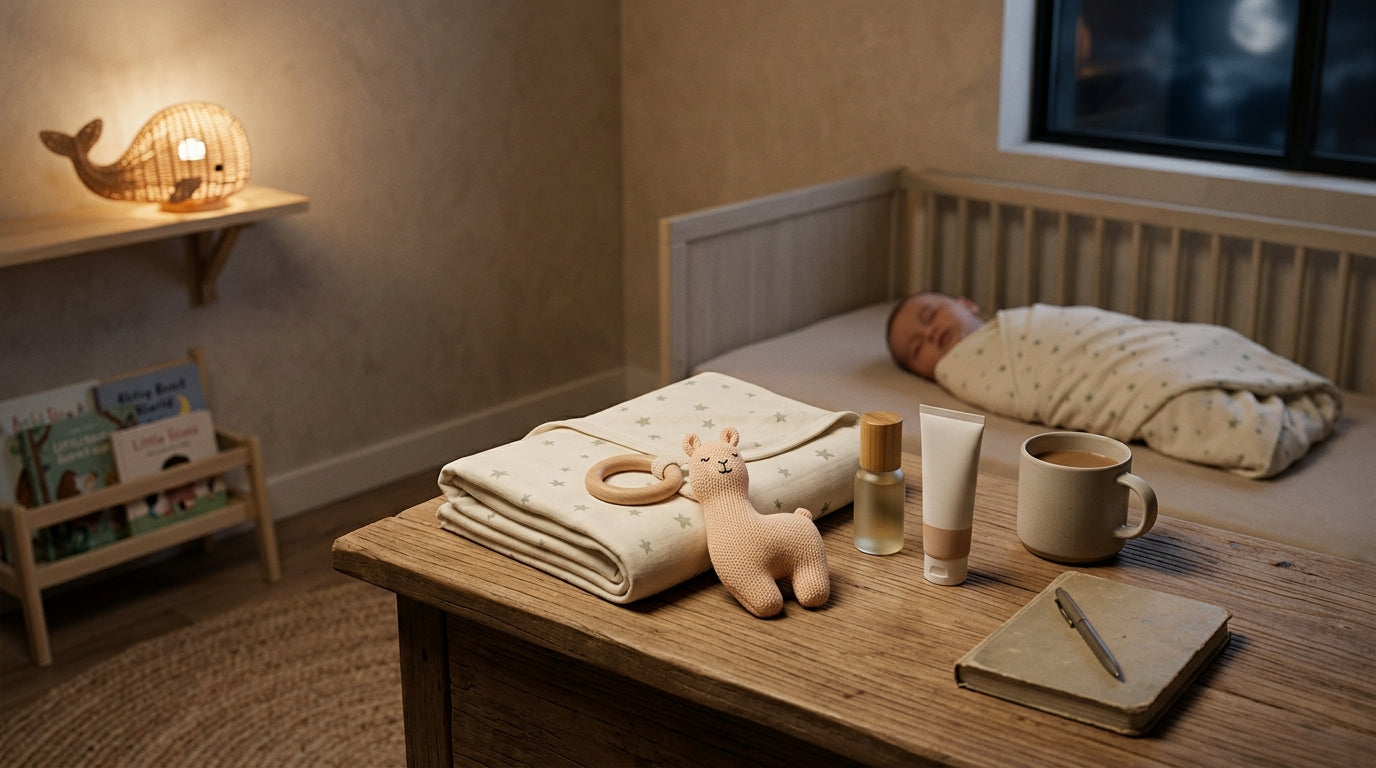
Listen. It was 3:14 AM on a Tuesday in February, and the wind was howling off Lake Michigan loudly enough to rattle the bedroom windows. I was standing in the dark, holding a screaming four-month-old at arm's length because a blowout had somehow breached the diaper, bypassed the onesie, and painted a modern art masterpiece on my left forearm. My pediatric nursing degree was doing absolutely nothing for me. In the hospital, we had monitors, bright lights, and a team of professionals to handle a code brown. In my apartment, it was just me, a pile of wet wipes, and a big sense of regret about my life choices.
I wiped us both down with cold wipes while he screamed like I was actively injuring him. The room was freezing because every sleep expert insists babies need to sleep in a meat locker. I stood there trying to remember the safe sleep guidelines I used to recite to nervous new parents every single day, but my brain was just static.
When you're in the thick of it, the clinical advice feels like a joke. They tell you to just follow the rules, put the kid down, and walk away. But the reality of baby sleeping is a lot closer to psychological warfare.
The thermodynamics of tiny humans
My doctor told me we should keep the nursery between 68 and 72 degrees. To an Indian mother, 68 degrees is basically a survival situation. My instinct is always to wrap him in three quilts and a woolen hat, but apparently, overheating is a massive risk factor for things you don't even want to think about at 3 AM. They tell us that babies control temperature differently, which is a polite way of saying they've no idea what they're doing thermoregulation-wise.
So you end up playing this ridiculous guessing game. You touch the back of their neck to see if they're sweating, you feel their toes to see if they're freezing, and you pray you nailed the layer combination. My mother-in-law keeps asking why he needs a baby sleeping bag instead of the heavy knit blanket she spent three months making. I've tried explaining suffocation risks to her five times, but she just clicks her tongue and tells me I'm being dramatic, yaar.
But the sack is non-negotiable. I spent three hours one night nursing and scrolling on my phone, desperately trying to figure out what the best organic baby sleeping bag was because the polyester one we got at our shower felt like wearing a plastic grocery bag. You want something breathable, mostly because they spend half the night flailing around. We ended up with three different baby sleeping bags in rotation because one is always covered in spit-up, one is in the wash, and one is actually on the kid.
When I finally got him cleaned up that February night, I shoved him into the Baby Romper Organic Cotton Footed Jumpsuit. I used to think I hated buttons on baby clothes because zippers are faster, but when a zipper jams in the dark, you've to rip it open like a bag of chips. The buttons on this romper actually saved me that night. The fabric is thick enough that he doesn't freeze but breathable enough that I don't panic about him overheating under his sleep sack. It survived the blowout, it survived the hot wash cycle, and it's pretty much the only thing he wears to bed now.
Blanket bans and nursery crimes
If you look at modern nursery design on social media, you see cribs full of throw pillows, heavy quilts, and giant stuffed giraffes. It's all a lie. The clear cot rule is the only rule that actually matters. My doctor hammered this into my head even though I already knew it from the wards. No pillows, no loose blankets, no bumpers.

You basically have to leave them on their back in a stark, empty box, which goes completely against every biological instinct you've to build them a cozy little nest. It feels mean. You look at them lying flat on a firm, waterproof mattress, and you think they must be miserable. But every time I felt tempted to tuck a soft blanket around his waist, I remembered the emergency room triage board. You just zip them into their sack, turn on the white noise machine loud enough to vibrate the floorboards, and walk away.
That doesn't mean you can't buy the cute stuff. I bought the Polar Bear Organic Cotton Blanket because the blue matched the ridiculous ocean theme I planned while heavily pregnant and delusional. It's incredibly soft, but it never goes in the crib. We use it exclusively for stroller walks along the lakefront when the wind is cutting through my coat. He sits under it like a tiny emperor while I freeze to death pushing him. It washes well and hides the inevitable milk stains, so it earns its keep outside the nursery.
The mythical drowsy but awake
Listen. If one more internet sleep consultant tells me to put my baby down drowsy but awake, I'm going to lose my mind. They sell this concept like it's a precise mathematical formula. You're supposed to catch your kid in that magical ten-second window where their eyes are heavy but they're not fully asleep, lay them gently on the mattress, and let them peacefully drift off to dreamland.
I've seen a thousand babies in the hospital, and maybe three of them really did this. For the rest of them, drowsy but awake is just a trap. The second their back hits that mattress, their eyes snap open, their arms flail, and they look at you like you just dropped them into a volcano. You try to shush them, you pat their chest, you do the weird parental sway, and thirty seconds later they're screaming. Then you've to pick them up, bounce them on a yoga ball until your knees give out, and wait until they're in such a deep coma that you could drop a textbook next to their head without them noticing.
They say babies spend half their night in REM sleep, which basically means their sleep is shallow and fragile, so any minor disturbance wakes them up. I'm fairly certain my kid's REM cycle is triggered specifically by the sound of my head hitting my own pillow.
Teething just makes it worse, but honestly, you just give them some infant Tylenol, wipe the drool off their chin, and survive the week.
Things we throw in the crib
Once they're old enough to roll over and find things themselves, the rules shift slightly. You still keep it bare, but you start introducing sleep associations. Pacifiers are the classic choice. My doctor suggested throwing four pacifiers in the corner of the crib so he could blindly grab one in the dark instead of screaming for me to find it.

It works about half the time. The other half, he throws them out of the crib onto the floor and then cries because he has no pacifiers.
I thought maybe a teething toy would help him self-soothe. We got the Sleeping Bunny Teething Rattle because it looked organic and safe. It's fine. It's really cute, and the crochet work is nice, but it turns out a wooden ring makes a very loud, sharp sound when a frustrated six-month-old bangs it repeatedly against the wooden slats of a crib at 4 AM. It's no longer allowed in the bed. It lives in my diaper bag now, mostly as a distraction tool when we're waiting in line at the grocery store.
You realize quickly that most sleep gadgets are just parents throwing money at their own exhaustion. We buy blackout curtains, sound machines, humidifiers, and special organic sacks because we're desperate for an extra forty-five minutes of rest. Some of it helps. Most of it just clutters up the room.
If you're currently drowning in the middle-of-the-night chaos, you can check out some of the gear that really survived my rigorous testing process.
Shop our organic sleep and nursery collection for the things that might really help.
The math of newborn sleep
They tell you newborns sleep up to seventeen hours a day. What they don't tell you is that those seventeen hours are chopped up into agonizing forty-minute increments. You spend twenty minutes feeding them, fifteen minutes burping them, ten minutes changing a diaper, and by the time you get them to sleep, you've roughly twelve minutes to close your own eyes before the cycle starts again.
By four to six months, sleep is supposed to consolidate. They might sleep a six-hour stretch, which pediatricians generously classify as sleeping through the night. I remember the first time my son slept six hours straight. I woke up at dawn in a blind panic, convinced he had stopped breathing. I stood over his crib for ten minutes watching his chest rise and fall, entirely ruining the extra sleep I had just gotten.
The double-layer trick is the only piece of internet advice I genuinely endorse. Put down a fitted sheet, then a waterproof mattress protector, then another fitted sheet on top. When the inevitable 2 AM blowout happens, you strip off the top layer and the protector, throw them in the hallway, and the bed is already made underneath. Put them in a fresh baby sleeping bag and pretend the first half of the night never happened.
You can't control their sleep. You can only control the environment. Keep it cold, keep it dark, keep it empty. Buy the good cotton so you don't have to worry about weird rashes. Accept that some nights you're going to end up staring at the wall at 3 AM covered in bodily fluids.
It gets better. Slowly. And then they start crawling and the whole routine falls apart again. Beta, that's just how it goes.
Before you dive back into the internet wormhole of sleep regression theories, get your nursery basics sorted. Grab a few organic rompers that can genuinely survive a hot wash cycle at dawn.
The ugly questions about baby sleep
I know what you're genuinely googling at 2 AM. Here are the messy answers.
{ "@context": "https://schema.org", "@type": "FAQPage", "mainEntity": [ { "@type": "Question", "name": "Is it really that bad if my baby falls asleep in my bed just for a little bit?", "acceptedAnswer": { "@type": "Answer", "text": "Yes, it's. I know you're exhausted and it feels so easy just to nurse them side-lying and drift off together. I've fought that exact urge a hundred times. But adult mattresses are too soft, our pillows are death traps, and we roll over. Room-share all you want, but the kid needs their own flat, empty surface. It sucks, but the alternative is not worth the anxiety." } }, { "@type": "Question", "name": "How many sleep sacks do I really need to own?", "acceptedAnswer": { "@type": "Answer", "text": "Three is the magic number. One is on the baby, one is in the laundry basket covered in spit-up, and one is clean in the drawer for the midnight blowout. If you only own one, you'll find yourself using a hair dryer on damp cotton at 4 AM while your kid screams on the changing table." } }, { "@type": "Question", "name": "My baby rolls onto their stomach in the middle of the night. Do I've to flip them back?", "acceptedAnswer": { "@type": "Answer", "text": "My doctor told me that once they're strong enough to roll themselves over independently, they're strong enough to sleep that way. You always put them down on their back initially. If they do a midnight flip on their own, you leave them alone. Just make sure you've stopped swaddling their arms by this point, or they'll be stuck." } }, { "@type": "Question", "name": "Does the white noise machine really have to be on all night?", "acceptedAnswer": { "@type": "Answer", "text": "Unless you want to tip-toe around your house and whisper for the next three years, yes. Babies spend a ton of time in light sleep. The white noise acts like an acoustic blanket. Just don't put it right next to their ear. Put it across the room so it drowns out the dog barking and the floorboards creaking when you try to sneak out." } }, { "@type": "Question", "name": "Why do people obsess over organic cotton for pajamas?", "acceptedAnswer": { "@type": "Answer", "text": "Because babies sweat a lot, and synthetic fabrics trap heat like a greenhouse. Heat leads to waking up angry, and it also triggers eczema flare-ups. Organic cotton breathes. Plus, they chew on the collars of their own pajamas constantly, and I'd rather my kid suck on plain cotton than whatever chemicals they use to treat polyester." } } ] }




Share:
The 3AM Cot Politician: Surviving the Baby Sleep Regression Ages
Why those stiff miniature adult sneakers are ruining baby feet