

It was 2:14 AM on December 26th, and I was sitting on the floor in a nursing bra that had completely given up the ghost sometime in 2016 and a pair of Dave's boxer briefs, furiously crying over a plastic purse. Maya was exactly six months old. She had just gone back to sleep after a two-hour waking window of sheer, unadulterated screaming, and the living room looked like a Pepto-Bismol factory had violently exploded.
Everywhere I looked, it was pink. Hot pink, pastel pink, glittery pink. Friends and family had descended for her first Christmas, and because she was a baby girl, the gift theme was apparently "screaming plastic garbage."
The worst offender was this electronic purse that yelled "LET'S GO SHOPPING, BABY!" every time a slight breeze hit it. It had motion sensors. It was possessed. Dave was sitting cross-legged next to me, using a butter knife to frantically pry the battery compartment open because we couldn't find a tiny screwdriver, whispering "die, die, die" under his breath while I chugged cold brew straight from the fridge carafe. Because sleep was clearly a joke anyway.
I realized right then that the whole baby girl toys market is basically a massive scam designed to drive parents insane and turn our daughters into hyper-stimulated little consumers before they even have teeth.
Anyway, the point is, you don't have to do it. You don't have to buy the flashing pink aisle.
Look, I'm not saying you need to swing entirely in the other direction and only buy those depressing, oatmeal-colored sad-beige toys that look like they survived the Great Depression.
But there has to be a middle ground, right? Between the blinding technological rave toys and a literal stick. I took Maya to her doctor, Dr. Miller, a few weeks later and honestly asked her if I was ruining my kid's development by confiscating all her electronic toys, because my mother-in-law had made some comment about her falling behind if she wasn't pushing buttons that recited the alphabet. Dr. Miller just kind of laughed and told me that babies don't need iPads or light shows to learn. She explained something about how their brains actually get overloaded by all that flashing crap, and what they really need is physical feedback from the world—like, dropping a heavy thing and hearing it thud, or chewing on a block and realizing it's squishy. I think she called it unstructured play, but my brain was 90% caffeine at that point so I'm probably butchering the science. The gist was: simple is better.
The potato phase when they just stare at things
When Maya was super little, like zero to six months, she was basically a warm, very demanding potato. She didn't need much. But when she started actually looking at things, we had this Wooden Rainbow Play Gym that honestly saved my sanity.
I loved it mostly because it didn't play a robotic lullaby that would get stuck in my head for three days. It just sat there, looking nice in my living room, while she stared at the little hanging elephant. The best part was when Leo—who was three at the time and adjusting terribly to not being the center of the universe—tried to literally hang from the wooden A-frame like a monkey. It didn't snap. It just tipped over, and Leo cried, but the gym survived. It's solid wood. It just felt so much better than laying her under a canopy of harsh neon plastic.
The era of throwing everything on the floor
Right around eight months, Maya entered her gravity-testing phase. This is when the "baby g" marketing really tries to push you toward miniature pink kitchens and tiny makeup sets, which is just... no. She can barely sit up without toppling over, she doesn't need to learn how to contour.

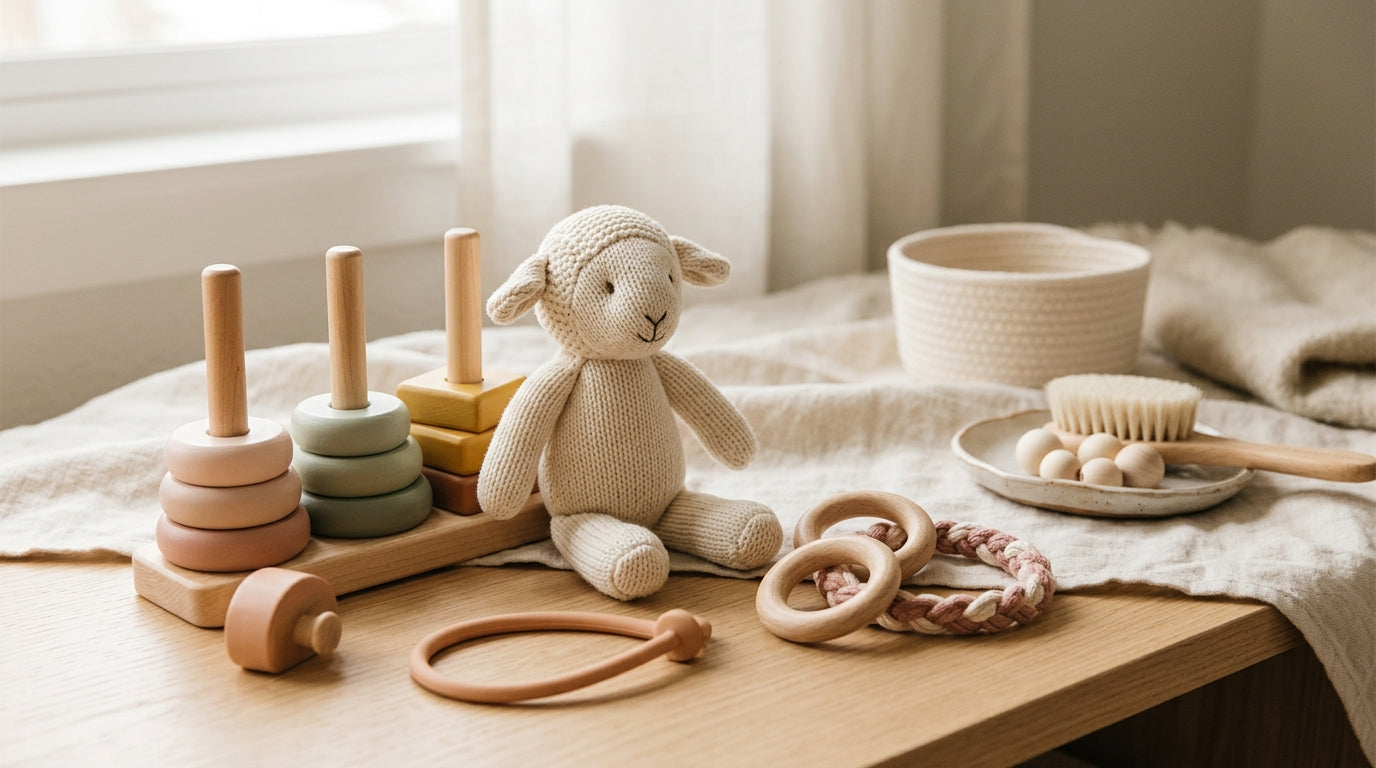
What she actually needed was stuff to grab, chew, and throw at my head. We got the Gentle Baby Building Block Set and it became her absolute obsession. I'm not exaggerating when I say we took these everywhere. They're these soft rubber blocks in really nice macaron colors—not aggressively pink, just pretty—and they've little numbers and animals on them. She would just sit there squishing them, and when she lobbed one at Dave's face while he was watching football, nobody had to go to the ER.
Plus, they squeak a little when you squeeze them, which gave her that cause-and-effect feedback Dr. Miller was talking about. She felt like a total genius every time she made it squeak.
Teething also hit hard right around this time. Oh god, the teething. If you haven't been through it yet, buckle up. I bought so many teethers. Some were great, some were a total waste of money. I got the Panda Teether because it was cute and made of food-grade silicone. Honestly? It was just okay for us. It did the job, she chewed on it for like ten minutes while I drank my coffee, but she mostly just dropped it under the couch and forgot about it. It's fine for the diaper bag, but it wasn't a hero product.
The real lifesaver was the Bear Teething Rattle. It's this natural wooden ring with a soft crochet cotton bear attached to it. The contrast between the hard wood on her swollen gums and the soft yarn for her hands to grab was exactly what she wanted. I used to hand wash it in the sink at midnight while rocking her on my hip. It was just so simple and grounding.
Need to restock your diaper bag with things they'll honestly use? Explore our teething toys collection here before the next tooth hits.
Walking and the terrible realization that they can reach the coffee table
By the time they hit a year, the toy situation usually gets out of control. It just multiplies in the night. If you try to force yourself to clear out half the crap and just hide it in a closet, bringing out only like three or four things at a time, it supposedly helps them seriously play with their toys instead of just dumping them all over the rug and walking away.

I tried doing that rotation thing, and it mostly worked, though half the time I just forgot where I hid the extra toys. But seeing Maya figure out how to stack her soft blocks or figure out how to shake her wooden rattle to get the exact noise she wanted—it was so much cooler than watching her stare blankly at a flashing screen.
We don't need to put our daughters in a pink, plastic box the second they're born. They deserve toys that are made of real materials, that let their brains do the heavy lifting, and that don't make their parents want to commit crimes at two in the morning.
The shopping purse never woke us up again. Dave eventually got the batteries out, and we "accidentally" left it at an Airbnb in Vermont. Oops.
If you're ready to ditch the overstimulating plastic and invest in toys that really support your baby's development without making your living room look like a carnival, explore our wooden play gyms and organic collections. Your sanity will thank you.
Messy questions you're probably asking yourself right now
Do I really need to avoid all pink toys?
No, of course not! Pink is just a color, it's fine. Maya has a pink sweater she refuses to take off. The problem isn't the color itself, it's the hyper-gendered marketing that assumes baby girls only want to play with makeup, purses, and dolls, all wrapped in cheap plastic that falls apart in a week. Mix it up. Give her blocks, trucks, and dolls. Let her chew on a wooden rattle. Just escape the pink aisle trap.
How many toys should be out at once?
If you ask Instagram, like, three wooden blocks on a minimalist shelf. If you ask my actual house on a Tuesday, it's seventy-four things scattered across the rug. But seriously, keeping fewer toys out (like 5 to 8) really does stop them from getting overwhelmed. I just toss the rest in a laundry basket in my closet and swap them out when I notice she's bored. It's not an exact science.
Are wooden toys really better or just prettier for Instagram?
A little bit of both, honestly. They look way better in your house, which matters when you live in the mess 24/7. But they also offer different sensory feedback. Wood has weight, it has texture, it sounds nice when it clacks together. Plastic is just light and hollow. Plus, since babies literally put everything in their mouths, I sleep better knowing I'm not letting her gnaw on sketchy cheap plastics with who-knows-what chemicals in them.
What if people keep gifting us loud plastic crap?
This is the ultimate struggle. Grandparents love buying the biggest, loudest thing in the store. I usually say thank you, let her play with it for a day or two so they see her with it, and then quietly put some clear packing tape over the speaker to muffle the sound. If it's totally unbearable, the batteries magically "die" and we never replace them. Or it gets donated. You're the mom, you control the inventory.
When do babies seriously start playing with things?
For the first few months, you're their favorite toy. Seriously, your face is all they care about. Around 3 or 4 months they'll start batting at things on a play gym, and by 6 months everything is going straight into the mouth. True "play" where they figure out what things do doesn't really ramp up until closer to 9-12 months. So don't stress if your newborn ignores the beautiful expensive toys you bought. They're just figuring out how to exist first.




Share:
Finding The Perfect Baby Goat Name For Toys and Nursery Themes
Surviving the 9-Month Sleep Regression and Absolute Chaos