

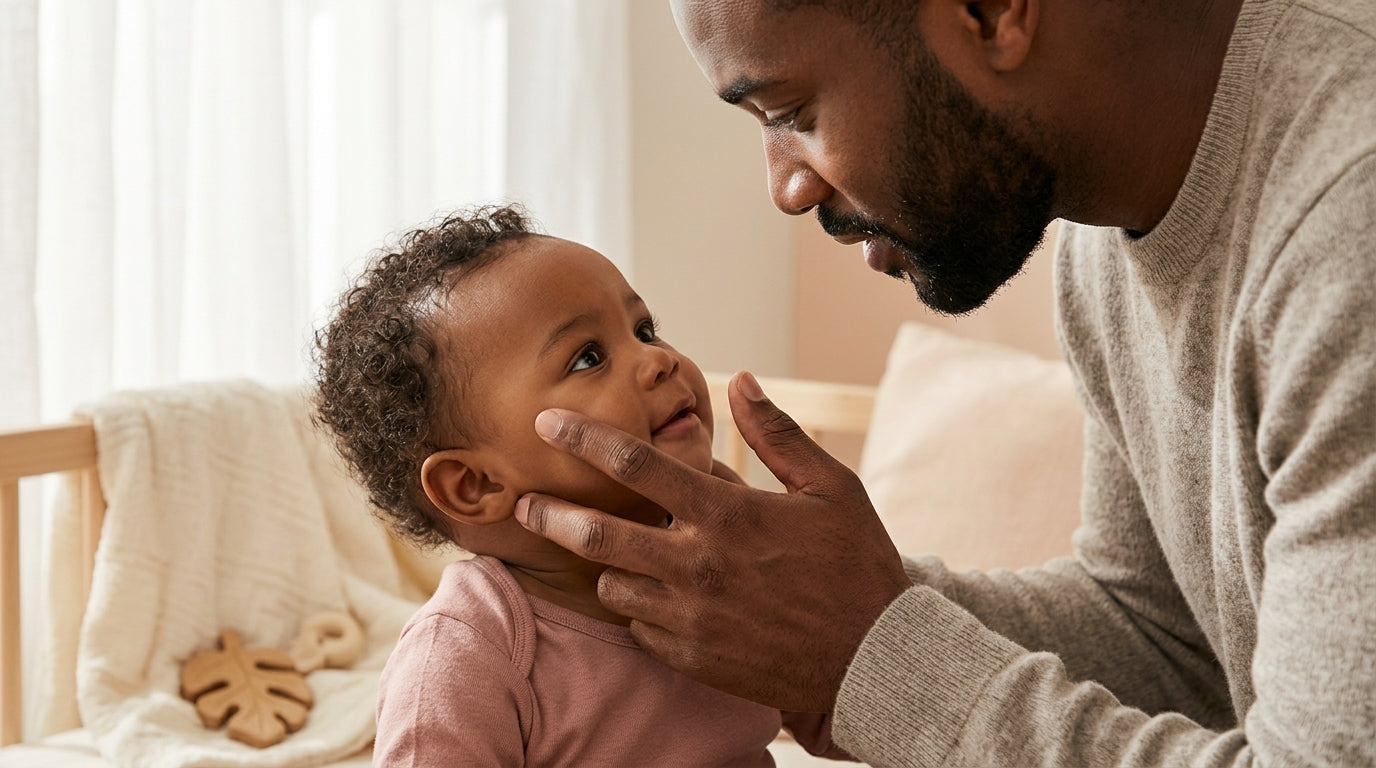
Hey Marcus from six months ago. You're currently standing by the window in our perpetually gray Portland living room, angling a five-month-old infant toward the meager sunlight, trying to determine if her irises are hex code #4B5320 (Army Green) or #4682B4 (Steel Blue). You have a spreadsheet open on your laptop. You're exhausted.
I'm writing to you from the future—specifically, the eleven-month mark. I've good news and bad news. The good news is that she's sleeping slightly better. The bad news is that you spent way too much time obsessing over her eye color, which, apparently, is a completely dynamic system that takes nearly a year to finish rendering.
When you bring a new human home from the hospital, you assume the hardware specs are locked in. Ten fingers, ten toes, a specific hair color, a specific eye color. But it turns out babies are shipped with beta versions of their own features. Their eyes are just one massive, slow-moving firmware update.
The Trader Joe's cashier prophecy
I need to warn you about the grocery store interactions. For some reason, an infant's eye color is public domain commentary. You will go to Trader Joe's to buy coffee because you're dying inside, and the cashier will lean over the car seat, stare into your kid's face, and declare with absolute certainty that "those are going to turn hazel." You will nod politely, but inside you'll wonder what occult knowledge this nineteen-year-old possesses.
Then you'll take the baby to your in-laws' house, and your uncle will hold her under a fluorescent kitchen light, insisting that she has the "Smith family blue" and that they'll never change. He will point out the subtle flecks of gray that prove his theory. He will be entirely wrong, but his confidence will briefly make you question your own eyesight.
It's genuinely wild how much social weight we put on predicting these tiny aesthetic details before the system has even fully booted up. We desperately want to assign them a permanent identity, projecting our own family genetics onto a child who just wants to eat a Cheerio off the floor.
Apparently, the actual color mechanism has something to do with HERC2 and OCA2 genes inherited from both parents in a highly unpredictable lottery, but honestly, I just assume it's basically random number generation at this point.
Melanin is basically a slow loading bar
Because I'm who I'm, I literally typed "babi eye color timeline" into my phone at 4 AM one night because my thumb missed the 'y' and I was too tired to hit backspace. What I learned from scrolling through medical journals while she refused to sleep is that eye color is just a measure of melanin. You know, the same pigment that handles skin and hair.
When they're in the womb, it's completely dark. The melanocytes—which are the cells that produce the pigment—haven't been triggered yet because they need light to start working. So when the baby is born, the lights turn on, and the script finally starts executing. If the cells only output a little bit of melanin, you get blue eyes. A medium amount gets you green or hazel. A massive data dump of melanin gets you brown eyes.
I also read this California study that completely destroyed the myth that every baby is born with blue eyes. Apparently, something like 63 percent of babies are born with brown eyes right out of the gate, and they just stay brown. But for the rest of us, it's a waiting game. If you look at my browser history from last fall, it's just a wall of "when do babies sleep through the night" and "when do babies start producing iris melanin."
The timeline according to my camera roll
If you want the actual timeline of when this change happens, I can only give you my severely sleep-deprived data points. Our pediatrician, Dr. Chen, looked at my insane tracking chart and gently told me to stop driving myself crazy, noting that most of the heavy lifting happens between three and six months.

From birth to three months, her eyes were this muddy, slate-gray color. I used to lay her down under the Wooden Baby Gym | Rainbow Play Gym Set and just stare down at her face while she batted at the little hanging elephant. By the way, I genuinely like that play gym. A lot of baby gear looks like a plastic toy factory exploded in your living room, but the natural wood blends in, and the color palette is muted enough that it didn't mess with my attempts to gauge her exact eye hue under natural light.
Right around six months, I noticed the slate gray was getting warmer. Sarah has this habit of texting me from the other room asking "how is the sweet babie doing?" with an 'ie' for some reason, and I remember texting back a zoomed-in photo of her eyeball saying "I think we've brown incoming."
(Hey, quick pause—if you're currently scrolling through endless forums trying to distract your kid while you stare intensely at their face to decode their genetics, you might want to explore Kianao's organic baby clothes instead. It’s a much better use of your internet time.)
The outfit that proved the color shift
By eight months, the update was mostly complete. The blue-gray was entirely overwritten by a very warm, light brown. Dr. Chen said that by nine to twelve months, whatever color you're looking at is likely the permanent one, though she threw in a caveat that some kids experience minor shifts all the way into their toddler years. So, basically, science has no hard deadlines.
I finally accepted the new brown eyes when Sarah bought this Flutter Sleeve Organic Cotton Baby Bodysuit in an earthy tone. I'll be completely honest here: when I first saw it, I thought the ruffle things on the shoulders were totally illogical for a human who spends 90 percent of her time crawling through dust bunnies. It seemed like unnecessary aerodynamic drag.
But I was wrong. The natural organic cotton actually contrasted perfectly with her new eye color, making the brown look incredibly vivid. More importantly, the fabric somehow survived a catastrophic diaper blowout at a local coffee shop without staining permanently, so I'm now a fully converted believer in this specific bodysuit.
On the flip side, teething hit us right around the same time her eye color settled. We picked up the Handmade Wood & Silicone Teether Ring to help. It's a beautifully made object, the silicone is high quality, and it looks incredibly aesthetic on the coffee table. But I've to be real with you: our kid currently prefers chewing on my Apple Watch charger and the TV remote. She'll humor me and gnaw on the wooden ring for about four minutes before lunging for my electronics. It's a great product, but you can't logic with an infant.
Sun damage and the whole UV thing
There was one actually useful piece of medical info I got from Dr. Chen regarding eye color. Lighter eyes have less melanin. I guess melanin literally is a natural sunblock by absorbing light, so without it, the UV rays just kind of bounce around in there? I'm not an optometrist, and my understanding of ocular biology is basically pieced together from Wikipedia, but it sounds bad.

Dr. Chen told us that if our baby had kept those early blue or green eyes, we'd need to be much more aggressive about UV protection because lighter retinas are highly sensitive to sunlight. Even with her brown eyes, you basically just have to throw a wide-brimmed hat on them, buy some tiny UV-blocking sunglasses, and hope they don't immediately rip them off and throw them into a storm drain.
She also casually mentioned heterochromia—which is when the eyes render in two completely different colors. It's a rare glitch where one eye gets a different melanin dump than the other. Usually it's harmless, though Dr. Chen said if it happens you should definitely bring it up at a checkup just to rule out any underlying hardware issues. Ours match, so I didn't have to go down that particular WebMD rabbit hole.
Waiting for the final render
So, Marcus from six months ago, here's my advice: stop staring at her eyes with a flashlight. Stop trying to map out a Punnett square on the back of a Portland General Electric bill.
The color is going to do whatever it wants to do. It's a slow, messy biological process that you've zero control over. Just take a lot of photos, because one day you'll look back at those early pictures and realize the baby you've now looks entirely different than the one you brought home. The firmware update is mandatory, and you just have to sit back and watch it install.
If you're ready to stop stressing about melanin production and start focusing on dressing that ever-changing baby in something sustainable, take a look at Kianao's collection. Shop our organic baby accessories to find the perfect pairing for whatever eye color they finally settle on.
My highly unscientific FAQ about infant eye color
Are all babies actually born with blue eyes?
No, this is a massive lie told by people who haven't looked at the actual data. Something like 60-plus percent of babies are born with brown eyes and they just stay brown. The whole "everyone starts blue" thing is a total myth that I fully believed until I spent three hours googling it in the dark.
When will my baby's eye color officially stop changing?
Our pediatrician basically said that between six and nine months is when the biggest shifts happen. By a year old, what you see is mostly what you get, though apparently some kids keep subtly shifting hues until they're like three years old. But the major jump from gray/blue to brown usually wraps up by the first birthday.
Can I predict my baby's eye color using my own eyes?
I mean, you can try, but genetics is a chaotic system. Even if you and your partner both have brown eyes, you could both be carrying recessive genes for blue or green that suddenly decide to activate in your kid. It's less of a math equation and more of a biological slot machine.
Do babies with light eyes need special sunglasses?
Yeah, Dr. Chen was pretty firm about this. Less melanin means less natural protection against UV light. If your kid ends up with blue, gray, or green eyes, they're much more sensitive to the sun. Honestly, even with brown eyes, you should be wrestling them into UV sunglasses, but it's especially critical for the light-eyed babies.
What if my baby's eyes are two different colors?
That's heterochromia. It's super rare and usually just a quirky genetic trait, but our doctor said you should definitely point it out at your next visit. Sometimes it can be tied to other genetic things, so it's worth having a professional look at it rather than trying to diagnose it yourself on Reddit.




Share:
The 3 AM Teething Triage: Surviving the First Tooth
When Can You Find Out Gender Of Baby? A Twin Dad's Honest Guide