

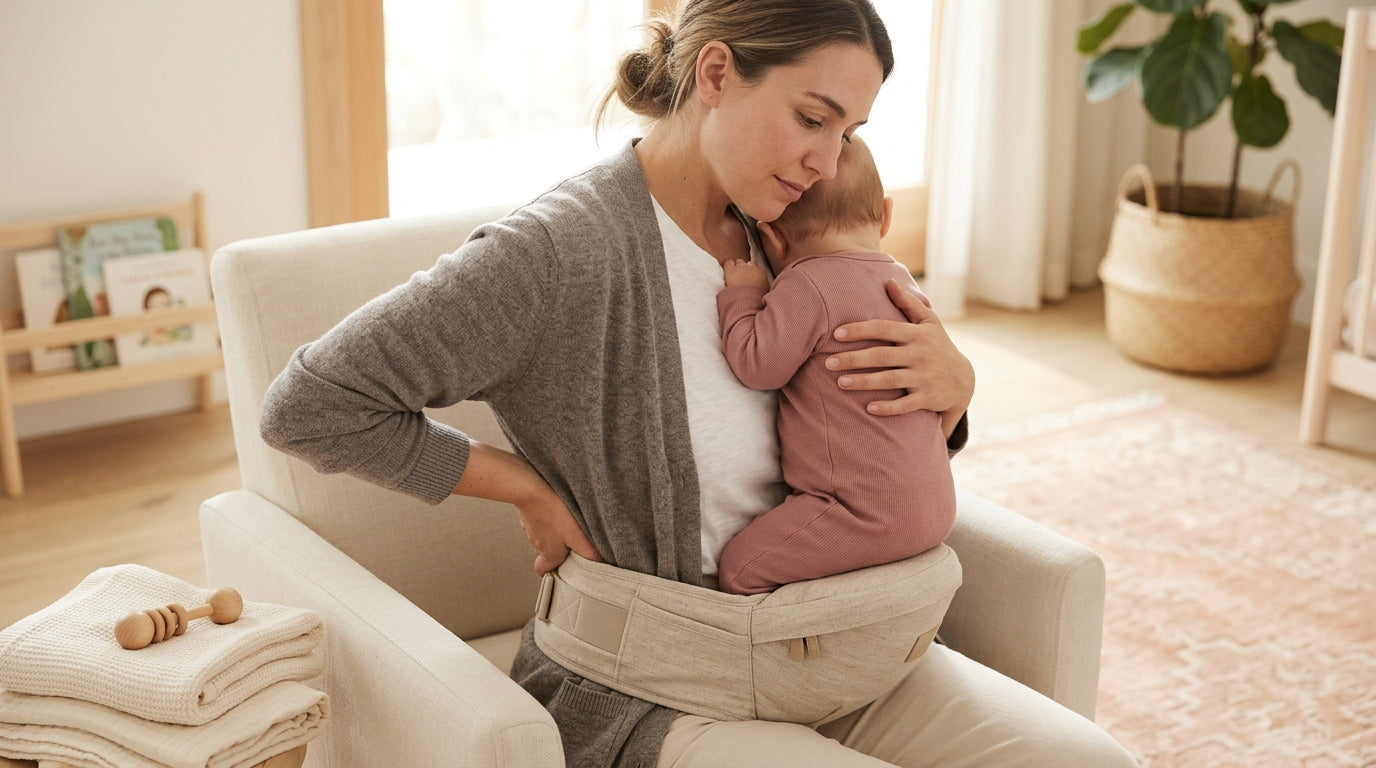
We were twenty minutes into the Parker County Peach Festival when I felt something in my lower spine actually shift. It was 98 degrees in the shade, the air felt like a wet wool blanket, and my sixteen-month-old son, Beau, was playing his absolute favorite game: the up-down game.
You know the one. He wants down to stomp in the dust and point at a tractor. Three seconds later, a teenager walks by too fast, and suddenly he's clawing at my kneecaps, screaming to be picked up. I heave his thirty-pound, solid-muscle body onto my right side, jutting my hip bone out so far to create a ledge that I practically have my own separate zip code. Two minutes later, he kicks his little boots, arches his back like a startled cat, and demands to be put down again. We repeated this dance approximately forty-two times before we even made it to the funnel cake stand.
My grandma always told me that if you carry a heavy child on one side for too long, you'll end up walking like a crab for the rest of your life. I always thought she was just being dramatic, but standing there by the port-a-potties, wiping sweat off my upper lip while my spine screamed for mercy, I realized she was dead right.
The nightmare of traditional toddler strapping
I know what you're thinking because it's what my husband said to me that morning. Why didn't you just bring the regular body pack? Let me tell you about standard structured carriers for toddlers. First of all, the sheer sweat factor is a crime against humanity. Strapping a thirty-pound furnace to your chest in the middle of a Texas summer is basically asking for heatstroke, leaving you both with a disgusting patch of shared belly sweat that takes hours to dry.
Then there's the buckle gymnastics. You have to hoist the screaming child, pin them against your chest with one forearm, yank the thick canvas straps over your shoulders, and then reach blindly behind your own neck like a contortionist to try and snap that tiny back clip. Half the time, the strap is twisted, or the clip is stuck under your shirt collar, and by the time you hear the click, your armpits are chafing and you're breathing like you just ran a 5K.
But the worst part is the toddler rage. Babies don't mind being strapped into a fabric prison. Toddlers despise it. The second you get them locked in, they spot a pebble on the ground they absolutely must eat, and the entire unbuckling process has to happen in reverse. It's maddening.
Ring slings are basically just expensive scarves that slowly choke you while your kid slides out the bottom.
Finding the waist shelf thing
I was standing near a lemonade stand when I saw her. Another mom, looking completely unbothered, wearing what looked like a giant fanny pack with a foam shelf attached to it. Her toddler was sitting on the shelf. She was holding a drink in one hand and casually supporting the kid's back with her other arm. The kid pointed at the ground, she slid him off the shelf, and they kept walking. No buckles. No backward neck reaching. No sweat patch.
I went home that night, put an ice pack on my lower back, and started Googling. I ended up dropping sixty bucks on a waist seat contraption, which honestly felt incredibly steep for a foam wedge strapped to a Velcro belt. I'm usually the first person to scoff at expensive parenting gadgets that look like they belong on an infomercial, but I'm just gonna be real with you—my chiropractor bills were going to cost a lot more if I didn't change something.
If you're constantly hunting for baby gear that actually survives the toddler years without driving you insane, you probably already know how much garbage is out there.
What my pediatrician actually told me
Before I strapped my kid to a shelf, I dragged the thing to Beau's next checkup. He had an ear infection, but I hijacked the appointment to ask about my back pain and whether this foam wedge was going to ruin my kid's joints.

Dr. Evans looked at it, sighed, and started drawing on the paper examining table cover. He told me about the International Hip Dysplasia Institute, which sounds like a very serious building full of people in lab coats looking at X-rays, but his explanation was pretty muddy. Apparently, if a kid's legs dangle straight down like a pencil, it puts weird pressure on their hip sockets and can cause developmental dysplasia? I don't pretend to understand the exact biomechanics of it.
He basically told me to make sure Beau's knees are sitting higher than his butt, kind of forming an M shape, so the joints stay where they belong. The seat needs to be tilted backward toward my stomach so he doesn't slide off the front.
The biggest thing Dr. Evans stressed was the age limit. He told me strictly no newborns on the seat, which makes sense because they're floppy like overcooked noodles. You can't put a kid in an upright sitting position until they can independently hold their heavy little heads up and sit on the floor without face-planting, which is usually around six months. Some brands try to say you can use it from birth to support them while you nurse sitting down, but for actual walking around, they need core strength.
Three harsh realities about the toddler shelf
Once I really started wearing the hip belt, I realized Instagram moms leave out a lot of the messy details. It's a lifesaver, but it's not magic. Here's what nobody warns you about:
- It's absolutely not hands-free. You don't have a back panel holding your child in. If you let go with your arm, your child will swan-dive into the concrete. You always have to keep one arm wrapped tightly around their waist or back. It's an arm-assist, not a magic floating chair.
- Your muscles will still scream if you're stubborn. You have to switch sides. If you wear the belt exclusively on your right side for three hours, your left side will overcompensate, and you'll wake up the next morning feeling like you got hit by a truck. The belt takes the twisting out of your spine, but the weight is still there.
- Taking it off sounds like a chainsaw. The waistband relies on a massive strip of industrial Velcro. If your child falls asleep on the shelf and you manage to lay them down in the crib, don't undo the belt in the nursery. Walk to the other end of the house, or the sound will wake them up instantly.
The diaper bag loophole
The single greatest thing about the waist seat is that the foam shelf is usually hollow. It unzips, and you can cram an ungodly amount of stuff inside it. I completely stopped carrying a diaper bag for quick trips.

I remember wiping actual sticky peach juice off my chest with the Kianao polar bear organic cotton blanket at that horrible festival. I absolutely love that blanket because it's massive enough to throw over a gross public bench when I need to do an emergency diaper change, but the material is thin enough that I can roll it up and shove it straight into the storage pocket under the foam seat along with two diapers and a pack of wipes. It survived the Great Peach Incident of 2021, washes like a dream, and still feels ridiculously soft. It has my eternal respect.
I also have the squirrel pattern blanket in my truck, which is honestly just okay for us. It's made of the same great organic material, but I got the smaller travel size. Beau outgrew using it as a play mat pretty fast, so now it mostly just sits in the backseat to intercept spilled snacks and wipe muddy boots.
The ghost of newborn past
Now that I'm chasing three kids under five, I realize how incredibly easy the newborn potato phase really was. Back when my oldest was tiny, he just laid on his back under his wild western wooden baby gym staring at the little crochet horse for twenty minutes at a time. You just set them down, and they stayed exactly where you left them. Bless their little hearts.
Toddlers are a completely different breed of animal. They're heavy, opinionated, and constantly in motion. The up-down phase is going to happen whether your spine is ready for it or not. Just strap the belt on tight, shove your stuff in the seat pocket, and try to survive the outing.
If you want to grab some gear that really holds up to the mess of real parenting, check out Kianao's organic cotton blankets before your next chaotic trip out of the house.
Answers to the questions you're probably Googling
Can I put my three-month-old on a waist seat?
Absolutely not, unless you're sitting in a recliner using it as a pillow to feed them. Babies that young have zero core control and their heads are massive compared to their bodies. If you sit them upright on a shelf, they'll slump over and their airway can get pinched. Stick to the fabric wraps until they can sit up on the floor without immediately toppling over like a bowling pin.
Does the belt dig into your stomach?
Depends on how cheap you go. The first one I bought had a very thin belt, and the edge of it dug directly into my C-section scar when my kid sat on the foam. It was awful. I had to hike it up weirdly high. Look for one that has a really wide, thick waistband with extra padding right behind the foam block. It makes a huge difference in how it distributes the pressure across your gut.
Can my husband wear it?
Usually, yes, but you've to check the waist measurements. My husband is built like a linebacker, and the standard belt barely caught on the last inch of Velcro. We had to order a waistband extender strap for him. But once it fit, he honestly preferred it over our giant canvas backpack carrier because it didn't mess up his shirt.
What happens if they lean backward?
You catch them. That's the whole point of the one-arm rule. This isn't a device where you can check your phone with both hands while walking. If your kid throws a tantrum and throws their body weight backward, your arm has to be firmly around their waist to pull them back into your chest. If you've a kid who constantly stiff-boards and throws backward tantrums, this might not be the right gear for you today.
Is it seriously better for your back?
For me, yes, by a mile. When I hold my son naturally, I pop my hip out and twist my spine to create a ledge for him to sit on. Doing that for an hour makes my lower back seize up. The thick belt creates an artificial ledge, which means I can stand perfectly straight with both feet flat on the ground. The weight is still heavy, but it's distributed evenly around my waist instead of wrenching my lumbar spine to one side.




Share:
When You Become the Default Human Holder for Your Baby
The Panic Over Getting a Baby Helmet for Flat Head Syndrome