

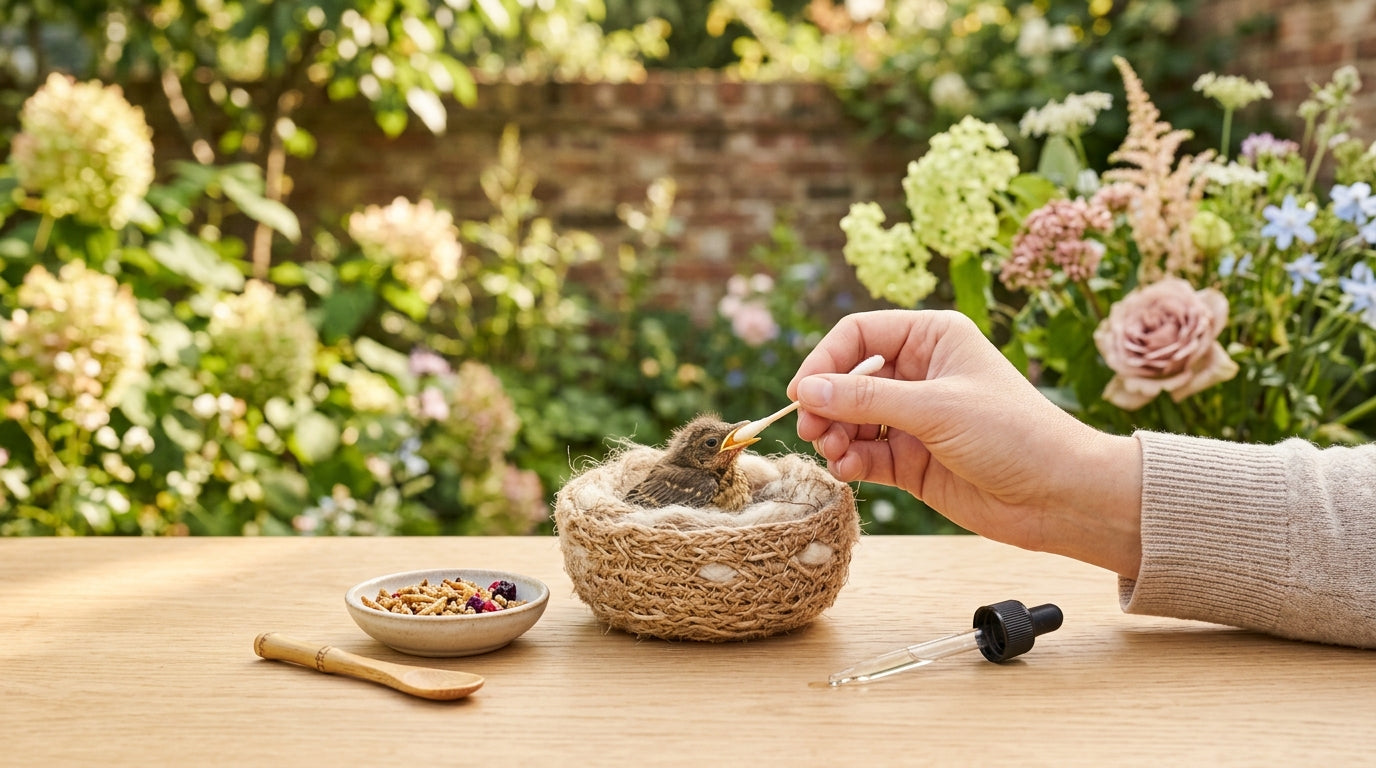
It's 2 PM on a Tuesday, I'm supposed to be pushing code to a staging server, and instead I'm on my knees in the dirt staring at what appears to be a raw chicken tender that has somehow sprouted a beak. Next to me, my 11-month-old, Leo, is aggressively trying to eat a handful of mulch, entirely oblivious to the wildlife crisis unfolding by our hydrangeas.
My wife Sarah comes out to the patio, takes one look at the situation, and immediately tells me not to touch the tiny pink alien because the mother will smell my human scent and reject it. I frantically pull out my phone with dirt-covered thumbs to fact-check this. Apparently, avian creatures have a notoriously terrible sense of smell, so the whole "scent rejection" thing is just a myth our parents invented to keep us from picking up random animals in the nineties.
So, I scooped the little guy up. And thus began the most stressful afternoon of my entire parenting career so far, which is saying a lot because last week Leo figured out how to bypass the child locks on the chemical cabinet.
Is this a bug or a feature
Before you even think about playing wildlife chef, you've to run a quick diagnostic on the bird itself. If the bird has feathers and is hopping around the grass like a tiny drunk person who lost their keys, leave it alone. That's a fledgling, they're basically teenagers learning to fly, and the parents are probably sitting in a tree right above you wondering why a grown man is staring at their kid.
But the one I found was pink, completely bald except for some weird alien fluff, and eyes fused shut. This is a nestling, or a hatchling. If they're on the ground, their operating system is crashing and they need immediate intervention. The absolute best thing you can do is just put them back in their nest if you can find it, but in my case, the nest was thirty feet up a Douglas Fir and my ladder only goes to the gutters.
Emergency system boot
My first instinct was to figure out a menu, but the avian vet I panic-called told me that hypothermia will shut down a tiny bird's systems way faster than an empty stomach. If you feed a cold bird, their digestion just stops working and they essentially crash.

So we built a makeshift incubator. I grabbed a small cardboard Amazon box, lined it with one of our clean muslin cloths, and set half the box on a heating pad on the lowest setting. The vet mentioned they need an ambient temperature of around 95 to 97 degrees Fahrenheit, which feels absurdly precise. I don't even know what the ambient temperature of my own living room is right now. While I was setting this up, Leo was thoroughly occupied with his Squirrel Teether. It's a decent piece of silicone that keeps him from screaming while his molars come in, but honestly, the acorn shape is just okay because he drops it constantly and it bounces under the TV stand. Still, it bought me five uninterrupted minutes to play wildlife medic.
I also realized during this dirt-crawling expedition how grateful I'm that Leo was wearing his Organic Cotton Baby Bodysuit. It has these super stretchy envelope shoulders, which meant after he inevitably smeared wet soil all over his chest while watching me rescue the bird, I could just peel the whole thing down his body rather than dragging a mud-soaked collar over his face. Plus it’s undyed, which feels right when you’re literally rolling around in the earth.
Explore our collection of organic, dirt-friendly baby essentials.
The great diet query
Once the little dinosaur was sufficiently warmed up, I hit the main problem: figuring out exactly what meals to serve an infant bird. My brain immediately went to seeds or bread, because that's what you feed ducks at the park, right?
Wrong. Never give them bread. It has zero nutritional value and just clogs up their tiny hardware. Also, absolutely no milk, because birds are lactose intolerant, and don't try to squirt water into their mouths. They get all their hydration from their food, and giving them direct water will just go down their windpipe and cause a catastrophic system failure.
In the wild, apparently 96 percent of terrestrial parent birds feed their kids insects. Specifically, soft, squishy caterpillars loaded with fat and protein. I'm a software engineer in Portland; I don't have a stockpile of caterpillars, and I'm certainly not foraging for them in the bushes while my son tries to eat a beetle.
If you can't get a hold of commercial hand-feeding formula from a pet store, the vet gave me an emergency 24-hour workaround. For insect-eaters, you take dry cat or dog kibble, soak it in warm water until it's spongy, and mash it into a weird meat pudding. If it's a seed-eater, you mix plain infant oatmeal with a tiny bit of hard-boiled egg yolk and warm water. I used the dog kibble method, mostly because our Golden Retriever was perfectly willing to donate to the cause.
The temperature protocol that broke me
Here's where I completely lost my mind. The clinic informed me that the mush you feed them has to be exactly 102 to 106 degrees Fahrenheit.

Think about that for a second. If the food is 107 degrees, you'll severely burn their crop, which is apparently a little storage pouch in their throat where food sits before digestion. If the food drops to 101 degrees, the bird can't process it, leading to a fatal condition called crop stasis where the food just rots inside them. I'm out here in my kitchen probing mashed up dog food with my expensive Bluetooth meat thermometer, praying it hits exactly 104 degrees.
I don't even treat my own coffee with this level of thermal precision. I've definitely fed Leo pureed peas straight out of the fridge when I was too tired to use the microwave. The amount of anxiety I felt trying to maintain the thermal equilibrium of soaked kibble took years off my life. You have to use a soft-tipped infant medicine syringe to drop tiny amounts into the side of their mouth when they open it, tapping the box to trigger their "gape" reflex. Don't ever pry their beak open.
The waiting game
Once you get the food in them, the loop just repeats. Hatchlings require a firmware update of food every 20 to 30 minutes from dawn until dusk. Older nestlings can stretch to an hour or two. Thankfully, wild birds sleep from 10 PM to 6 AM, so you don't have to pull a night shift.
We sat out on the patio waiting for the wildlife rehabilitator to call us back, watching the little box. I had our Bamboo Baby Blanket draped over my lap with Leo tucked underneath it. This thing is genuinely my favorite item in our nursery. It has a subtle watercolor leaf pattern that looks great, but more importantly, the bamboo fabric somehow magically controls heat. Leo runs hot and usually wakes up sweaty from naps, but this blanket breathes so well that he just snoozes peacefully. We sat there, wrapped in soft bamboo, watching a bald bird digest warm dog food.
Eventually, a local rescue volunteer drove over and took the box, syringe, and my heavily monitored meat thermometer notes. Parenting a human is terrifying, but trying to debug the biological needs of a one-ounce wild animal makes changing a blowout diaper feel like a vacation.
Shop our sustainable nursery collection before your next backyard adventure.
Frequent troubleshooting questions
Can I give the bird a little dish of water?
No, please don't do this. The vet was super clear with me that baby birds are incredibly clumsy and will just fall into the dish and get hypothermia, or they'll try to drink it and aspirate. They pull all the moisture they need directly from the mushy food you give them. Keep water far away from the box.
What if the bird won't open its mouth when I try to feed it?
It might just be too cold. If their body temperature drops, their digestion halts and they lose the feeding reflex. Make sure the ambient heat is around 95 degrees. Also, try gently tapping the edge of the cardboard box or making a soft clicking noise—that sometimes simulates the parent landing on the nest and triggers them to open up.
Is it safe to keep the bird inside my house?
Only temporarily, and keep them completely isolated from your pets and kids. I learned the hard way that wild birds can carry salmonella and other weird parasites. I washed my hands so thoroughly after handling the rescue box that my knuckles cracked. You really want to hand them off to a licensed rehabilitator as fast as possible.
Can I just use worms from the garden?
You would think so, right? But apparently earthworms are actually toxic to a lot of bird species and carry a bunch of parasites that will wreck a nestling's immune system. Stick to the soaked kibble or baby cereal emergency diet until the professionals take over. Leave the garden worms alone.




Share:
What Actually Decides If You're Having a Boy or a Girl
What Do Baby Bunnies Eat? A Texas Mom's Guide To Not Panicking