

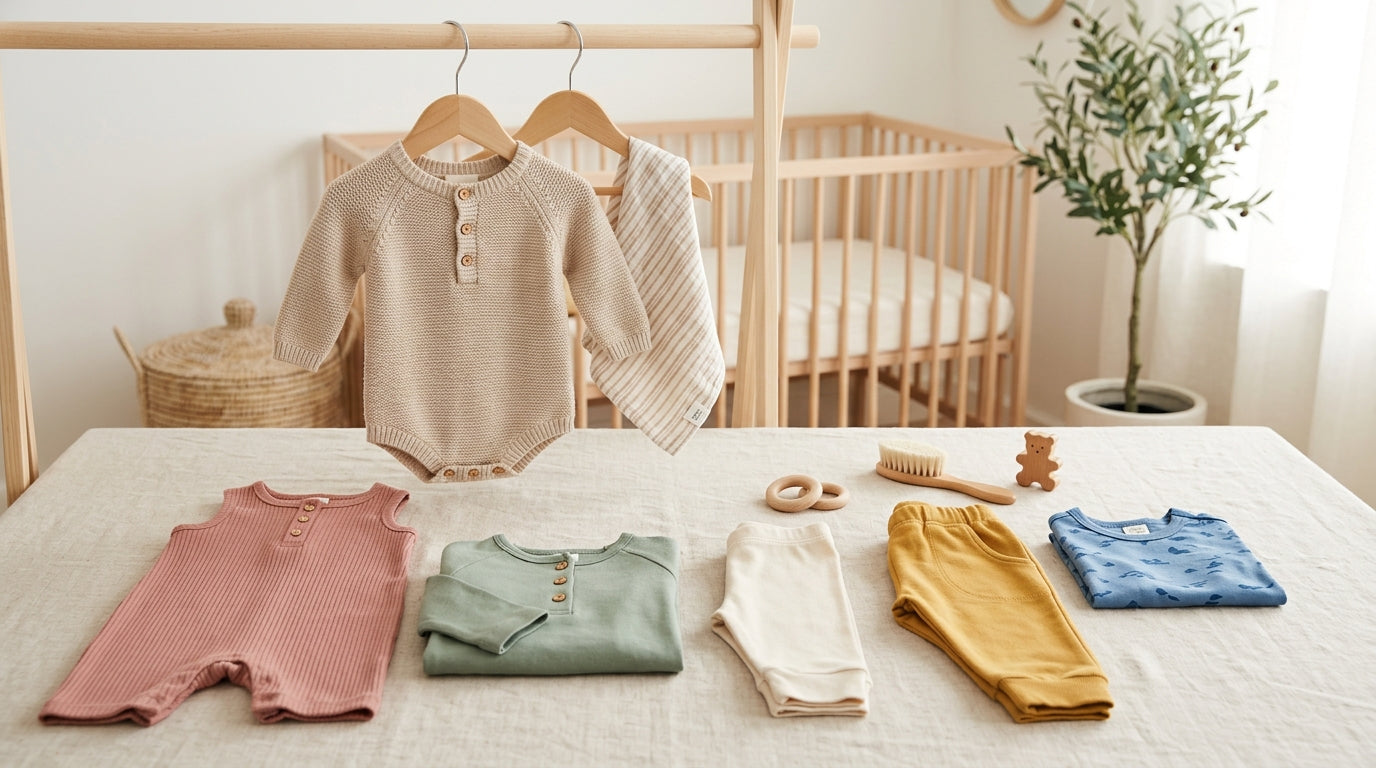
"Buy them a size up so they get two seasons out of it," my mom told me over the phone while I was staring blankly at a rack of toddler jeans, trying to figure out if the waist looked wide enough for a diaper. "Make sure clothes are snug-fitting so they don't catch on playground equipment," my doctor casually mentioned at our last wellness check, totally contradicting my mother. "Why don't you dress him in those little button-down linen sets?" my mother-in-law asked, bless her heart, as if my child doesn't regularly eat handfuls of Texas dirt.
I was standing in the middle of Target holding a 2T shirt that looked like it would barely fit the family dog, realizing that nobody actually knows what they're doing with putting fabric on small humans. We're all just guessing. I'm just gonna be real with you—buying clothes for kids under five is a relentless, expensive, mind-numbing guessing game that usually ends with a drawer full of stuff they wore exactly twice before waking up three inches taller.
Why buying clothes by age is a spectacular scam
My oldest, bless his heart, was built like a tiny linebacker from day one. When he was nine months old, he was somehow bursting out of 18-month onesies, and by the time he was a year and a half, I was stuffing him into 3T pants that were miles too long but finally fit around his chunky little thighs. I used to get so stressed out thinking he was growing too fast or that I was doing something wrong, but the truth is that American age-based sizing is basically just a practical joke played on sleep-deprived mothers.
I ended up going down a late-night internet rabbit hole searching for European sizing standards—specifically frantically Googling kinder kleidergrößen because apparently the Germans figured out a system that actually makes sense while we were all blindly buying "4T" and hoping for the best. European sizing doesn't care how old your kid is, it goes entirely by their height in centimeters. So if your kid is 104 centimeters tall, you buy a size 104, which is a frankly brilliant concept that would save me from having to return half the things I buy.
But even with smarter sizing, you still have to buy clothes that account for the fact that toddlers grow in explosive, unpredictable spurts. If you want to keep clothes out of the donation bin for more than two months, you really only need to look for a few specific details.
- Fold-over cuffs that actually stay folded so you can buy them a little long and roll them up without your kid looking like they're wearing clown pants.
- Wide, stretchy neck holes because toddler heads are disproportionately massive and trying to squeeze a rigid collar over their ears is a great way to start a morning crying session.
- Real, functional drawstrings that seriously tighten the waist instead of just sitting there looking cute.
Dress code reality for feral toddlers
If you ever search online for kinder kleider für jungs trying to find durable boys' clothes, you're instantly bombarded with stiff denim jeans, tiny rigid polo shirts, and scratchy little sweaters that look adorable on a mannequin but are absolute torture for a kid who spends 80 percent of his day army-crawling across a gravel driveway. I don't care about dressing my boys like tiny accountants, I care about whether or not the knees are going to blow out in forty-five seconds.

Which brings me to my absolute biggest pet peeve in the entire world: fake drawstrings.
I just want to know who's sitting in a design studio in New York sewing a tiny, completely useless bow onto the front of a pair of toddler sweatpants. You know exactly what I'm talking about. You buy a pair of pants because your kid has the waist of a string bean, and you think you can just tie them tight. You get them home, you pull them onto your squirming alligator of a child, and you pull the string. Nothing happens. It's stitched right into the waistband. It's a decoy string designed purely to mock you.
I've spent literal hours of my one wild and precious life trying to yank fake strings on cheap pants while my two-year-old screams because he wants to go outside and eat bug spray. If you manufacture pants with fake drawstrings, you're my mortal enemy, and I'll write you a strongly worded letter in my head while I fold laundry at midnight. Just give me an elastic waist or a real string, it's not that complicated.
Also, anybody who irons their toddler's clothes is probably a serial killer, moving on.
What my doctor honestly said about that weird chest rash

When my middle kid was about eight months old, he broke out in this angry, red, sandpaper-like rash all over his chest and back. I immediately panicked, convinced he had contracted some rare medieval plague from chewing on the shopping cart handle at H-E-B. I dragged him to the doctor, who took one look at him, felt the fabric of the fuzzy little zip-up sleep suit I had him in, and raised an eyebrow.

He told me to stop wrapping my kid in plastic, which honestly offended me for a second until he explained what he meant. I guess a baby's skin is incredibly thin and permeable, kind of like a sponge, and a lot of those cheap, fluffy synthetic fleeces are made of polyester, which is literally just spun plastic. My doctor said that putting a baby in synthetic fabrics basically traps all their body heat, sweat, and whatever bacteria is hanging around directly against their skin with zero airflow, causing massive heat rashes and eczema flare-ups.
He told me I'd probably want to ditch the cheap poly-blends and switch to breathable natural fabrics if I wanted the rash to go away, which is easier said than done when organic cotton usually costs an arm and a leg. But since I run a small Etsy shop out of my guest room and deal with textile suppliers a lot, I kind of knew he was right about how fabrics are processed with harsh chemical dyes and formaldehyde finishes that just don't wash out.
That whole rash incident is honestly why I'm ride-or-die for the Organic Cotton Baby Blanket Eco-Friendly Purple Deer Pattern from Kianao. I bought one on a whim, and it's hands-down the most used item in our house. It's 100% GOTS-certified organic cotton, so there are no sketchy pesticides or toxic dyes, and it has this double-layer construction that makes it heavy enough to feel comforting but breathable enough that my kid doesn't wake up feeling like a swamp monster. The edges are genuinely reinforced, so my toddler drags it through the kitchen, the yard, and the living room daily, and after about forty million trips through the washing machine on the cold cycle, it hasn't unraveled or lost its shape at all.
Now, on the flip side, we also have their Plain Bamboo Baby Blanket, and I'm going to be completely honest about it. It's ridiculously, luxuriously soft. Like, I want adult sheets made out of this material. I'm pretty sure bamboo works like magic to wick away sweat, or at least that's what I understood when I was reading up on it. But my mom bought us the solid terracotta color because it fits that minimalist, earthy nursery aesthetic that looks great on Instagram. In real life? That beautiful solid color shows absolutely every single drop of spit-up, milk dribble, and mysterious toddler smudge within five minutes of use. It's a great blanket, but if you don't have the energy to spot-treat stains every afternoon, skip the solid aesthetic colors and buy something with a busy pattern that hides the chaos.
Surviving the 7 AM wrestling match
Getting a child dressed in the morning shouldn't feel like an Olympic combat sport, yet here we're. I used to just lay out an outfit and tell my oldest to put it on, which usually resulted in him throwing his shoes across the room and refusing to wear anything but a Batman cape.
My mom's advice was to just force him into the clothes because "I'm the parent," but trying to physically wrestle a rigid pair of jeans onto a thrashing toddler is exhausting and usually makes everybody late. Instead, I started doing this thing I read about called "guided choice," which basically means you give up total control to trick them into thinking they're in charge.
I don't just ask "what do you want to wear," because the answer will be a swimsuit in December. I hold up two weather-appropriate, functionally indestructible shirts and say, "Do you want the green one or the striped one?" It completely bypasses the part of their brain that wants to fight you. We talk about whether it's cold outside or if we're going to the park, and as long as they pick something from the breathable, comfortable rotation I've already curated, I literally don't care if the colors clash horribly.
You have to let go of the idea that your kids are going to look perfectly styled all the time. If the clothes fit over their massive heads, if the fabric isn't giving them a horrible rash, and if the knees survive a trip to the playground, you're doing a fantastic job.
If you're tired of throwing out outgrown clothes and dealing with scratchy fabrics, do yourself a favor and invest in pieces that seriously breathe and stretch. Check out Kianao's organic collections and grab something that will survive the washing machine more than twice.
The messy realities of sizing and fabric (FAQs)
Why do European clothes use random numbers like 86 or 104?
Because they're infinitely smarter than us and measure by the child's height in centimeters instead of randomly guessing based on their age. If your kid is 86 centimeters tall, you buy size 86. It completely eliminates the problem of having a tall one-year-old who doesn't fit into standard 12-month clothes. Get a measuring tape and save yourself the return shipping fees.
Are boys' clothes seriously made differently than girls' clothes?
Honestly, mostly no. A lot of it's just marketing nonsense where they slap dinosaurs on one shirt and flowers on the other. Sometimes boys' pants have slightly thicker reinforced knees, but if you're shopping for durable basics, just buy whatever color your kid likes from the sturdiest section you can find. A tough organic cotton legging works exactly the same on a boy as it does on a girl.
Do I really need to buy organic cotton?
Look, nobody is perfect and you don't have to overhaul your entire house. But if your kid struggles with dry skin, mysterious rashes, or eczema patches in the winter, swapping their cheap synthetic sleepwear for organic cotton is probably the easiest fix. Normal cotton is blasted with pesticides, and organic just skips all those harsh chemicals, which makes a huge difference for sensitive skin.
How do I wash organic clothes so they don't shrink into doll clothes?
Wash them on cold and hang them to dry if you've the patience for it. If you're like me and mostly operate in survival mode, just wash on cold and dry on the lowest possible heat setting. Natural fibers will shrink a tiny bit the first time, but avoiding high heat keeps them from warping completely out of shape.
What's the deal with bamboo fabric?
It's incredibly soft and naturally keeps stable temperature, which means it keeps sweaty babies cool and cool babies warm. It's a great option for kids who run hot while they sleep. Just remember my warning: solid, light colors will show every single stain, so either embrace the mess or buy patterns!




Share:
Dressing a newborn without panicking (was ziehe ich meinem baby an)
The Staring Contest: The Truth About Baby Blue Eyes