

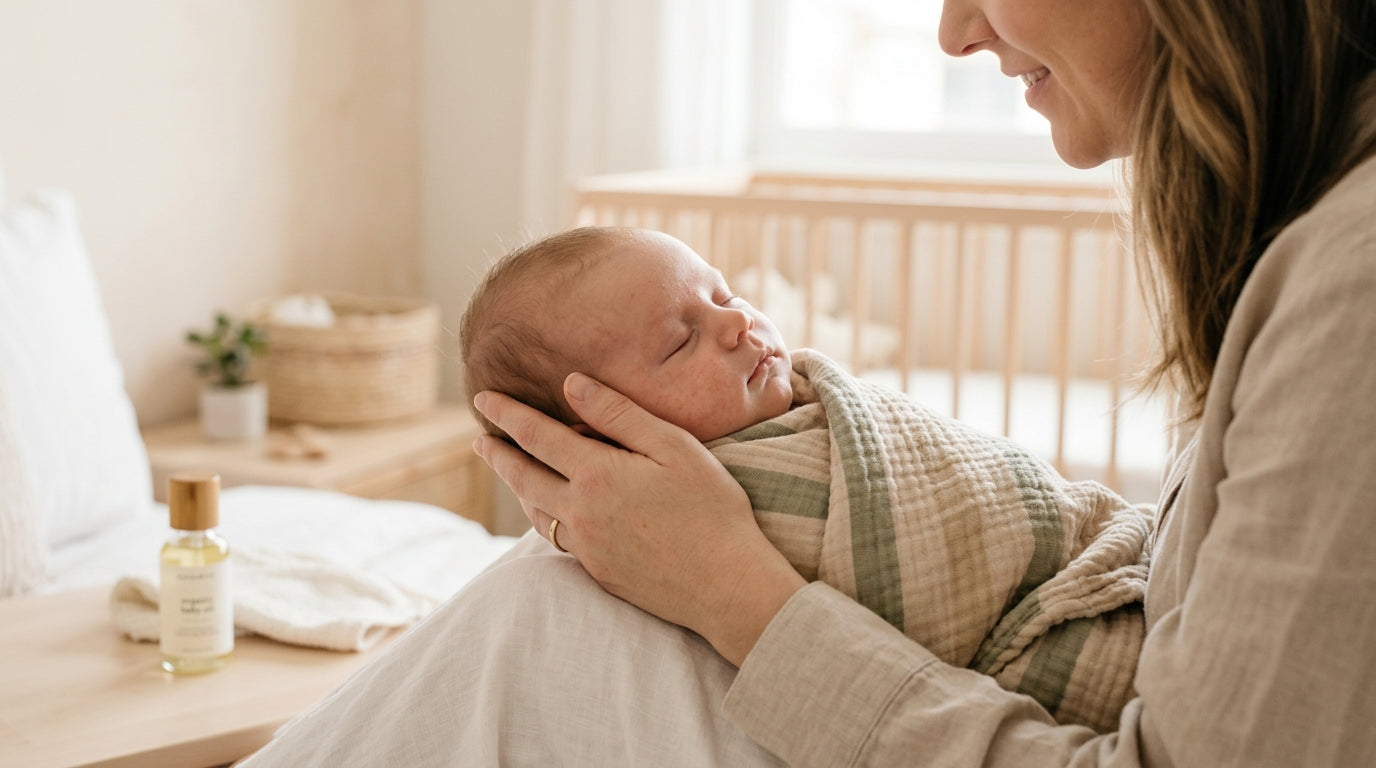
I was standing in line at my local coffee shop, wearing these black maternity leggings that I had fully sworn to myself I'd burn the second I gave birth, but here we were, three weeks postpartum, and they were the only pants that didn't aggressively dig into my stomach. I was bouncing three-week-old Maya against my chest, desperately waiting for an iced Americano that I needed like oxygen. Her little face, which just five days prior was this perfect, smooth, flawless porcelain doll situation, suddenly looked like a hormonally enraged teenager. It was covered in these angry red bumps. My phone buzzed in my pocket—it was my mother-in-law texting me to immediately, right that second, rub fresh breastmilk all over the baby's cheeks. Like, just douse her in it. Then the barista, handing me my life-saving coffee, leaned over the counter and confidently whispered that I should slather her entire head in raw coconut oil. Not two minutes later, I get to the car, and my husband Dave looks at her bumpy little forehead from the driver's seat and goes, "Babe, are we... not washing her enough?"
Three different people. Three completely different, deeply unhelpful, totally conflicting pieces of advice within a fifteen-minute window.
I sat in the passenger seat and just cried. Because that's what you do at three weeks postpartum. You cry because your coffee is too cold, you cry because a commercial for life insurance came on the radio, and you definitely cry because you're convinced you've somehow ruined your beautiful newborn's skin by being a terrible mother who doesn't know how to wash a tiny face properly. I grabbed my phone and immediately started Googling exactly when this newborn breakout phase goes away, falling down a terrifying rabbit hole of terrifying forums while Dave nervously drove us home.
The doctor visit that talked me off the ledge
By the time we got to her one-month checkup, I was a wreck. My pediatrician, Dr. Miller—a saint of a man who has literally seen me cry over everything from weird mustard-colored poop to a dropped pacifier—had to sit me down on that incredibly loud, crinkly paper exam table and explain the whole timeline to me.
He told me it's totally normal and I hadn't broken my baby. Neonatal acne (which is the fancy, terrifying medical term for it) hits something like twenty to thirty percent of all newborns. It just happens. And of course, I demanded to know whose fault it was, fully expecting him to tell me it was because I ate too much dairy or forgot to sterilize a washcloth.
Nope. It was my hormones' fault. Which is basically my fault, but out of my control. You see, when you're pregnant, your body is just dumping this absolutely massive cocktail of hormones into the baby through the placenta. Like, thanks a lot, placenta, you did a great job keeping her alive but you really messed up her complexion. So Maya was basically swimming in my extra hormones for nine months, and once she was out in the real world, her little oil glands just went into total overdrive trying to process it all.
I could talk about pregnancy hormones for hours. Actually, I'll, because I'm still mad about it. It's so wildly unfair that we spend almost a whole year growing a human from scratch, our hair gets thick and glossy, we finally get that elusive "glow" everyone lies about, and then BAM. The baby comes out, and our hair starts falling out in absolute clumps in the shower. I'm talking handfuls clogging the drain while you're just trying to get three minutes of peace. And don't even get me started on the sweating. The postpartum night sweats are a special kind of hell. I remember waking up totally drenched, thinking I had a fever and was dying of the flu, but no, it was just the hormones violently leaving my body and apparently migrating directly to my infant's cheeks. IT IS EXHAUSTING.
Anyway, the point is, Dr. Miller also mumbled something about how some researchers think the bumps could be a mild reaction to this yeast that just naturally lives on human skin—I think he called it Malassezia or something equally villainous-sounding—but honestly, whatever the actual microscopic cause is, he promised me it was entirely harmless and she wasn't in any pain at all.
The difference between a few weeks and a whole year
So, exactly how long does this baby acne stick around? Dr. Miller told me that these normal neonatal breakouts usually show up around two to six weeks of age. With Maya, it was right at the three-week mark like clockwork. And usually, if you just leave it the hell alone, it clears up on its own in a few days to a few weeks. Sometimes it hangs on stubbornly for a few months, but it does fade.
But then he warned me about infantile breakouts, which is a whole different beast that shows up after six weeks, usually between three and six months. My older kid, Leo, actually had a touch of that, and let me tell you, it lasted forever. Like, almost his entire first year. We actually had to go see a pediatric dermatologist for Leo's because the later-stage infantile stuff can sometimes leave permanent scars, which is a terrifying thought when you're staring at your perfect baby.
What I genuinely did (and what you definitely shouldn't do)
You're probably wondering what you're supposed to do to fix it right now. Well, the answer is pretty much nothing, which goes against every single biological instinct I've as a mother because when there's a visible problem on my child, my anxious brain screams at me to buy ten different expensive creams, scrub the area, and fix it immediately. But Dr. Miller looked me dead in my tired, baggy eyes and said I just needed to gently wash her face once a single day with some lukewarm water and a super mild, unscented soap, and then kind of delicately pat it dry with a clean cloth, while completely ignoring the screaming urge to squeeze or pick at the bumps because popping them is exactly how you introduce nasty bacteria and cause the real scarring we all want to avoid.

Oh, and about the breastmilk and coconut oil? He literally laughed out loud. He told me that slapping thick, greasy home remedies or heavy baby lotions on an already overactive oil gland is just going to clog their tiny pores even worse, so skip the pantry items.
The fabric factor (and my favorite things)
He also told me to keep her cool. Heat makes the redness so much angrier. I noticed Maya's cheeks would flare up like crazy after her afternoon naps when she was wrapped up in those cheap, polyester-blend fuzzy blankets we got from my baby shower. The synthetic fabric trapped all her body heat against her skin, and she'd wake up looking like a little boiled lobster.
We ended up ditching the polyester and switching to this bamboo baby blanket from Kianao. Let me tell you, I'm fully obsessed with this thing. I originally bought it just because the floral pattern looked pretty with her nursery paint, but the bamboo fabric is seriously the real hero here. It's incredibly breathable. It magically controls her temperature so she wasn't waking up sweaty and cranky with a face full of aggravated, red bumps. Plus, it's blended with organic cotton, so it's ridiculously soft against her face when she inevitably face-plants into it while practicing tummy time.
Friction is also your worst enemy when their skin is acting up. If your baby is anything like mine, they've zero neck control and they just violently rub their face on everything. My shoulder. Their own shoulders. The living room rug. I started being hyper-aware of what Maya was wearing because stiff collars and scratchy seams were just making her cheeks raw. The Kianao long sleeve organic cotton bodysuit was basically her entire uniform for two straight months. Is a onesie a magical medical cure? No, obviously. But it's made of this buttery, un-dyed organic cotton that's so gentle it didn't aggravate her face when she was aggressively rubbing her chin on her collarbone. Plus it has those stretchy lap shoulders, so when she had a completely unholy, up-the-back diaper blowout at Target, I could pull the whole messy thing down over her legs instead of dragging mustard poop over her already-angry face. Which is a win.
If you're currently dealing with sensitive, angry newborn skin and you want to overhaul what's touching it every day, honestly, go poke around Kianao's organic baby apparel collection because switching from cheap synthetics to breathable natural stuff made a really noticeable difference for us.
The drool complication
When Leo had his longer infantile phase later on, it unfortunately overlapped exactly with his teething era, which was just brilliant timing by the universe. He was drooling everywhere. It was like a leaky faucet that never, ever turned off. The constant wet saliva sitting on his chin made his skin so furious and chapped.

We gave him the Kianao Panda silicone teether to chew on instead of his own spit-covered fists. I'll be totally honest with you here—it's a good teether, but it's just a teether. The silicone is safe, and you can throw the whole thing in the dishwasher when it inevitably gets launched onto the dirty kitchen floor (which is my personal love language for baby gear), and he seemed to like chewing on the little bamboo shape. It didn't magically solve all my parenting problems or change my life, but it kept his hands out of his mouth for five minutes so I could drink my coffee while it was still somewhat warm. It does the job.
When you should honestly panic and call the doctor
I'm a massive fan of calling the pediatrician for literally anything that makes your stomach do that weird anxious flip. You're the mom. You know when something feels off. Dr. Miller told me to absolutely bring them back in if the bumps start looking super inflamed, if they're oozing weird yellowish crusty stuff, or if the baby genuinely seems uncomfortable. Normal newborn hormone bumps are totally painless. They bother us way more than they bother the baby. If your kid is screaming, scratching at their face, or feeling warm with a fever, get your butt to the doctor because that could be an infection or eczema, not just regular old hormones.
Parenting a tiny newborn is already a wild, sleep-deprived, deeply confusing ride, and you really don't need to stress over every single little red spot on their nose. Focus on keeping them comfortable, washing gently, and dressing them in soft, breathable fabrics that won't make things worse. If you're ready to upgrade your little one's wardrobe to something way gentler on their sensitive skin, definitely check out Kianao's collection of safe, organic clothing before you fall down another 3 AM Google rabbit hole of anxiety.
My Messy FAQ on Newborn Skin Freaks Outs
Does my diet affect my breastfed baby's skin?
I literally cried over a slice of pizza thinking the cheese was causing Maya's face to explode. But my doctor swore up and down that typical newborn breakouts are driven by the leftover pregnancy hormones in their system, not by what you ate for lunch. Obviously, food allergies are a real thing that can cause rashes, but standard little whiteheads? Eat the pizza. It's not your fault.
Should I put lotion on their face?
Every fiber of your being will want to moisturize those little bumps, but don't do it. Dr. Miller explained that thick lotions, oils, and creams just trap the oil and dirt in the pores and make the whole situation ten times angrier. Just use water and a super mild soap, and let it breathe.
Will these bumps leave permanent scars?
The early neonatal stuff that shows up in the first month almost never leaves scars, even if it looks absolutely terrible right now. It just fades away. But if your kid gets the infantile kind that shows up months later and looks more like actual blackheads or deep cysts, you really need a dermatologist to look at it because that kind really can scar if you don't manage it right.
How can I tell if it's a milk rash or something else?
It's so confusing because literally everything makes a baby turn red. Milk rashes usually happen right where the milk dribbles—like in their neck folds or on their chin—and it's more of a flat, irritated red patch from the moisture. Acne looks like actual little teenage pimples with tiny white heads on their cheeks and nose. But honestly? If you're staring at it with a flashlight at 2 AM and you can't figure it out, just take a picture and send it to your pediatrician. That's literally what they're there for.




Share:
How Does Preeclampsia Affect the Baby? My NICU Story
When Does the Newborn Phase Actually End? A Dad's Late-Night Dive