

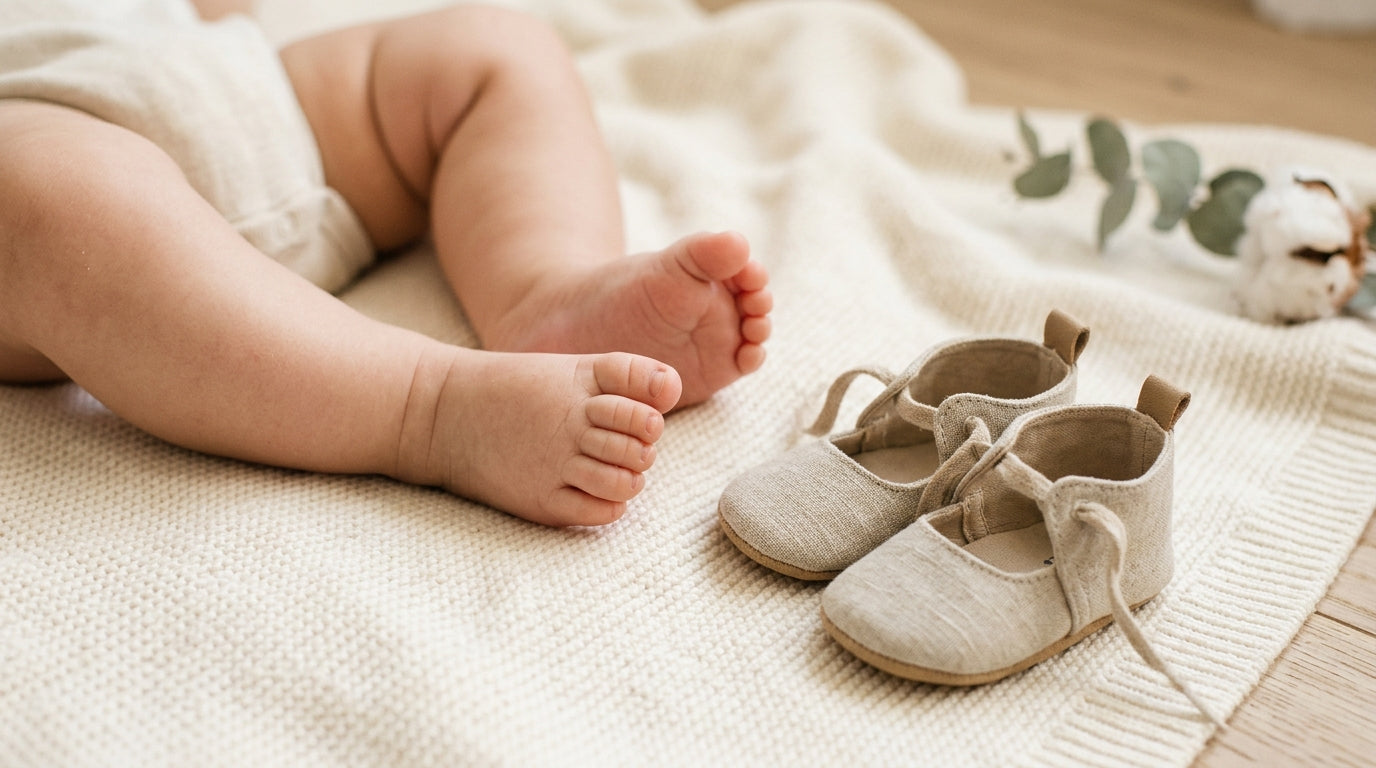
My mother-in-law held up a pair of hot pink, patent leather, miniature high heels at my baby shower like she had just extracted a rare diamond from a mine. I smiled, nodded, and immediately mentally categorized them as biohazard waste. They had little ankle straps. They had a microscopic arch support. They were stiff enough to use as a weapon. She told me she couldn't wait to see her little beta walking around in them.
I didn't have the heart to tell her that putting those on an infant would be a developmental disaster. When you first have a baby, the urge to dress them up like a tiny, compliant doll is strong. You see the racks of miniature footwear and lose your mind a little bit. But from a medical and practical standpoint, the entire infant shoe industry is mostly a scam.
The anatomy of a tiny foot
Listen. You need to understand what's actually happening inside a baby's foot. When they're born, their feet are basically just squishy bags of fat and cartilage. The bones haven't formed yet. They say the cartilage doesn't fully fuse into solid bone until they're in their late teens, which means everything you put on their feet in those early years has the potential to warp their development.
I've seen a thousand of these cases back in pediatric triage. An anxious mother comes in because her ten-month-old has a mysterious, angry red welt on the back of her heel or the side of her pinky toe. They think it's a spider bite or a staph infection. I'd take one look at the rigid, bedazzled baby shoe sitting in the stroller and just hand them a bandage. The shoes are almost always the culprit.
My pediatrician told me that babies learn to balance entirely through sensory feedback. Their nervous system is trying to map the terrain. They need to feel the hardwood, the carpet, and the grass. Putting a thick rubber sole on a learning walker is like trying to read braille while wearing ski gloves. They can't feel the ground, so they overcompensate, they throw their weight around, and they fall over.
Miniature adult fashion is a trap
If you're shopping for baby shoes, girl clothing aisles are completely unhinged. You will find tiny riding boots. You will find miniature gladiator sandals with twelve different straps. You will find shoes covered in sequins that shed everywhere and end up in the baby's mouth.

This is where the industry really preys on us. They take an adult shoe trend, shrink it down to a size three, and charge you fifty dollars for it. But an adult shoe is designed for an adult foot, which strikes the ground heel-first. A baby walks like a drunken sailor. They stomp flat-footed. Their toes splay out wildly to grip the floor like little monkey claws. When you cram that wide, splaying foot into a narrow, pointed dress shoe, you're actively working against their anatomy.
I tried it once, just for a family photo. I spent ten minutes sweating, trying to shove my daughter's chubby, curling foot into a stiff leather Mary Jane. She screamed the entire time. The shoe popped off three seconds later because baby feet are shaped like inverted triangles and despise being contained. I gave up and let her wear socks.
I refuse to even discuss baby shoes with laces, just throw them directly into the trash.
The checklist for acceptable footwear
Eventually, your kid will start walking outside, and you'll need to protect their feet from broken glass, hot pavement, and whatever mystery liquid is on the playground equipment. This is the only time a baby shoe becomes medically necessary. When that day comes, you need to ignore aesthetics and look at functionality.

Here's what you actually need to look for.
- The taco fold. You should be able to take the shoe in one hand and easily fold it in half, touching the toe to the heel. If you can't bend it, don't buy it.
- A massive toe box. The front of the shoe should look comically wide. It should look like a clown shoe. If it tapers into a neat, stylish point, it's going to squish their toes.
- Zero drop. The heel and the toe should be completely flat. No elevated heels, not even a fraction of an inch.
- breathable material. Babies sweat profusely. If you put them in synthetic plastic leather, their feet will smell like a locker room by noon.
For those early indoor days when the floor is just a bit too cold, I skip traditional shoes entirely. We use the Enchanting Baby Shoes from Kianao. They're knit from organic cotton and are basically just glorified, heavy-duty socks. They keep her feet warm, the cuffs prevent them from sliding off every five minutes, and they offer zero structural resistance. Her foot moves exactly how it would if she were barefoot. That's the whole point.
If you need to outfit a tiny human without ruining their physical development, you can explore our organic baby clothes and essentials to find things that actually make sense.
Measuring a moving target
Getting an accurate measurement of a toddler's foot is a logistical nightmare. They won't stand still. They will curl their toes under just to spite you. But you've to measure them while they're standing up, bearing their full weight. When a baby stands, their foot spreads out and gets longer. If you measure them while they're sitting in a high chair, the shoe will be too small.
The rule of thumb is literal. You want about a thumb's width of space between their longest toe and the end of the shoe. You should also be able to slide your pinky finger down the back of their heel. If you can't do both, the shoe is too tight.
When my daughter started cruising the coffee table and trying to walk on our slippery hardwood floors, we needed something with actual grip. I got her a pair of Baby Sneakers with a non-slip soft sole. They have this classic boat shoe look. Honestly, they're pretty cute. But more importantly, the sole is just pliable enough to let her feel the floor, while the bottom has enough traction to stop her from doing an accidental split on the wood. They have an elastic closure, so I can slip them on with one hand while she's trying to squirm away from me.
I pair them with whatever is clean. Lately, it's the Baby Shorts in organic cotton. They're retro style ribbed shorts. They're fine. They cover the diaper, and the elastic waistband doesn't leave those angry red indentations on her chunky thighs. with baby clothes, avoiding red marks on the skin is pretty much the only standard I care about anymore. They do the job.
We don't need to overcomplicate this. Ditch the miniature fashion trends. Let their feet be flat and wide and messy. They have the rest of their lives to wear uncomfortable shoes for the sake of an outfit.
Ready to build a wardrobe that respects your baby's biology? Shop our collection of functional, organic baby essentials.
Questions you're probably asking
Do babies need hard soles for ankle support?
Not really. This is a myth that refuses to die. Your baby's ankles get stronger by making micro-adjustments while they balance. If you put them in a hard, stiff boot, you're basically putting a cast on their foot. The shoe does the work instead of their muscles. My pediatrician laughed when I asked if my kid needed arch support. Let them wobble.
When should my baby wear her first shoe outside?
Only when she's genuinely walking independently on surfaces that could hurt her. If you're just carrying her from the car to the grocery store cart, she doesn't need shoes. If she's crawling in the grass at a park, socks or bare feet are fine. I only put shoes on my daughter when she insists on walking across the blistering asphalt in our driveway.
How do I know if the shoes are too small?
Aside from the pinky test, just look at her feet when you take the shoes off. If you see deep red lines, blisters, or if her toes look squished together like sardines, they're too small. Babies will rarely tell you their feet hurt. They will just get cranky, refuse to walk, or randomly throw a tantrum in the middle of a bakery. Always check the toes.
Can I put her in hand-me-down shoes?
I'm all for hand-me-down clothes, but shoes are tricky. A worn shoe has already molded to the shape of the previous child's foot. If you put your baby in a shoe that has a deeply grooved footprint from her cousin, it can force her foot into a weird alignment. If the shoes look brand new and were only worn once for a wedding, go for it. If they look heavily broken in, skip them.
My baby's feet look completely flat, is that normal?
Yeah, it's totally normal. All babies have flat feet. There's a massive pad of fat sitting right where the arch is supposed to be. It makes their feet look like little dinner rolls. The arch usually doesn't start to show up until they're two or three years old, as the fat pad melts away and the muscles develop. Don't go buying orthopedic inserts for a ten-month-old.




Share:
The Real Story Behind Those Unworn Infant Shoes on Resale Apps
Baby Shoes Never Worn: Why Barefoot Is Always The Smart Move