

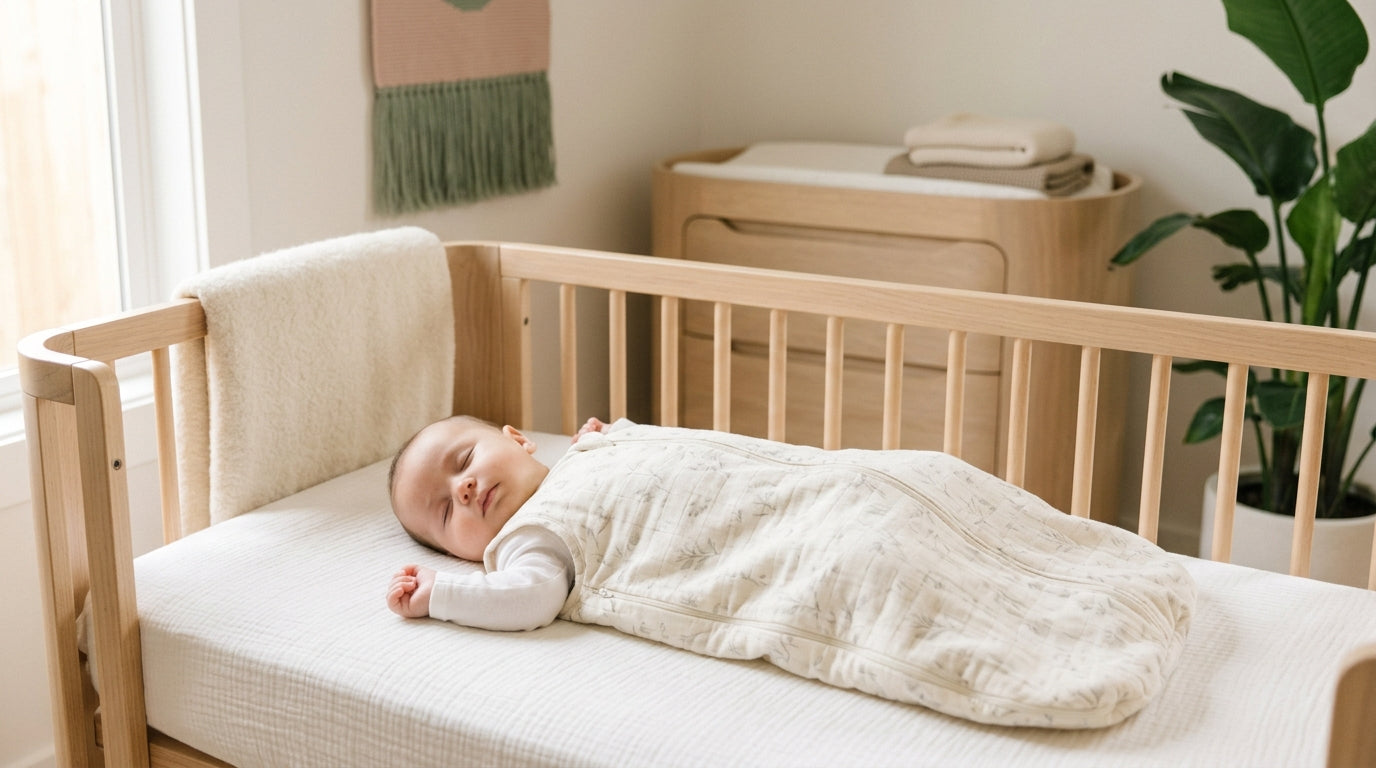
Dear Marcus from exactly six months ago,
You're sitting in the glider chair right now, aren't you? It's 3:17 AM in Portland, the rain is aggressively smacking against the nursery window, and you're staring at your phone screen with the brightness turned all the way down so you don't wake the baby. He's currently thrashing around in his crib like a tiny, angry breakdancer. You've been scrolling through Reddit threads about infant sleep regressions for an hour, and your thumb is hovering over the "Complete Purchase" button for a Dreamland baby weighted wearable blanket. You think a baby sleep sack filled with glass beads is going to magically debug this whole sleep deprivation situation.
I'm writing from the future to tell you to put the credit card down, close the browser tab, and step away from the deep touch pressure therapy.
I get it. You're operating on about 42 minutes of interrupted REM sleep, and your brain is looking for a quick software patch to fix a baby who wakes up every hour on the hour. You saw some targeted ad claiming this heavy garment would mimic the feeling of a hug and increase his serotonin levels. You're probably thinking, "Hey, I like heavy blankets when I'm stressed, so this is just a micro-version of that."
But thing is about babies, man: their underlying architecture is completely different from ours. What feels like a comforting hug to a grown adult with a fully calcified skeleton is apparently a massive, system-critical hazard for a five-month-old.
The hardware limits of a tiny rib cage
Let me tell you about the absolute dressing down we got from Dr. Lin at the pediatrician's office when I casually mentioned I was thinking about ordering a heavy sleep wearable. I brought it up like I was presenting a brilliant new tech solution to a stubborn coding problem. I expected her to nod in approval at my proactive parenting data-gathering.
Instead, she looked at me over her glasses like I had just suggested feeding the baby pure espresso. She explained that a baby's rib cage isn't made of solid bone yet. It's mostly pliable cartilage, which means their chest cavity is highly flexible. She threw around terms like chest wall excursion, which is basically the physical mechanism of how the lungs expand and contract. Because their respiratory muscles are basically still in beta testing, any extra weight on their chest forces their diaphragm to work overtime just to pull in a normal breath.
It's like putting a heavy textbook on top of a laptop fan; the system is going to overheat and struggle to ventilate. Dr. Lin told us that the American Academy of Pediatrics explicitly updated their safe sleep guidelines to ban all weighted blankets, weighted sleepers, and weighted swaddles for infants because the risk of restricted breathing is just too high. You're inadvertently introducing a massive SIDS risk into the crib just because you want three uninterrupted hours of sleep. I felt my stomach completely drop out when she explained that.
Just because some millionaire investors on a reality television show decided to fund a sleep product absolutely doesn't mean it's safe for your child's developing respiratory system.
My pivot to thermal management instead of physical restraint
Once Dr. Lin successfully terrified me out of trying to pin our son down with a weighted vest, I had to completely rethink my approach to his sleep environment. If I couldn't use gravity to keep him asleep, I needed to figure out what was actually causing his frequent wake-ups. I started tracking variables in my spreadsheet—room temperature, humidity, diaper status, ounces consumed before bed.

It turns out, he wasn't waking up because he needed a hug. He was waking up because he was sweating through his synthetic pajamas. His thermal management was a disaster.
Babies are terrible at regulating their own body heat. They don't have the biological firmware to sweat efficiently, so if you put them in polyester fleece, they just bake. I went down a completely different rabbit hole researching TOG (Thermal Overall Grade) ratings and natural fiber breathability. I realized that if we could just keep his microclimate stable, he'd stop waking up crying.
If you're desperately looking for a way to improve his sleep architecture, I highly think browsing a reliable baby blankets collection to find some lightweight, organic layers instead of buying what's essentially a wearable sandbag.
The actual tech stack we use for the crib
So, what do we actually use now that our son is almost a year old and (mostly) sleeping through the night? We completely switched to a breathable, natural-fiber setup. I became weirdly obsessed with the material science of baby gear.

My absolute favorite piece of gear we own right now is the Blue Fox in Forest Bamboo Baby Blanket. I'm not exaggerating when I say this thing is the MVP of our nursery setup. It's a 70% organic bamboo and 30% organic cotton blend, which sounds like marketing fluff until you actually feel it. It has this incredible silky texture that feels cool to the touch when the room is warm, but somehow traps just enough body heat when the Portland nights get drafty.
My wife Sarah thought I was being dramatic about the fabric specs until the baby had a massive blowout at 2 AM, and I had to hand-wash it in the sink. I hung it over the shower rod, and by morning, it was completely dry and somehow softer than before. Plus, the blue fox design satisfies my need for Scandinavian minimalism while giving the baby something visually interesting to stare at while he winds down. It's a brilliant piece of textile engineering.
For his base layer, we ditched all the weird synthetic pajamas with the itchy tags. He sleeps exclusively in the Long Sleeve Organic Cotton Baby Bodysuit. It's got 5% elastane in it, which gives it just enough stretch so you aren't wrestling his arms into the sleeves like you're trying to stuff a wet noodle into a straw. The organic cotton is undyed and chemical-free, which apparently matters because his weird cheek eczema completely cleared up a week after we switched to these.
We also have the Organic Cotton Baby Blanket with Squirrel Print in the rotation. I'll be honest, it's just okay compared to the bamboo one. The cotton is definitely high quality and it breathes well, but the squirrel illustrations have these wide, staring eyes that make them look permanently startled. Sarah thinks it's adorable woodland whimsy, but I always feel like the squirrels are judging my parenting when I lay it over him in the stroller. It functions perfectly fine as a 0.5 TOG equivalent layer, though.
My current parameters for a successful bedtime
Listen, past Marcus, I know you're drowning in anxiety right now. You're tracking every single minute of his daytime naps and panicking when he only sleeps for 28 minutes instead of the "recommended" 45. You're convinced that if you don't find the perfect consumer product, you're failing him.
But the truth is, baby sleep is incredibly messy and largely out of your control. His brain is frantically wiring millions of new neural connections every day. He's learning to roll over, babble, and process gravity. Of course his sleep data looks like a corrupted hard drive right now.
You don't need a heavy Dreamland baby product to fix him. He isn't broken. If you just lock in the safe sleep basics—keeping the crib totally bare, ensuring the room is sitting at exactly 69.2 degrees, and putting him in a breathable bamboo sleep sack or blanket that won't trap his body heat—you're doing everything right. The regression passes. The sleep consolidates. You eventually stop hallucinating from exhaustion during your morning stand-up meetings.
Save your money, trust the pediatrician's safety warnings, and just ride out the storm. It gets better, I promise.
Before you lose your mind entirely, go look at some truly safe, breathable sleep setups. Explore Kianao's organic cotton clothing and get some gear that honestly supports his thermal regulation instead of trying to weigh him down.
Messy late-night questions I definitely Googled
Why did pediatricians suddenly turn against weighted baby items?
It wasn't sudden, honestly; the data just finally caught up to the trend. From what Dr. Lin told me, pediatricians were noticing that babies in weighted gear were experiencing lowered oxygen saturation. Their rib cages are basically made of cartilage, so placing even a few ounces of weight on their chest restricts their natural lung expansion. It forces them into a state of physical exhaustion just to breathe normally, which drastically spikes the risk of SIDS.
What if my baby really loves deep pressure and won't sleep without it?
I thought our guy needed pressure too, but he really just needed to feel securely contained without being compressed. We switched to a slightly more snug (but unweighted) organic cotton sleep sack that gave him a physical boundary without putting any downward force on his respiratory system. Sometimes they just want to know where the edges of their environment are.
How do you keep them warm in the winter without a heavy blanket?
It's all about layering natural fibers, not adding mass. I learned that bamboo and organic cotton trap a layer of warm air right against their skin without turning them into a sweaty mess. A long-sleeve cotton bodysuit under a standard 1.0 or 2.5 TOG wearable blanket provides incredible thermal insulation. You don't need weight for warmth; you just need smart material science.
Did the four-month sleep regression ever genuinely end for you?
Yeah, though it felt like it lasted a decade. Around six months, his brain finally figured out how to connect sleep cycles on its own. We didn't do any aggressive sleep training or buy any miracle devices. We just kept his room dark, kept his clothes breathable, and waited for his neurological firmware to finish updating.
What's the actual deal with bamboo fabric anyway?
I thought it was a total marketing gimmick until we used it. Apparently, the structure of bamboo fibers is naturally round and smooth, meaning there are no microscopic rough edges to irritate the baby's skin. It also has incredible moisture-wicking properties. When our son inevitably overheats because I left the heater on too high, the bamboo pulls the sweat away from his skin and evaporates it, preventing those nasty heat rashes he used to get in polyester.




Share:
Why Your Dog Freaks Out When the Kid Screams (A Father's Log)
Creating A Salt-Free Dry Rub For Baby Back Ribs To Feed My Baby