

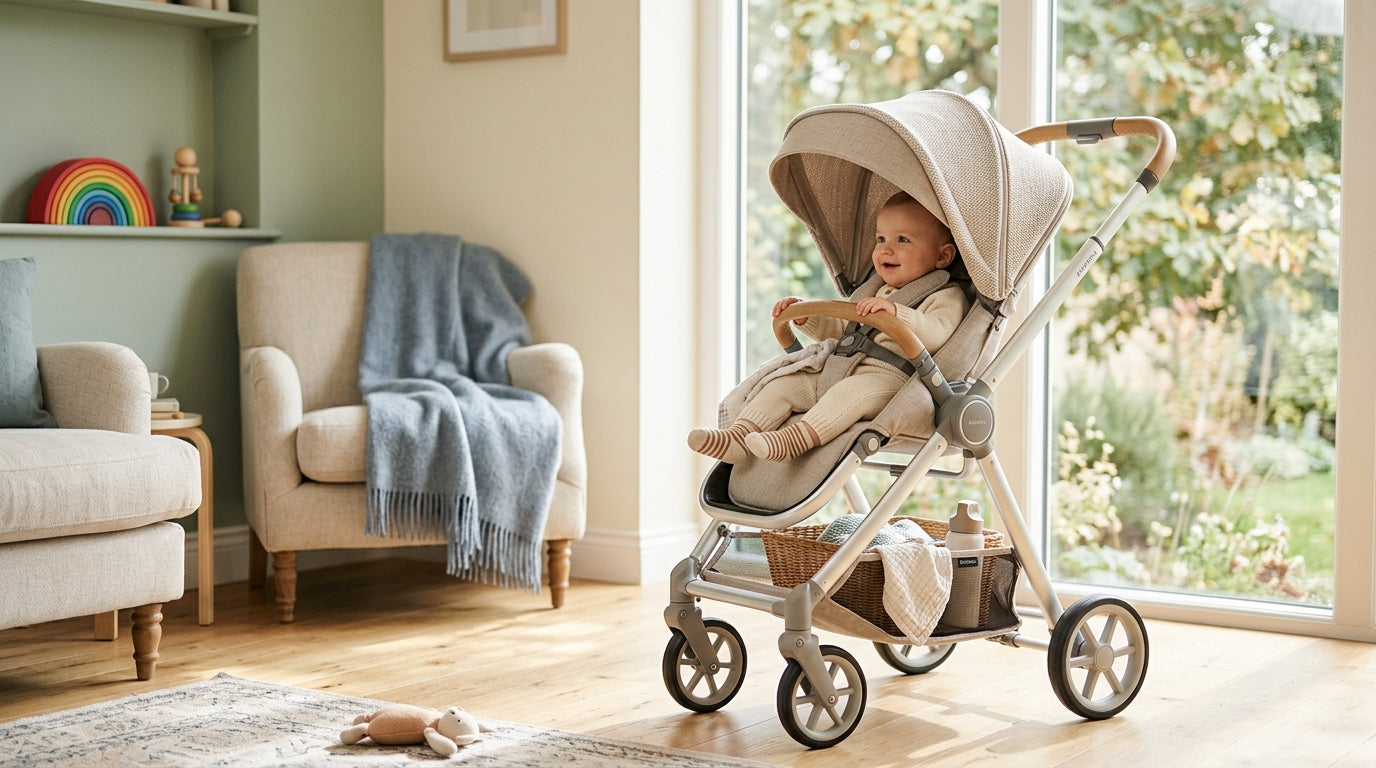
I'm currently wedged in the doorway of a Costa Coffee in Balham, the rear left wheel of our double transport system inexplicably locked, whilst twin A attempts to lick the condensation off the glass and twin B practices a high-pitched scream that could realistically shatter a pint glass. The biggest lie they sell you about parenthood in the UK isn't that you'll ever sleep again, nor is it the fantasy that you'll somehow maintain a tidy living room. It's the persistent, glossy illusion that you'll elegantly push a heritage, chrome-spoked pram through a leafy park while wearing a crisp trench coat, looking like a minor royal on a Tuesday.
The reality is sweat, swearing, and an alarming amount of squashed rice cakes embedded in the folding hinges. When my wife and I first started looking at buggies, I genuinely thought I was preparing to buy a small, sensible vehicle that would safely transport my future children from point A to point B. I didn't realise I was entering a high-stakes world of pneumatic tyres, suspension debates, and folding mechanisms that require a degree in mechanical engineering to operate while operating on two hours of sleep.
The royal carriage fantasy dies in the rain
Let's talk about those massive, vintage-style prams for a second. You know the ones. They look like they should be pulled by a miniature pony and cost roughly the same as a deposit on a studio flat in Croydon. When my wife was pregnant, we walked into a boutique in Chelsea and I stood staring at one of these magnificent beasts. The suspension was literal leather straps. The chassis was polished chrome. It was beautiful, sweeping, and utterly detached from the reality of twenty-first-century infrastructure.
Imagine, if you'll, trying to get a coach-built carriage onto a rail replacement bus service on a wet Sunday in November. You can't fold it. You can barely turn it. You just stand there taking up the entire designated wheelchair space while pensioners passively-aggressively sigh at the sheer square footage of your child's transport. These things weigh as much as a small tractor, which is fine if your daily routine consists exclusively of parading around a private country estate, but entirely useless if you ever need to encounter a kerb, a narrow shop aisle, or a moderately steep hill in South London.
I spent twenty minutes trying to figure out how one might theoretically dismantle a heritage pram to fit it into the boot of a Volkswagen Golf, only for the sales assistant to look at me with pity and suggest that perhaps I should consider purchasing a larger vehicle. I had come in for a pram and was being up-sold an SUV.
Those ultra-compact travel systems are entirely fine, provided you don't mind driving a plastic transformer that routinely jams halfway between car seat mode and pushchair mode while it's pouring with rain.
What the health visitor actually told me about flat backs
Before the twins arrived, I assumed babies could just be propped up in whatever seat looked remotely comfortable, much like a drunken mate in the back of a minicab. Then Brenda, our fiercely no-nonsense NHS health visitor—a woman who has seen more chaos than I've had hot dinners—sat on our sofa, drank my lukewarm tea, and thoroughly dismantled my ignorance.
According to Brenda, you absolutely can't just chuck a newborn into a seated stroller and hope for the best. She started drawing diagrams of infant spines on the back of an envelope, explaining something about how their little airways can compress if their chins drop down to their chests. The medical reasoning wrapped itself in layers of oxygen saturation and spinal curvature that I didn't entirely absorb because I was distracted by the sheer terror of impending fatherhood, but the fundamental takeaway burned itself into my brain: keep them completely, totally flat until they can sit up by themselves.
This means your first buggy has to have a carrycot attachment or a seat that reclines precisely 180 degrees. You end up staring intensely at product specifications at 2am, trying to determine if a 170-degree recline is going to ruin your child's posture for life or if the manufacturer just rounded down. Brenda's advice basically dictated our entire purchasing strategy, ruling out half the market instantly because they were only "suitable from six months."
The vocabulary lesson nobody asked for
If you're buying a buggy in Britain, you've to decipher the local terminology, which seems designed specifically to confuse exhausted people. We use words interchangeably that actually refer to entirely different stages of a child's life, leading to panicked internet searches and accidental purchases of things your baby won't fit into for a year and a half.
A "pram" is traditionally the lie-flat carriage meant exclusively for newborns. It's essentially a bed on wheels. Then you've the "pushchair," which is what it turns into when your kid develops neck muscles, decides lying flat is an insult to their dignity, and wants to sit up to hurl abuse at passing pigeons. A "stroller" or "buggy" is usually the lighter, flimsier thing you buy when they hit toddlerhood and you realise you can't be bothered to lug the massive pushchair onto the Central line anymore.
Trying to find a system that smoothly transitions from a newborn pram to a toddler pushchair without forcing you to store three different bulky fabric attachments in a flat that barely has enough room for your own shoes is an extreme sport. You end up living with a carrycot shoved on top of the wardrobe for two years just in case you decide to have another baby.
Things that actually keep me sane on the pavement
The buggy itself is only half the battle; the rest is what you put inside it to prevent total meltdowns. When you're miles from home and one of the twins decides to enact a biological incident that breaches the boundaries of their nappy, your survival depends entirely on how you've dressed them.

I can't overstate my love for the Organic Cotton Baby Bodysuit Sleeveless Infant Onesie. This isn't just me liking a piece of clothing; this is a deeply forged bond born in the trenches of a public park toilet. The magic of these specific onesies is the envelope-style shoulders. When a blowout occurs—and it'll occur, usually when you're furthest from your front door—you don't want to pull a soiled garment upwards over your baby's head, thereby painting their face with disaster. You pull it down over the shoulders. It stretches beautifully, the organic cotton is so soft it doesn't irritate the skin we've just aggressively scrubbed with wet wipes, and it genuinely holds its shape after I've thrown it into a boiling hot wash in a state of deep trauma.
Then there's the teething phase, which transforms peaceful buggy rides into desperate hostage negotiations. I bought the Panda Teether Silicone Baby Bamboo Chew Toy thinking it would buy me twenty minutes of quiet walking time. In all honesty, it's just okay. The twins do like chewing on the textured silicone ears, and it's completely safe and non-toxic, which is great. The issue is entirely mechanical: it's not attached to anything. They chew it happily for three minutes and then forcefully eject it from the pram onto the filthy London pavement. I now spend half my walk picking up a panda, sanitising it with a wipe, handing it back, and repeating the cycle until my lower back gives out.
If you need to mindlessly scroll for things that seriously make this parenting chaos marginally more manageable while you're trapped under a sleeping infant, take a look at the organic baby clothes collection. It's infinitely better than reading parenting forums that tell you you're doing everything wrong.
The great suspension lie
Let's address the marketing fiction of "all-terrain" capabilities. Every brand wants you to believe their buggy can seamlessly transition from a smooth shopping centre floor to the rugged peaks of the Scottish Highlands. They proudly advertise independent four-wheel suspension, puncture-proof tyres, and shock absorbers that look like they belong on a mountain bike.
I believed this hype. I bought a heavy, robust, "all-terrain" double pushchair thinking we would take the girls on bracing country walks through the mud. But we live in Zone 3. The most treacherous terrain we handle on a daily basis is a cracked paving slab outside the off-licence and the rogue cobblestones near the local pub. Yes, the massive air-filled tyres handle the cobbles beautifully, but they also make the buggy so catastrophically wide that I can't fit through the door of my local bakery. I've to stand outside in the rain and shout my order for a flat white through the open doorway like a Victorian street urchin.
You quickly realise that in a city, your true enemy isn't mud or rough terrain; it's narrow aisles, sharply angled corners, and the structural pillars of underground stations. A buggy with massive off-road wheels is completely useless when you're trying to pivot 180 degrees inside a tiny pharmacy without knocking over a display of discounted paracetamol.
Why the centre of gravity matters more than cup holders
When you first test drive a buggy in a shop, you push it around empty. It glides. It feels weightless. You push it with one finger and feel like a masterful parent who has everything under control.

This is a trap. You never, ever push an empty buggy. You push a buggy containing a sack of potatoes masquerading as a child, alongside a changing bag packed with enough provisions to survive a minor apocalypse, three discarded coats, a half-eaten banana, and your own shattered dignity. The centre of gravity completely shifts.
I learned about tip hazards the hard way. I had foolishly hung a heavy changing bag over the handlebars of our supposedly sturdy pushchair. I then removed twin A from the seat to deal with a tantrum. The sudden removal of counterweight at the front, combined with the heavy bag at the back, caused the entire £800 contraption to rear up like a frightened horse and tip backwards onto the pavement, scattering wet wipes and Calpol syringes across the high street. Always buy something with a massive, low-to-the-ground basket underneath the seats. Cup holders are a vanity project; a low centre of gravity is a survival requirement.
The sweet relief of coming indoors
The only genuinely peaceful part of the buggy experience is the moment you finally heave it back over the threshold of your own front door, lock the wheels, and let the children out. Once they're safely contained in the living room, the transport nightmare ends and the indoor chaos begins.
This is where the Wooden Baby Gym | Rainbow Play Gym Set has saved my sanity more times than I can count. When we get back from a particularly harrowing walk where everyone has screamed and it has rained continuously, I just lay them under this wooden A-frame. I don't know what it's about the gentle wooden shapes and the quiet aesthetic, but it instantly resets their mood. Unlike those plastic nightmare toys that flash strobe lights and aggressively sing out of tune, this just sits there quietly offering tactile comfort. It lets me sit down on the sofa, drink a glass of water, and stare blankly at the wall for five uninterrupted minutes while they bat at a wooden elephant.
Before you commit to spending the equivalent of a second-hand car on a set of wheels that will inevitably get covered in mashed peas within a fortnight, perhaps pour yourself a strong coffee and browse some sustainable baby gear that won't require you to remortgage your house.
Questions I frantically googled at 3am
Can a newborn really not go in a normal seated buggy?
No, they really can't, unless you want Brenda the health visitor to haunt your dreams. They have the neck strength of a cooked noodle. Until they can sit up completely unaided (usually around six months, though my twins took their sweet time), they need to be flat on their backs in a carrycot so they can honestly breathe properly. It's annoying and expensive to buy the attachment, but entirely non-negotiable.
Do I honestly need a travel system?
A travel system just means the buggy frame can take a car seat, a flat carrycot, and a toddler seat. If you've a car and plan on driving a lot, yes, clicking the car seat straight onto the wheels without waking the baby is a beautiful, rare piece of parenting magic. If you don't own a car and rely entirely on the bus or the tube, don't bother. You'll just be paying extra for adapters you'll inevitably lose in the back of a drawer.
Why are three-wheel buggies so popular?
They look terribly sporty, like you're about to jog a 5k with your infant instead of trudging to the shops for emergency milk. They're genuinely brilliant for getting up kerbs and steering with one hand while holding a coffee in the other. However, if you hit a dip in the pavement at the wrong angle, the single front wheel can aggressively swerve, threatening to tip the whole thing over. I prefer four wheels. I need all the structural stability I can get.
Will a side-by-side double buggy fit through my front door?
Take a tape measure, measure your front door, measure the buggy, and then assume the manufacturer is lying by at least an inch. Our side-by-side double technically fits through our front door, provided I scrape my knuckles against the doorframe and hold my breath. It doesn't, however, fit down the aisle of our local corner shop, which forces me to leave the children in the doorway like bouncers while I sprint to grab bread.




Share:
Why the boss baby characters explain your toxic toddler
Why I Googled the Brooklyn Baby Lyrics in the Minivan Today