

My mother-in-law arrived on a Tuesday afternoon with a battery-operated plastic farmyard that screamed distorted animal noises at 120 decibels, proudly declaring it highly educational for the twins. The very next day, my heavily bearded friend who lives in Hackney and has exactly one six-year-old child told me that manufactured baby toys are a capitalist trap, suggesting I should just give the girls a wooden spoon and a sensory bin full of organic dry lentils. Meanwhile, our NHS health visitor looked at my daughters with deep exhaustion during their weigh-in and muttered that anything brightly coloured would irreparably overstimulate their developing optic nerves, advising me to stick strictly to black-and-white flashcards until they could walk.
So there I was at 3am, sitting on the nursery floor in the dark, clutching a flashing plastic cow that I couldn't figure out how to turn off, trying to brush a rogue organic lentil off my knee, and wondering how my house had been entirely swallowed by infantile clutter in under six months.
When you've a baby (and particularly when you've two at the exact same time), your home rapidly transforms from a sanctuary of adult peace into a brightly coloured warehouse of tripping hazards. Everyone wants to buy you things, and you, operating on roughly four cumulative hours of sleep, are desperately searching for anything that will keep a tiny human occupied long enough for you to drink a cup of tea before it goes cold. But navigating the absolute minefield of what's safe, what's genuinely helpful for their development, and what's just a noisy piece of future landfill is exhausting.
The great plastic noise machine
Before having kids, I assumed babies naturally gravitated towards those massive plastic activity centres that feature flashing lights, mechanical voices, and buttons that trigger aggressive synth-pop melodies. I thought you needed these things to make your child clever.
Then I had a very humbling conversation with our exhausted GP while one of the twins was getting her jabs. I asked him if I needed to buy more electronic learning toys to help with their cognitive milestones, and he looked at me like I was an absolute idiot. He vaguely explained that a baby's brain grows through real-world, face-to-face interaction, and that flashing digital toys actually interrupt that natural process because they do all the work for the child. Apparently, the medical consensus is that the best toy for a baby is actually just a responsive adult, which is a terrifying prospect when you're deeply sleep-deprived and can't remember your own postcode.
He basically told me that toys shouldn't need batteries to be engaging. A toy should be mostly powered by the child's imagination rather than lithium-ion cells. I’m pretty sure my understanding of the neuroscience here's deeply flawed, but the core takeaway was clear: stop buying the flashing junk and just let them hit a wooden block against a saucepan.
Checking if everyday items will kill them
The paranoia regarding choking hazards hits you like a freight train the moment your child figures out how to put their hand in their mouth. Suddenly, every object in your house looks like a lethal weapon.
My health visitor mentioned the "toilet roll test" in passing, which sent me into an absolute tailspin. The premise is simple: if a toy, or a piece of a toy, can fit completely inside a standard cardboard toilet paper tube, it's a choking hazard for a baby. For three days after learning this, I walked around our flat shoving my wife’s lip balm, errant keys, and every single baby toy we owned into a toilet roll core. If it slid through, it went straight into a high cupboard. You would be horrified by how many things marketed for small children fail this basic sizing test.
Then there's the absolute nightmare of button batteries and magnets. I read one terrifying article on a parenting forum about how high-powered magnets and button batteries can cause horrific internal injuries if swallowed, which resulted in me spending an entire Sunday afternoon with a tiny screwdriver, checking that every single battery compartment in the house was screwed shut. If you've any baby toys with unsecured battery flaps, you should honestly just bin them or permanently tape them shut because the anxiety simply isn't worth it.
The potato phase
During the first four months, babies are essentially very demanding, leaky potatoes. They can't move much, they can't hold things properly, and their vision is restricted to things roughly eight inches from their face.

People will buy you incredibly complex toys for this age, but newborns genuinely only care about high-contrast patterns because it’s all their unformed eyes can actually see. We ended up relying heavily on an organic cotton high-contrast soft book. I'll be perfectly honest with you—this was a "just okay" product in the grand scheme of things, mostly because they grew out of the high-contrast phase quite quickly, but for those first few months, propping that book up during tummy time was the only way to stop them from face-planting into the playmat and screaming. It eventually ended up crushed at the bottom of the nappy bag, but it did miraculously keep one of them completely silent during a particularly tense, traffic-heavy bus ride to Croydon, so it earned its keep.
The era of maximum drool
Right around five months, the grasping reflex kicked in, accompanied by the eruption of their first teeth. This meant that every single object within a two-foot radius was immediately grabbed, dragged toward their face, and coated in thick, sticky drool.
This is the age where you really have to start caring about what things are made of. When you realise your child is using a toy to vigorously massage their bleeding gums, you suddenly become deeply suspicious of cheap plastics and mysterious painted finishes. We switched entirely to food-grade silicone teethers and natural wood during this period, mostly because the thought of them ingesting whatever chemicals make cheap plastic smell like a petrol station made me feel quite ill. You just freeze the silicone ones for twenty minutes, hand them over, and let them gnaw away like tiny, aggressive rodents.
The gravity experiments
Between six and twelve months, babies discover cause and effect, which mostly translates to: "If I drop this from my highchair, Dad has to bend over and pick it up. Let's see if he'll do it forty-seven times in a row."
They also start figuring out how things fit together. This was when we found our absolute holy grail product. Someone gifted us a set of wooden stacking rings, and I can't overstate how much abuse these things have survived.
They're completely open-ended, meaning the girls don't just stack them. They use the rings as bracelets, they use the base as a makeshift hammer to hit the skirting boards, and they constantly fight over the blue ring even though there are two identical blue rings. Because they're solid wood, they don't break when hurled across the kitchen floor, and because they're painted with non-toxic stuff, I don't panic when they inevitably end up in someone's mouth. Having a few high-quality, indestructible items like this completely eliminates the need for a massive toy box full of plastic rubbish.
What lurks inside the bath rubber duck
I need to take a brief moment to ruin your day by talking about bath toys. For the first year of their lives, my daughters played with those classic squeezable rubber animals that squirt water out of a little hole.

One evening, I gave the little yellow duck a particularly hard squeeze to make my daughter laugh, and a horrific clump of thick, black, stringy mould shot out of the hole and floated menacingly in the pristine bathwater. I nearly threw up. Because those toys never fully dry on the inside, they become absolute breeding grounds for toxic black sludge.
I immediately gathered every single squirt toy we owned, threw them into a bin bag, and marched them out to the wheelie bin in the dark. We now only use solid wooden bath boats or open nesting cups that can be thoroughly dried with a towel. Do yourself a favour and cut open your child's rubber bath toys today—you'll be deeply traumatised, but it's necessary.
Embracing the chaos
The truth about navigating the world of playthings is that less is genuinely more. When you've fewer, better-made things, the children honestly have to use their imaginations rather than just pressing a button to be passively entertained. Plus, it takes significantly less time to hoover the living room when you aren't navigating a minefield of brightly coloured plastic.
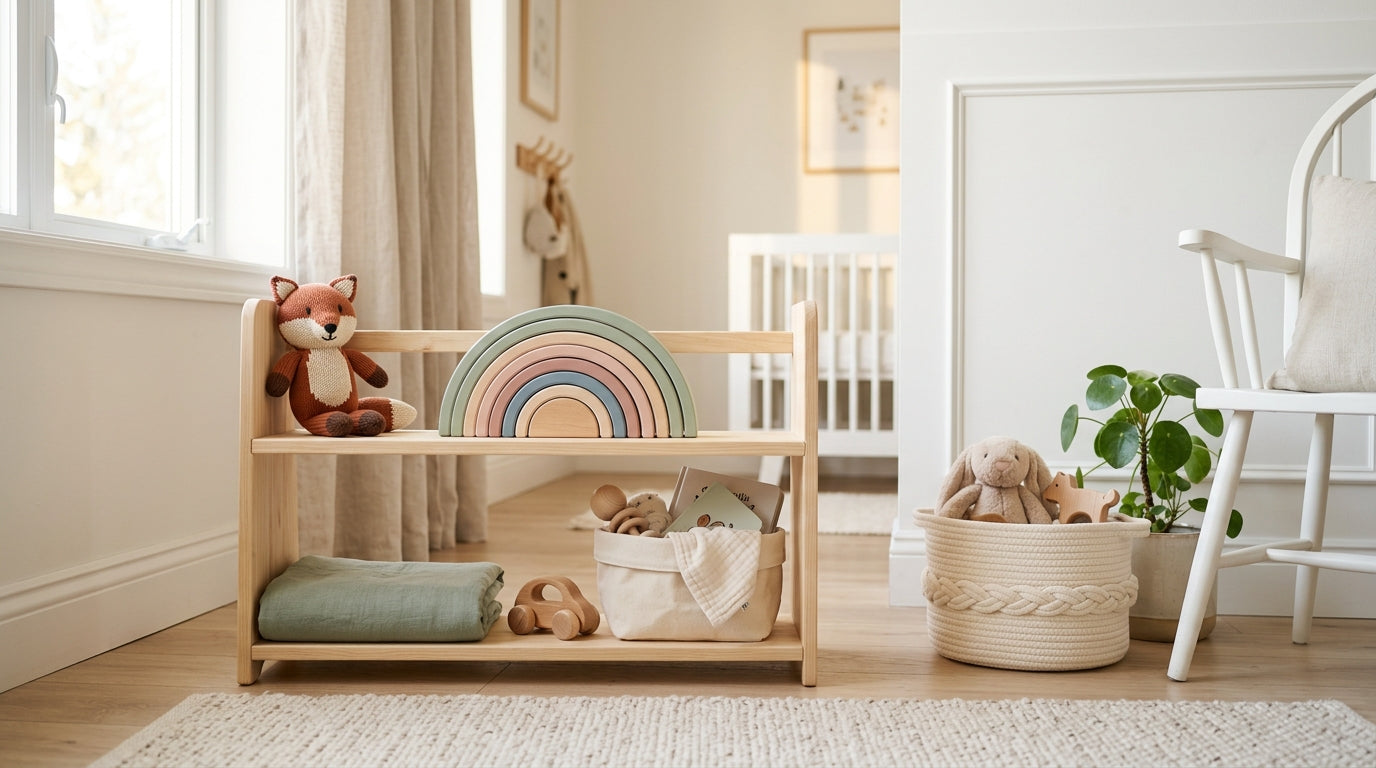
If you're trying to reclaim your living space from the plastic invasion, highly suggest checking out a curated sustainable baby toys collection to find things that won't make your eyes bleed or spontaneously play tinny music in the middle of the night.
Before you completely overhaul your nursery and bin everything you own, here are a few honest answers to the questions you're probably muttering to yourself right now.
The messy realities of baby toys
How do I get relatives to stop buying giant plastic rubbish for birthdays?You have to be ruthlessly proactive. About a month before any birthday or holiday, send a polite but firm text explaining that you only don't have the physical space for large electronic items, and suggest a specific book or a small wooden item instead. If they ignore you and buy the giant plastic farmyard anyway, let the child play with it for a week, take a photo to send to the relative, and then quietly donate it to a charity shop while the baby is sleeping. They have zero object permanence; they'll never know it's gone.
Did you really throw away all your bath squirt toys?Every single one of them. Once you see the black sludge float past your child's knee, you can never unsee it. We replaced them with a few heavy-duty plastic cups from the kitchen cupboard and a solid natural rubber boat that has absolutely no holes in it. The twins still love the bath, and I no longer lie awake at night wondering if I'm exposing them to a rare fungal infection.
Are wooden toys seriously better or just prettier for Instagram?Look, they absolutely look better in your living room, which is a valid point when your house has been overtaken by children. But practically, they just last longer. The plastic ones crack when dropped on hard floors, and the electronic ones break the second a bit of drool gets into the battery casing. The wooden stacking rings we've look practically brand new despite being used daily as blunt force weapons by two angry toddlers.
How do I clean drooled-on wooden blocks without ruining them?Don't soak them in the sink, unless you want them to swell up and crack. I just use a damp cloth with a tiny bit of mild soap, wipe off the layer of crusty saliva, and let them air dry completely on the kitchen counter. If they're looking a bit sad and dry after a year of abuse, you can rub a tiny bit of olive oil or coconut oil into the wood to make it look nice again, though I rarely have the energy to really do this.
What do you do when one twin uses a soft toy to bash the other twin?This is precisely why I prefer soft, fabric-based dolls for the toddler stage. When one of my daughters inevitably decides that her sister needs to be aggressively disciplined with a toy, a stuffed organic cotton rabbit causes a lot less damage and requires far less Calpol than a solid plastic action figure. You just separate them, confiscate the rabbit, and pour yourself another coffee.




Share:
What Nobody Tells You About Your Baby's Breath
The Truth About Baby's Breath (And Why Pinterest Lied To You)