

I'm sitting on my living room floor in Chicago watching a blue animated tang fish bump into a coral reef for the fortieth time today. My toddler is mesmerized by the screen. Half the moms in my playgroup think this movie is just aquatic background noise designed to keep kids quiet while we drink lukewarm oat milk lattes. They think the parents in the film are just cute cartoon fish with zero relevance to raising human toddlers in a major city. They're dead wrong. The biggest myth in modern parenting is that keeping your kid in a sterile, padded bubble keeps them safe. It actually ruins them.
I've seen a thousand of these kids in the pediatric ER. The ones whose parents hover so close they breathe their recycled air. They come into triage with a scraped knee acting like they need a chest tube because they've never experienced a single uncontrolled moment in their lives. The mom is hyperventilating, the dad is asking for a specialist, and the kid is screaming because they don't know how to process minor physical discomfort. Then you look at the little blue fish on the screen and her parents, and you realize an animated movie has better child psychology than half the parenting influencers on the internet.
The problem with the padded bubble
Listen, my pediatrician said that a brain needs a little bit of stress to grow. I vaguely remember from my neuro-pediatrics rotation that when kids figure things out by themselves, their neurons actually physically change. Synapses form. Dendrites sprout. Or something along those lines. The biological reality is that development requires friction. If you shield your baby from every little frustration, you starve their brain. You turn them into a fragile little teacup.
The parents in that movie model what child psychologists call authoritative parenting. They have a kid with severe short-term memory loss. A literal disability. And they don't lock her in an anemone for the rest of her life. They let her try things. They let her fail safely. They just drop little shells on the sand.
We have this obsession right now with clearing the path for our kids. Snowplow parenting. It's exhausting. Frankly, I don't have the energy for it. Raising a toddler is already like running triage in a trauma unit during a full moon, so you've to prioritize the bleeding and let the minor cuts heal themselves. I call this the baby d approach. You give them the tools, but you let them swim the scary reef alone.
Dropping shells instead of snowplows
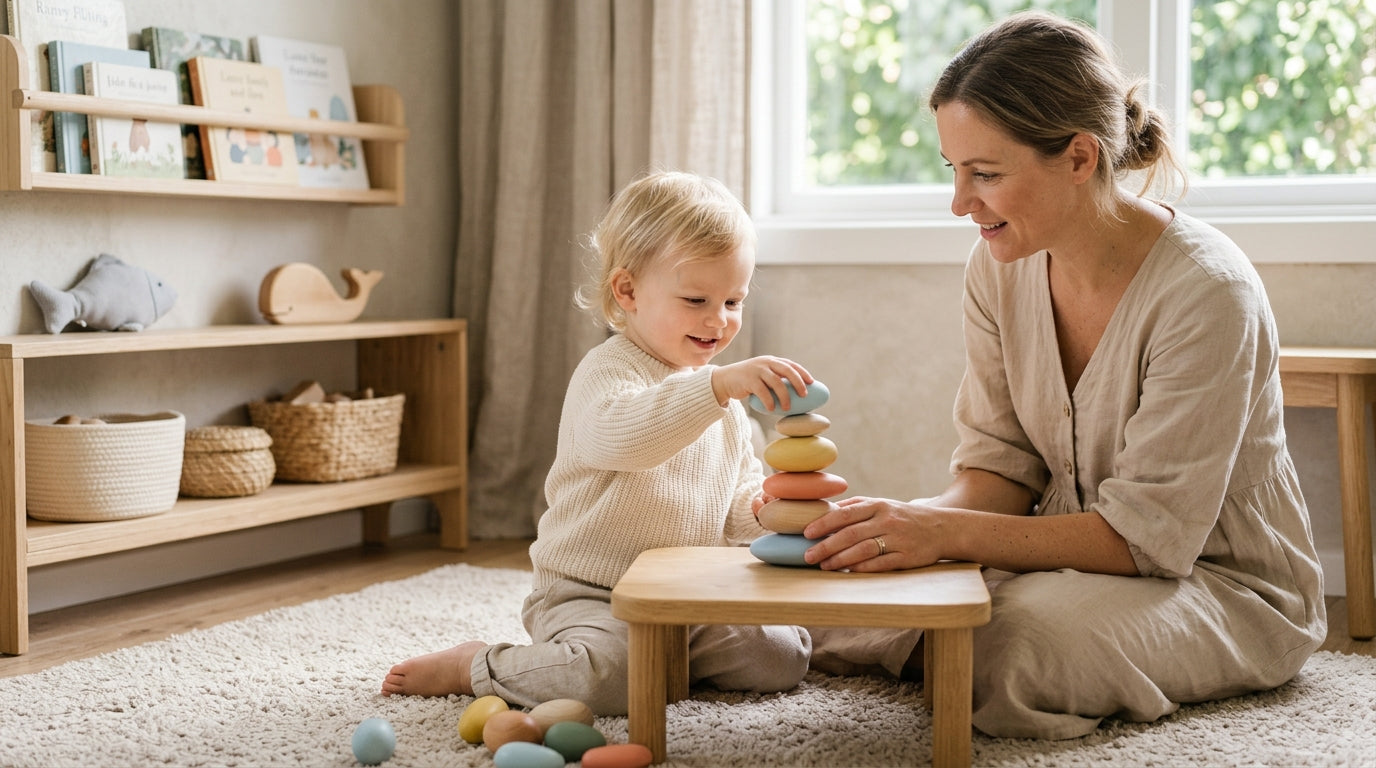
When my kid gets stuck trying to get his Gentle Baby Building Block Set to stack, my instinct is always to reach over and fix it. To align the little soft rubber shapes perfectly so he stops whining. But I force myself to sit on my hands. I let him get furious at the blocks.
Honestly, these blocks are a lifesaver because they're soft enough that when he inevitably throws one at my head in a fit of rage, it just bounces off. I bought them because they're completely non-toxic and BPA-free, which matters to me since he chews on everything. I watched him try to shove a square peg onto a round bump for ten solid minutes yesterday. He failed repeatedly. He cried a little. Then he finally found a matching shape and looked at me like he just cured a disease. That's the whole point. He learned something because I stayed out of his way.
If you constantly step in to solve the geometry problem, your kid learns that they're incompetent. It's a subtle message, but they internalize it. They learn to look over their shoulder for an adult the second things get hard, beta.
Rehearsing for the real world
Another thing about that little aquatic family. They practice what to say. They run drills over and over. It reminds me of how we prep pediatric patients for IV insertions. We don't lie and say it won't hurt. We tell them exactly what's coming and give them a job to do. We give them a script.

If your kid has a peanut allergy, or sensory issues, or just a really specific anxiety, you've to teach them to own it. You practice the words at home. My kid gets completely overwhelmed by loud noises. The El train goes by our apartment and he loses his mind. We practice saying, "too loud, ears hurt." It's incredibly basic. But it gives him a script he can use when I'm not standing right next to him.
You can't expect a child to suddenly advocate for themselves in the wild if you never ran the drill at home, yaar. You practice the social interactions until they're boring. Just like practicing saying, "I suffer from short-term memory loss." It removes the shame from the equation.
Environmental cues and sensory crutches
We rely heavily on environmental cues in our house. Physical shells on the sand, so to speak.
When my son was a few months old, we got the Wooden Baby Gym. It's okay. Honestly, it looks beautiful in the living room, which is mostly why I bought it over those neon plastic monstrosities. The wooden frame is sturdy, and the little hanging elephant is cute. But it only held his attention for about a month before he wanted to crawl away and eat a shoe. Still, it gave him a physical boundary. He knew that when he was under the wooden arch, it was time to reach and grab. It was a physical perimeter that told his little brain what was expected of him.
You don't need a perfectly curated Montessori home. You just need clear visual signals. Routine charts, tactile paths, a specific chair where shoes go. These are your modern shells. You set them up so you don't have to micromanage their every move.
If you want to set up an environment that actually lets your kid figure things out independently without tearing your house apart, you might want to look at some of the sensory tools in the Kianao educational toys collection.
Using pain as a data point
Listen, as parents we try to numb every discomfort. But sometimes a baby just has to experience the awful sensation of a tooth cutting through the gums to figure out how to self-soothe. Pain is just a data point for the brain.

When my baby was cutting his first molars, it was a nightmare. He was an absolute feral animal at 3 AM. Instead of dosing him with medication every four hours around the clock, we handed him the Panda Teether. He had to learn how to maneuver the flat little panda head into the back of his mouth to get relief.
I like this teether because it's just a solid piece of food-grade silicone. There's no weird liquid gel inside that might leak out and poison him. No complex parts to scrub with a tiny brush. I just throw it in the dishwasher with my coffee mugs. I'd put it in the fridge for ten minutes when his gums were really swollen. It taught him that when his mouth hurts, he has a tool to fix it himself. He grabbed the panda, gnawed on it violently, and stopped screaming. Problem solved without me having to rock him for three hours.
The harsh reality of stepping back
The hardest part of this whole philosophy is sitting with your own anxiety. When you let your kid take a risk, your heart rate spikes. Mine absolutely does. Every time my toddler climbs the back of the couch, my brain flashes to twelve different skull fracture protocols from my ER days.
But you've to let them climb. You have to let them fall onto the rug. You have to let them forget things and deal with the immediate consequences. If you fix everything and clear every obstacle, you send a very clear, toxic message. You're telling them they're too weak to handle this world without you hovering nearby.
One day, you won't be there to drop the shells. They need to know how to find their own way home. The earlier you start stepping back, the less painful it's for both of you when they finally swim off.
Before you jump in to fix your child's next minor crisis, take a breath and let them struggle for five seconds. In the meantime, you can stock up on gear that supports independent play in our baby essentials collection.
The real questions you've
How do I know the difference between a safe struggle and a dangerous one?
Listen, it's mostly common sense mixed with a little maternal panic. If my kid is trying to climb a bookcase that isn't bolted to the wall, that's dangerous. I intervene immediately. If he's trying to climb a soft foam block and keeps tumbling onto a thick rug, that's a safe struggle. Ask yourself if the worst-case scenario ends in the ER or just with some tears. If it's just tears, let them cry.
My mother-in-law says I'm neglecting my baby when I let him get frustrated over a toy.
Older generations love to judge our parenting while conveniently forgetting they let's ride in the beds of pickup trucks with no seatbelts. You just have to politely ignore her. I usually say something like, "My pediatrician wants him to practice problem-solving," and walk away. Blame the doctors. We're used to it.
Can you genuinely teach resilience to a tiny baby?
You don't teach it with flashcards. You build it by not rushing in the second they make a sound. When my baby drops a pacifier in the crib and starts fussing, I wait. Give it thirty seconds. Half the time, he finds it himself and goes back to sleep. That's the absolute foundation of resilience. Figuring out that they can solve their own minor inconveniences.
What if my kid has a total meltdown when I don't help them?
They will. It's guaranteed. Toddlers have the emotional regulation of an intoxicated adult. When the meltdown happens, I just sit nearby. I don't fix the toy, but I don't leave the room either. I just say, "I know you're mad the block won't fit." You validate the anger without solving the problem. It sucks to listen to, but it passes.
Are visual schedules really necessary for a toddler?
Honestly, yes. Toddlers have zero concept of time. Telling them "we're leaving in five minutes" means absolutely nothing to their developing brains. Having a physical chart or a visual timer gives them a concrete shell to follow. It saves me from repeating myself fifty times a morning, which is a win for my own mental health.




Share:
Surviving the Unexplainable Evening Crying Phase
Why the Baby Driver Actor Made Me Rethink Infant Safety