

Dear Jess from six months ago,
You're currently sitting in the rocking chair at 2 AM, running on three hours of sleep and a cold cup of coffee, frantically waving a muted sage-green wooden toy in front of your new baby’s face. You’re holding your breath, waiting for her to track it, and starting to spiral because she's completely ignoring it to stare blankly at the edge of the window frame. I know exactly what you’re doing because I'm you, and I’m just gonna be real with you right now: put the phone down. Stop typing when do babies start seeing into the search bar with your one free thumb, mostly because you keep misspelling it as when does a babi see and the internet is just going to give you things to panic about.
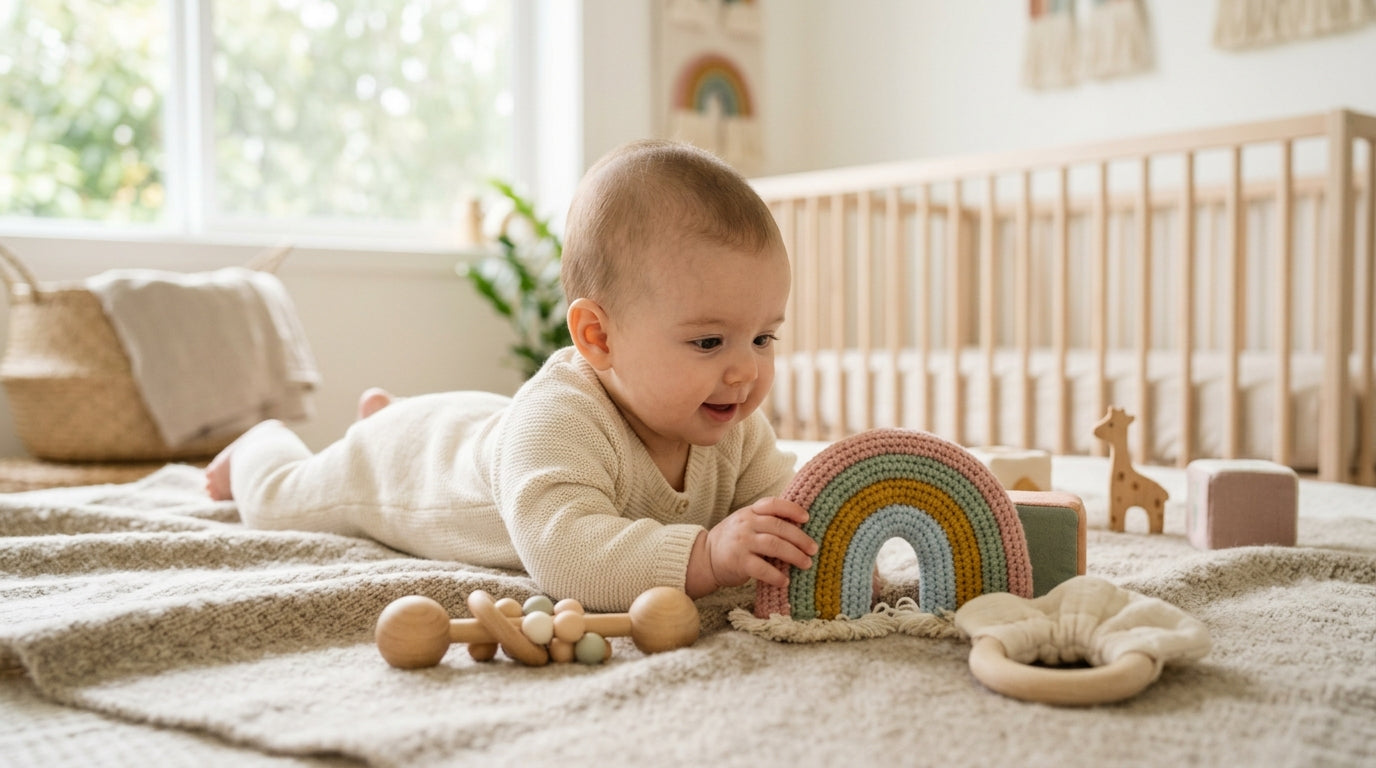
I'm writing this to save you a whole lot of money and a mountain of mom guilt. Because right now, you're obsessed with that expensive, Pinterest-perfect neutral nursery you put together, and you're deeply offended that your child doesn't appreciate your interior design skills.
Throw the beige aesthetic in the trash
Look, I get it. We all want the peaceful, earth-tone nursery that looks like it belongs in a magazine. I fell for it hard with our oldest, Jackson. I bought the beige crib sheets, the oatmeal-colored swaddles, the pale mustard wall art. And you know what he did for the first three months of his life? He ignored every single expensive thing in that room and stared exclusively at the black blades of the ceiling fan. Bless his heart, he’s five now and refuses to wear anything that isn't neon green with a monster truck on it, which is exactly the universe punishing me for my beige phase.
My doctor, Dr. Miller—who has the patience of a saint and has talked me off many ledges—told me that when these babies are born, they're basically living in an old black-and-white movie. Their vision is terrible, y'all. They can only focus on things about eight to twelve inches away from their face, which is conveniently exactly the distance from your chest to your face when you're nursing them. The rest of the room? It’s just a blurry gray soup to them.
My grandma always used to say that babies needed to be kept in dark, quiet rooms so their eyes could "cook," which is terrifying and medically completely unhinged. But she wasn't entirely wrong about the light sensitivity. Newborn pupils are tiny, so they don't let much light in. They literally can't see those lovely pale pastels you paid fifty dollars for. What they need is contrast. Harsh, ugly, bold black and white. So instead of buying expensive contrast cards, just grab a Sharpie, draw a giant target on a paper plate, and prop it up against the laundry basket while you fold clothes—I promise she will stare at it like it’s the most fascinating thing on earth.
The great red awakening
You're probably wondering exactly when do babies actually start caring about all the colorful junk their grandparents keep buying them. Well, right around the two or three-month mark, something shifts. I don't completely understand the science of it, but Dr. Miller mentioned something about the "cones" in their retinas elongating and maturing. It honestly sounded like middle school biology, but the gist is that the red-green receptors in their little eyeballs switch on first.

Red is the absolute holy grail of baby colors. It's the first thing they can really pick out of the blurry background.
I figured this out entirely by accident. I had just gotten this Flutter Sleeve Organic Cotton Baby Bodysuit in that deep, rusty red color. It’s honestly my favorite piece of clothing she owns, mainly because it’s organic cotton and doesn't give her those weird little rashy bumps on her shoulders, but also because it has these ridiculous little flutter sleeves that make her look like a tiny linebacker in a pageant dress. Anyway, I put her in it when she was about ten weeks old, and I swear to you, she spent twenty minutes just completely cross-eyed, staring at her own bright red arm. She kept bringing her little fist up to her face, dropping it, and bringing it back up, totally mesmerized by the color. The bodysuit is stretchy enough that I could wrestle her into it without waking the toddler, and it washes brilliantly, but the fact that it basically functioned as a developmental toy for a month makes it worth its weight in gold.
Now, my mom texted me around this time asking, "is the babie seeing the tv yet?" because my family's solution to everything is screen time. No, Mom, she wasn't watching TV, but she was definitely starting to track me across the room whenever I wore my hideous red college sweatshirt. It was a milestone, even if it meant sacrificing my dignity.
The rainbow explosion and the teether trap
By the time month four rolls around, the blue and yellow cones in their eyes decide to finally show up to work. Suddenly, your baby is what doctors call "trichromatic," which is a fancy way of saying they can see the whole rainbow, though they still aren't great at picking out subtle differences between, say, light pink and peach. Not that it matters, because by month five, they're shoving literally everything they can see directly into their mouths anyway.

This is where you're going to get sucked into buying aesthetic teethers. I know you. I know you're looking at that Llama Teether right now. Let me just be brutally honest: it’s fine. It's just okay. It’s made of food-grade silicone and it’s BPA-free, which is great because I refuse to let her chew on cheap plastic, but honestly? It’s a little awkward for her to hold. The llama shape is cute for an Instagram picture, but the little legs kind of poke her in the cheek when she gets aggressively chewing on it. She likes the rainbow colors well enough now that she's older, but it definitely wasn't the magical soothing cure-all I hoped it would be when I impulse-bought it at 3 AM.
If you're going to buy a silicone chew toy to survive the horror show that's infant teething, wait until she's around five months and get the Squirrel Teether instead. It's a ring shape, so she can actually grip it in her chubby little fist without dropping it on the filthy grocery store floor every thirty seconds. Plus, the mint green color with the contrast of the little acorn detail really grabs her attention now that her depth perception and full color vision are working together. She stares at it, figures out exactly where it's in space, and bam—straight to the gums. It's dishwasher safe, which is the only thing keeping me sane right now.
If you're feeling the urge to buy something right now while you're trapped under a sleeping infant, at least go look at a baby toys collection that has actual high-contrast items instead of more beige linen bunnies.
Things that actually warrant a doctor visit
Listen to me carefully: stop overanalyzing every time her eyes drift in two different directions. In those early newborn weeks, their eye muscles are about as coordinated as a drunk person on roller skates. Dr. Miller told me that a little bit of eye crossing is completely normal for the first two months.
But—and this is the important part—if she hits four months and her eyes are still constantly crossing inward or drifting outward, or if you wave a bright red toy in her face and she absolutely refuses to track it by three months, that's when you pick up the phone. Don't panic-post in a Facebook mom group, don't ask your aunt who thinks rubbing breastmilk in an eye cures astigmatism, and don't try to force the kid to do visual tracking exercises while both of you cry. Just call your doctor and let them do their job. You also need to watch out if one pupil looks way bigger than the other, or if her eyes start darting around uncontrollably in a circle, which is a scary little thing called nystagmus.
Most of the time, though? They're just developing on their own sweet, frustratingly slow timeline. They don't need you to be a perfectly educated developmental specialist. They just need you to be there, preferably wearing a highly saturated primary color so they can find you in the blur.
So, Jess from six months ago, drink your cold coffee. Stop worrying that you've ruined her visual development because you bought pale pink curtains. Close the internet browser, hold her close to your face so she can see the dark contrast of your exhausted under-eye bags, and just breathe. The color is coming.
Before you go down another rabbit hole of anxiety, just step away and explore the Kianao shop for stuff that will seriously hold up to a baby who's about to start seeing—and destroying—everything in your house.
Messy Mama FAQs About Baby Vision
How long are babies completely colorblind?
Honestly, they aren't totally colorblind at birth, they just have awful vision. Everything is basically a blurry, smudgy gray mess for the first month or two. You aren't doing anything wrong if they ignore your colorful toys; their eyeballs just literally aren't ready for them yet. Give it about 8 weeks before you expect them to care about colors.
What color should I wear so my newborn looks at me?
Black or white! Seriously, high contrast is the only thing that works at first. Once they hit about two months old, slap on the brightest, most obnoxious cherry red sweater you own. Red is the very first color their little retinas figure out how to process, and it'll absolutely blow their minds.
Do I need to buy expensive black and white flashcards?
Lord, no. Save your money for diapers. I literally used a thick black marker on the back of junk mail envelopes and taped them to the wall next to the changing pad. Babies don't care if a high-contrast pattern cost $40 or if you drew it yourself while watching reality TV.
My baby's eyes look crossed sometimes, should I freak out?
In the first couple of months? No. Their eye muscles are incredibly weak and they're just figuring out how to make them work together. Mine looked like a tiny, confused chameleon for the first six weeks. But my doctor said if they're still constantly crossing or drifting after 4 months old, that's when you really need to call the doctor to get it checked out.
When can my baby finally see pastels?
The blue and yellow receptors come online around 3 to 4 months, which gives them full color vision, but they still struggle to tell the difference between pale, muted colors until they're closer to 5 or 6 months. So that expensive sage and blush nursery? Yeah, it's pretty much just for you until they're half a year old.




Share:
When Will My Baby Actually Roll Over? A Dad's Data Log
The Honest Truth About When Your Baby Will Finally Say Mama