

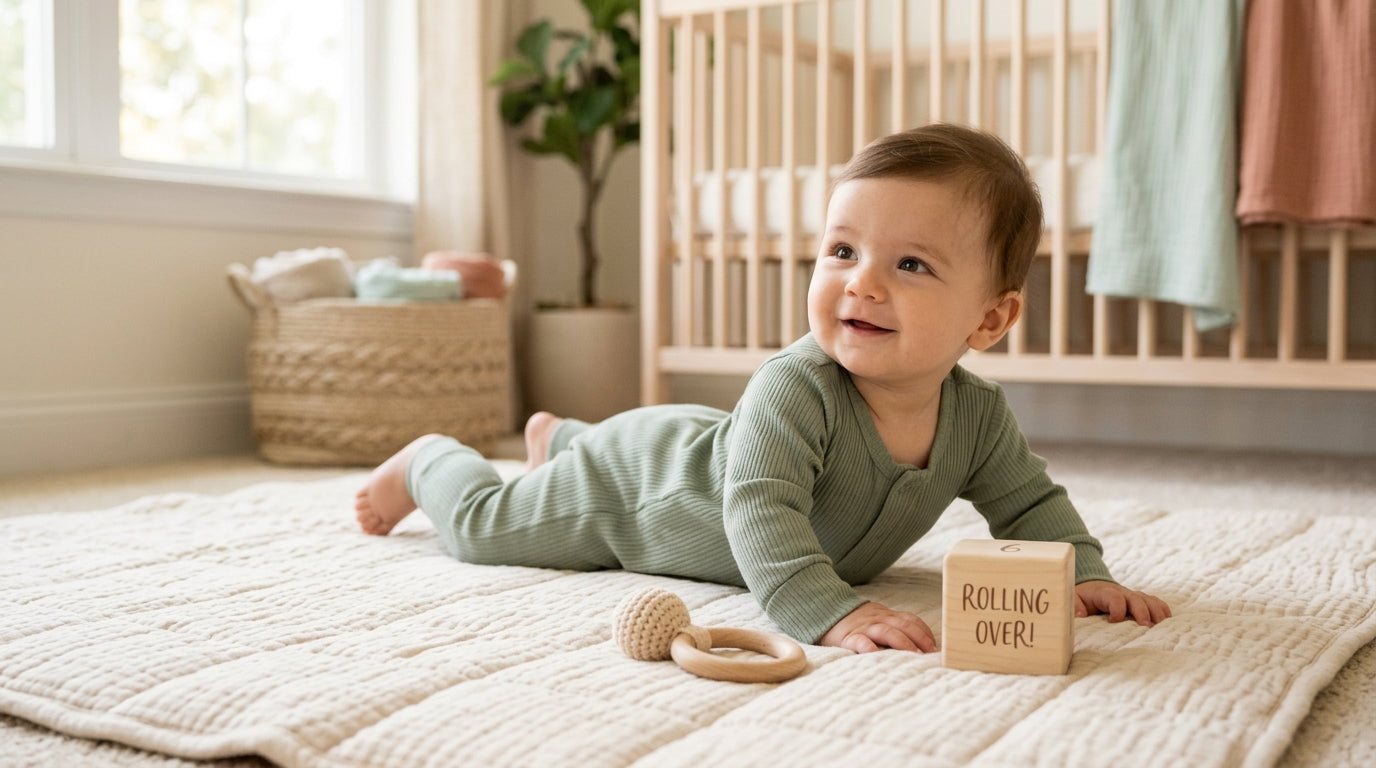
The monitor glowed like a radioactive potato on my nightstand at 3:14 AM. Usually, my son was a static lump of swaddled cotton, entirely predictable in his lack of mobility. Tonight, the lump was gone, replaced by a flat, face-down pancake at the far end of the crib. My stomach dropped straight into my pelvis. I sprinted down the hall with my nursing instincts kicking in, ready to start chest compressions on my five-and-a-half-month-old. I gently flipped him over. He looked up at me, mildly annoyed at the interruption, completely fine and breathing normally. That was the exact moment I realized we had hit the hardest gross motor milestone.
People always ask when do babies roll, but they don't realize it's actually a two-part series. The whole timeline is a mess of accidental physics and actual intent. If you're sitting there wondering when do babies start doing the gymnastics required to flip over entirely, you need to temper your expectations. It takes longer than the internet makes you think.
The physics of the flip
My doctor broke it down for me at our four-month visit because my mom kept texting me every morning asking is the babi rolling yet, like it was a competitive sport. I had to explain to her that rolling from the belly onto the back is usually the first thing that happens, somewhere between three and five months. But it's entirely accidental.
When they're on their stomachs pushing up, their heads are disproportionately heavy. They shift their weight wrong, gravity takes over, and they topple backward like a felled tree. They usually look shocked when it happens. It's not skill, it's just biomechanics.
But that back-to-belly maneuver is a completely different beast. That requires actual intent and a ridiculous amount of muscle coordination. My doctor said they've to engage their core, arch their spine, swing a heavy leg over their midline, and somehow figure out how not to trap their own arm under their ribcage. Most of the babies I used to see in the clinic figured this out between five and a half and seven and a half months.
Of course, I spent hours doomscrolling some weird babie development forum at 4 AM, convinced my son was behind because he was just lying on his back staring at the ceiling fan at six months. The reality is that every kid operates on their own weird internal clock.
Why tummy time is a psychological weapon
Listen, if there's one thing that unites modern parents, it's the shared trauma of tummy time. I spent the first four months of my son's life staring at the timer on my phone while he face-planted into the floor and screamed like I was actively torturing him. The guilt is heavy. You sit there watching them cry, knowing that if you pick them up, you're apparently ruining their core strength forever.

The problem is that you need those neck and shoulder muscles to develop so they can eventually pull off the back-to-belly flip. So you just sit there, apologizing to a red-faced infant, wiping up rivers of drool, and trying to distract them with anything shiny you can find in the living room. It's exhausting. I'd throw down a dozen different toys, sing songs I made up on the spot, and contort my own body onto the floor just to buy another thirty seconds on the clock.
Sometimes you'll see them do this little swimming motion where they lift their arms and legs off the floor at the same time while on their stomachs, which is just a reflex and doesn't actually mean they're about to roll.
The swaddle cold turkey
The day your kid shows even a hint of wanting to roll over is the day your sleep goes in the trash. The American Academy of Pediatrics says you've to drop the swaddle by eight weeks or at the first sign of rolling, whichever comes first. My doctor practically threatened me with this fact, reminding me that a baby trapped on their stomach without free arms is a massive suffocation risk.
I've seen a thousand respiratory distress cases in the ER. I don't mess with sleep safety. The night I found my son face down was the night the swaddle went into the donation bin.
We switched to sleep sacks immediately. The transition took about four days of absolute misery. He would wake himself up by smacking his own face with his newly freed hands. I was a zombie. But eventually, the startle reflex faded, and he learned to sleep with his arms out. You just have to rip the bandage off and endure the tired days, yaar.
If you're looking for soft landing spots to practice all this movement during the day, check out the baby blankets collection because the floor gets very cold and your aesthetic rugs will absolutely get ruined by spit-up.
Floor practice and the gear that survives it
Since we were spending half our waking hours on the floor waiting for a miracle roll, I needed something decent to put between my kid and the hardwood. I bought the Mono Rainbow Bamboo Baby Blanket on a whim.

It's actually my favorite thing in the nursery now. The bamboo is incredibly soft, but the real selling point is that the terracotta arch pattern perfectly camouflages the sweet potato puree he kept spitting up while trying to engage his core. I used it as a makeshift playmat cover every single day. It washes well, it doesn't pill, and it doesn't look like a circus exploded in my living room.
My mother-in-law bought us the Autumn Hedgehog Organic Cotton Baby Blanket a few weeks later. It's fine. The organic cotton is thick and the quality is definitely there. But the mustard yellow background is just a terrible color for a baby. It reflects up and makes them look faintly jaundiced. I ended up throwing it over the car seat to block the sun instead of using it for photos.
To seriously get him to practice rolling, you've to trick them into crossing their midline. Listen, just toss them on a blanket and drag a high-contrast toy across their line of sight until they get annoyed enough to reach for it. I used to lay him on the Organic Cotton Baby Blanket with the Gray Whale Pattern because the dark gray whales on the white background grabbed his attention. I'd put a wooden rattle just out of his grasp by his left ear. He would reach his right arm across his body, his hips would follow, and bam, he was on his side. From there, it was just a matter of gravity and momentum.
When I seriously start to worry
My threshold for panic is pretty high because of my background, but there are a few red flags that mean you should probably call the clinic instead of asking the internet. If you hit the six-month mark and there's zero attempt to roll in either direction, make an appointment.
I also watch out for asymmetry. If a kid is only ever rolling over their left shoulder and seems completely rigid when you try to guide them to the right, that warrants a physical therapy evaluation. Same goes for muscle tone. Babies should feel like a solid bag of flour. If you pick them up and they feel incredibly stiff like a board, or unusually floppy like they can't support any of their own weight, that's a neurological red flag my old attending doctors would want to see immediately.
Otherwise, beta, you just wait. They figure it out eventually, usually right when you turn your back to grab a wipe.
Before you spiral into an internet anxiety hole about your baby's gross motor skills, grab something safe and soft for them to practice on from our organic baby essentials and just let them figure out their own center of gravity.
The messy questions everyone asks
Do I've to flip him back over every time he rolls in his sleep?
My doctor told me that once they've the strength to flip themselves from back to belly independently, their brain and muscles are developed enough to protect their airway. If you put them down on their back initially, and they roll to their stomach in their sleep, you don't have to stay awake all night flipping them like a burger. Just make sure the crib is completely empty of blankets and toys.
He keeps getting his arm stuck under his chest. What do I do?
This is the worst phase. They flip over, trap their own arm, realize they can't move, and just scream into the mattress. I used to go in, gently tug the arm out, and pat his back until he went to sleep. You can try to guide them through the motion during the day by physically tucking their arm close to their side as they roll, but honestly, it just takes a few weeks of practice for them to figure out the spatial awareness.
Is it normal for my baby to hate being on their belly after they roll?
Yes. They spend all this energy achieving the milestone, successfully flip over, and then immediately realize they hate the view. My son would roll over and start crying within ten seconds. They're just frustrated because they haven't figured out how to roll back yet or how to crawl. You just have to sit there, flip them back, and wait for them to do it again.
Can early rolling be a bad sign?
Sometimes. In the clinic, if we saw a two-month-old every time flipping from back to belly, we didn't call them a genius. We usually checked them for hypertonia, which is unusually high muscle tension. Often, they aren't honestly rolling using intent and core strength, they're just arching their backs so rigidly that they tip over. If your newborn is throwing themselves backward constantly, bring it up at your next check-up.
Should I wake him up to practice if he's sleeping too much?
Never wake a sleeping baby unless they're medically underweight and you're on a strict feeding schedule. Sleep is when their brain consolidates all the motor skills they learned that day. Let them sleep, yaar. The rolling practice will be waiting for you when they wake up cranky and hungry.




Share:
The Honest Truth About When Your Baby Will Finally Say Mama
When Do Babies Roll: A First-Time Dad's Guide to the Midnight Flip