

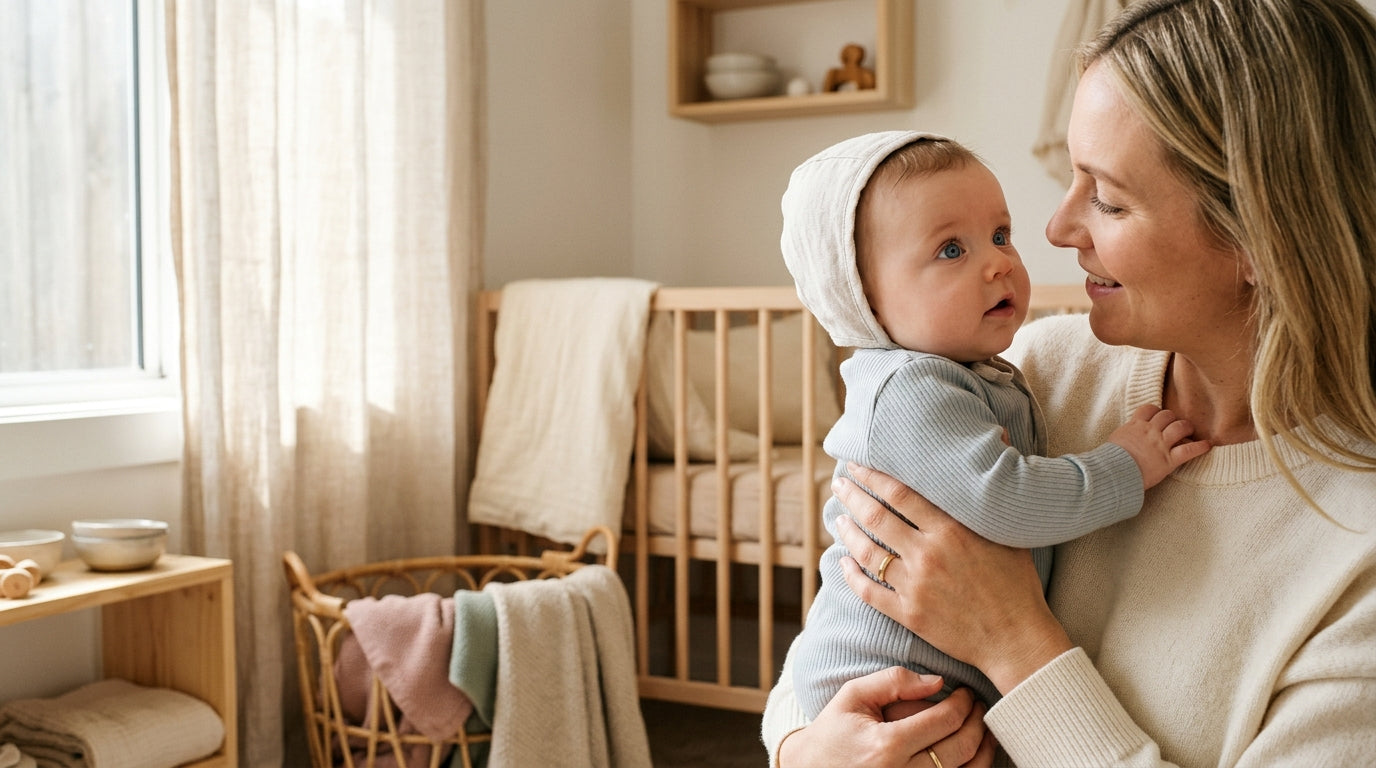
At exactly 3:14 AM on a Tuesday, I found myself holding Twin A directly under the hallway spotlight, trying to determine if her irises were the colour of the ocean or just the murky grey of the Thames at low tide. She was heavily soiled and screaming at a volume that threatened the structural integrity of our terraced house. I, on the other hand, was just desperately trying to crack her genetic code.
If you've recently brought a baby home from the hospital, you're likely playing this exact same game. We spend hours staring into their tiny, confused faces, waiting for them to reveal who they take after. My wife and I both have brown eyes, which meant this sudden appearance of pale, icy irises in our home felt like we had accidentally kidnapped a small Nordic child.
The absolute lie about all newborns
Everyone tells you that all babies are born with blue eyes. My mother-in-law mentioned this roughly forty times during the pregnancy. As it turns out, much like the advice to sleep when the baby sleeps (I prefer to sit rigidly on the sofa drinking cold tea while staring at the baby monitor), this is statistical nonsense.
I fell down a late-night research hole and discovered that only about one in five newborns actually arrive looking like tiny white walkers. The vast majority pop out with varying shades of brown. It all depends on your heritage and baseline melanin levels, but since we're a very mixed-European household, we were staring down the barrel of a complete genetic mystery.
An overly long explanation of why blue pigment is a myth
I eventually asked our GP about this at their six-week check, mostly because I needed an adult to talk to who wasn't my sleep-deprived wife. The doctor casually mentioned that there's absolutely zero blue pigment in the human body. None at all. Blue eyes are a massive optical illusion caused by something called Rayleigh scattering.
Apparently, it's the exact same physics that makes the sky look blue. Light goes into the eye, bounces around the completely empty, melanin-free space of the iris, and scatters back out as a blue wavelength. I spent three days obsessing over this fact. My children didn't actually have coloured eyes; they had empty voids that trap light and trick my brain. I tried to explain this to my wife over a lukewarm instant coffee, and she just stared at me until I agreed to go wash the mountain of plastic bottles in the sink.
Oh, and if you're wondering how two brown-eyed parents get a blue-eyed baby, it's just recessive genes hiding out for a generation. Boom. Science sorted.
Mud, sunshine, and a frankly indestructible blanket
I was so entirely distracted by this lack of actual pigment that I started noticing the colour everywhere. We had been gifted this Bamboo Baby Blanket in a blue floral pattern, and honestly, it became my absolute lifeline during those early months. The print is apparently modeled after the baby blue eyes flower (a real Californian wildflower that looks suspiciously like a weed but nicer).

I love this blanket not for its botanical accuracy, but because it's completely indestructible. Twin B managed to produce a projectile bodily fluid event that I was certain would permanently ruin the fabric, but I threw it in the wash on a blind-panic temperature setting, and it came out softer than before. Because it's made of bamboo, it controls their temperature so they don't wake up sweaty and furious, and it's incredibly gentle on their frankly ridiculous, eczema-prone skin. It's a genuinely brilliant piece of fabric that I've fully stolen to use as a lap blanket while watching television.
If you also want a blanket you can technically steal from your infant while pretending it's for their own good, you should probably browse Kianao's organic baby essentials collection before I buy them all.
What the NHS actually cares about
While I was busy worrying about aesthetics, the health visitor was looking for actual medical issues. During one of those early newborn screenings, she shined a terrifyingly bright light into my daughters' eyes to check for the 'red reflex.'
This is the part of parenting where you hold your breath and pray. If the light reflects back white or cloudy instead of red (like in a bad flash photograph from the 90s), it means you need a hospital referral immediately. The health visitor was entirely unfazed while I sweated profusely through my t-shirt. She confirmed both girls had normal reflexes and casually mentioned that I should just haul them to the doctor if I ever noticed a sudden colour change in just one eye, which is incredibly rare but definitely something that requires a medical professional rather than a Google search.
The messy reality of the timeline
Months two through six were basically an ongoing staring contest in our house. Because melanin production is triggered by light, their eyes started changing the moment they left the dark confines of the womb.

Twin A kept this piercing, terrifyingly bright gaze. Twin B, however, started going murky. First it was swamp water, then hazel, and by month eight, she had my wife's deep, permanent brown eyes.
Around this time, the brutal reality of teething kicked in. In a desperate bid for peace, we bought them the Bear Teething Rattle Wooden Ring. The crochet bear head is dyed in a shade that I can only describe as a sort of muted 'baby blu' (which was the exact, slightly pretentious spelling on a paint swatch we almost used for the nursery). Look, it's a perfectly fine teething toy. The untreated wooden ring is great for them to gnaw on, and the organic cotton is safe. But Twin A mostly just uses it as a blunt force weapon to lob at the dog's head. If your baby isn't currently training for the Olympic shot put, it's a solid purchase, but just know it might become a projectile.
Attempting to become a gardening family
Having one kid with light eyes and one with dark eyes means I now have to manage my sun paranoia asymmetrically. Those melanin-free optical illusions in Twin A's head mean she's vastly more sensitive to bright sunlight. We basically don't leave the house without a sun hat pulled down so far over her face she looks like a tiny, aggressive beekeeper.
Trying to lean into the whole eco-friendly parenting thing (and to distract myself from the toddler chaos inside the house), I honestly bought seeds for that baby blue eyes flower to plant in the back garden. They're technically called Nemophila menziesii, which sounds exactly like a Harry Potter spell that gives you severe indigestion.
I let the girls "help" with the planting, which mostly involved them eating handfuls of potting soil while wearing their Flutter Sleeve Organic Cotton Bodysuits. I'll admit I initially bought these because the little ruffled shoulders are absurdly cute, but the real win is the five percent elastane stretch. Trying to wrestle a mud-covered, rigid, angry toddler out of a normal cotton bodysuit is exactly like trying to stuff a live octopus into a string bag. This one just stretches perfectly over the chaos, survives the washing machine, and makes them look far more civilized than they honestly are.
By the time they hit eighteen months, the genetic lottery had completely settled. The daily staring contests ended, the eye colours locked in, and I was left with two entirely different tiny humans who both steadfastly refuse to eat anything green. Grab a coffee, stop shining torches in your infant's face, and just let the melanin do whatever the hell it wants.
Ready to outfit your own unpredictable offspring in clothes that can honestly survive them? Explore our full collection of sustainable baby gear and cross one less thing off your worry list.
Messy questions I Googled at 4 AM
When did your twins' eyes honestly stop changing colour?
Honestly, Twin B's eyes were doing a weird hazel-swamp-thing until about nine months, and then they just aggressively turned brown overnight. Twin A stayed blue the whole time. Most of the medical stuff I read (while panicking) said the biggest changes happen by six months, but they aren't fully "baked" until around their first birthday.
Are blue eyes really more sensitive to the sun?
My GP said yes, and anecdotally, Twin A squints way more in the sunshine than her sister does. Less melanin means less natural protection from the harsh light. Just jam a wide-brimmed hat on their head and try to keep them in the shade when they're tiny.
Did you really get that flower to grow in your garden?
Barely. I managed to get a few little blue blooms before the local foxes decided my flowerbed was a toilet. But they're supposedly very easy to grow from seed if you don't have two toddlers actively trying to trample them every time you open the back door.
What happens if one eye turns brown and the other stays blue?
The health visitor mentioned heterochromia—which is just the medical term for having two different coloured eyes—and said it's super rare but mostly completely harmless. That being said, if I suddenly noticed one of their eyes changing colour while the other didn't, I'd have absolutely bypassed Google and dragged them straight to the GP just to be safe.




Share:
The Brutal Truth About Kinder Kleider: Clothes That Actually Fit
My Chicago Winter Blowout and the Perfect Onesies Baby