

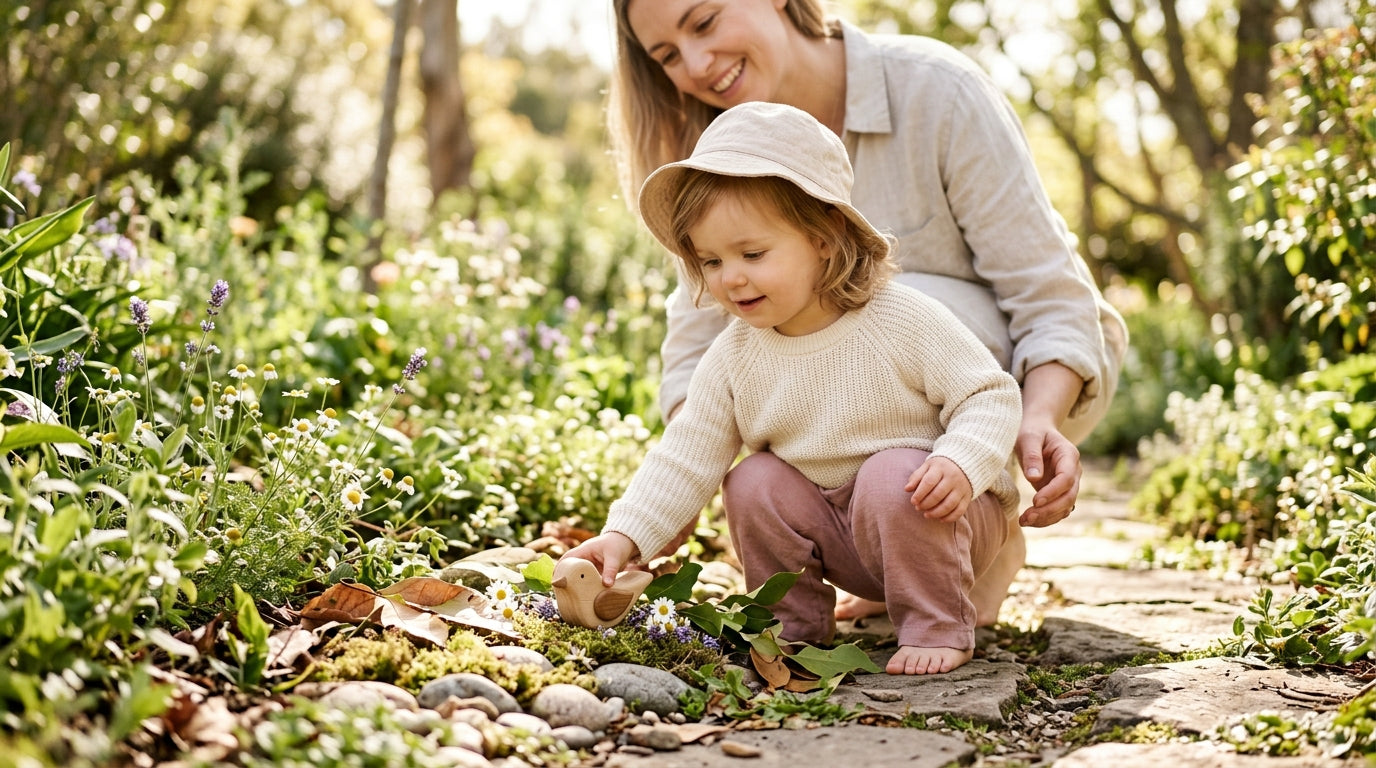
It was a Tuesday afternoon, roughly forty-five minutes before I usually cave and put the television on, when Florence trotted up to me holding what appeared to be a very angry, moldy tennis ball. She deposited it directly onto my knee. It took my brain three agonizing seconds to register that the tennis ball had a beak, was aggressively vibrating, and was, in fact, an infant bird.
My immediate physical reaction was to sort of violently hover, arms flailing, desperately trying to calculate the probability of avian flu while Matilda, the other twin, launched herself toward my leg shouting "CHICKEN! PET CHICKEN!"
If you've never had to simultaneously restrain two 2-year-olds from kissing a wild animal while attempting to frantically Google rescue procedures on a phone screen smeared in mushed banana, I highly think avoiding the experience entirely. The internet, in these moments of sheer panic, is an absolute disaster zone.
You type in something vague and desperate, and you're immediately bombarded by conflicting advice from incredibly intense wildlife forum moderators. Half the internet tells you that by merely looking at the creature, you've condemned it to death, while the other half suggests you should immediately chew up worms and spit them into its mouth like a surrogate mother (a line I'm simply not willing to cross for the local ecosystem).
It’s a uniquely stressful form of urban parenting where you’re trying to model beautiful, gentle nature stewardship while internally screaming because your daughter is trying to poke the local wildlife with a plastic spade.
The raw chicken test
I ended up calling a local wildlife rescue bloke who sounded exactly like a disappointed headmaster. He sighed heavily when I explained the situation and asked me to describe the bird. This, I learned, is the only thing that actually matters when you find one on the ground.
Apparently, you've to determine if it’s a nestling or a fledgling. My bird guy explained it to me in terms I could understand: if it looks essentially like a raw, pink supermarket chicken that someone dropped on a barbershop floor, it’s a nestling. These guys have fallen out of the nest and actually need help getting back in.
If, however, it’s covered in feathers, has a stubby little tail, and looks like a grumpy old man wearing a feather boa who's actively annoyed by your presence, it’s a fledgling. That’s what Florence had handed me. Fledglings are basically teenagers learning to fly from the ground up, and you're absolutely supposed to leave them alone to figure it out while their parents watch from a nearby branch.
Why you shouldn't offer them a snack
Once I realized we had a fledgling and I just needed to put it back in the grass, the immediate crisis shifted to Matilda, who had run into the kitchen and returned with a fistful of squashed Cheerios. Toddlers have a very specific instinct to force-feed anything smaller than them.

Naturally, your brain also starts wondering what do baby birds eat in these situations, but the wildlife guy was terrifyingly clear on this: absolutely nothing from your kitchen. It turns out that figuring out what to feed baby birds is a job exclusively for professionals, because different species have insanely specific diets and if you guess wrong, it’s disastrous. He also expressly forbade me from giving it water, muttering something dark about how easily they aspirate and drown if you try to drip water into their beaks.
So, the answer to the feeding question is just a resounding no, which is incredibly difficult to explain to a sobbing toddler who thinks the "chicken" wants a biscuit.
To preserve my own sanity, I scooped up the disgruntled little bird, marched it to the back of the garden under a bush, and immediately dragged the twins indoors to scrub their hands with boiling water and soap (wild animals being, as the rescue guy gently reminded me, feathery petri dishes of parasites).
To keep them away from the back door, I deployed the Wooden Baby Gym in the middle of the living room. I'm generally cynical about baby gear, but this thing is genuinely brilliant. It’s made of actual wood and organic shapes instead of screaming plastic, and while they're arguably a bit old for it, they still love lying underneath it and pulling at the fabric moon and wooden leaves. It bought me exactly fourteen minutes of peace—just enough time to stand by the window with a cup of cold tea and verify that the mother bird had, in fact, flown down to feed the grumpy teenager in the bushes.
That thing about human smell ruining everything
While watching them, I realized that everything my grandmother taught me about wildlife was a lie. We all grew up hearing that if you touch a baby bird, the mother will smell your human scent and abandon it forever.
According to the disappointed man on the phone, birds have a shockingly terrible sense of smell. They couldn't care less if you smell like expensive cologne or, in my case, stale milk and desperation. If you've to pick up a pink, featherless nestling to put it back in its nest, the parents won't mind at all. They’re just happy to have their kid back. It’s strangely comforting to know that nature is a bit more robust than we were led to believe.
If the neighborhood cat gets involved
We were lucky that our garden visitor was just a bit dazed, but I asked the rescue guy what to do if the neighborhood tabby had gotten to it first. He was remarkably grim about this.

Apparently, if a bird has even been inside a cat's mouth, it's a medical emergency. Cat saliva is filled with bacteria that's rapidly fatal to birds, so you can't just let it go. You're supposed to shove it in a well-ventilated cardboard box lined with kitchen roll, stick it in the downstairs loo or somewhere dark and quiet, and drive it to a vet or rescue center. He was very specific about the kitchen roll, by the way—never use normal towels or terry cloth, because their tiny claws get tangled in the loops and it causes a whole new disaster.
We didn’t have to do the box rescue, thankfully. But the garden excursion did claim one casualty: Florence’s Organic Cotton Baby Bodysuit. It’s a lovely bodysuit, incredibly soft and stretchy, and I genuinely like how it fits her. But it's undyed, natural cotton. The moment she knelt in the mysterious, damp garden sludge to pick up her feathery friend, the knees were permanently stained a color I can only describe as 'urban decay.' It’s still wonderfully soft, but it’s now strictly an indoor-only garment.
To distract Matilda, who was still quietly weeping by the glass doors about the abandoned bird, I handed her the Panda Teether from the freezer. We're on the tail end of the molar nightmare, and shoving cold silicone into her mouth is the only thing that short-circuits an emotional meltdown. It worked instantly.
(If your days are also filled with chaotic nature encounters and you need things to distract your children indoors, check out our collection of wooden toys and play gyms.)
The waiting game
Standing there watching the garden, I found myself wondering how long do baby birds stay in the nest anyway? It feels like they shouldn't be allowed out until they look a bit more put together. From what I can gather, they spend a couple of weeks in the nest just aggressively eating, and then they jump out into the bushes to spend another few days hopping around like drunken sailors before they figure out the flying part.
It’s a terrifying system, frankly. I thought teaching twins to use the stairs was stressful, but at least I don’t have to watch them hurl themselves out of a tree while hoping for the best.
We survived the afternoon. The bird eventually fluttered off into the neighbor's tree, the twins forgot about it the second somebody dropped a rice cake on the floor, and I learned that sometimes the best way to help nature is to just walk away and let it sort itself out.
Ready to bring some less stressful nature into your home? Explore our organic cotton essentials and wooden playthings that won't require a call to a wildlife rescue center.
Questions you're probably Googling right now
Can I just make a nest out of a shoebox if the real one blew down?
Actually, yes. The rescue bloke told me you can poke holes in the bottom of an old plastic butter tub or berry basket, line it with paper towels, and wire it to a branch near where the original nest was. The parents will usually find it. Just don't use anything that holds water, or the poor things will drown the next time it rains.
Will the mother bird attack me if I put her baby back?
Probably not, though I suspect she'll judge you from a distance. They might swoop a bit and make angry noises, but they're mostly just stressed out. Just pop the little pink raw chicken back into the nest quickly and retreat indoors so they can get back to business.
My kid definitely touched it. Do we need antibiotics?
Unless your kid took a bite out of the bird, you just need a very aggressive hand-washing session. Wild birds carry a lot of weird parasites and gross things, so treat it like your toddler just touched the floor of a public toilet. Hot water, lots of soap, and try not to panic.
I already gave it water before reading this. What do I do?
If the bird is still breathing and seems fine, just stop doing it immediately. They get all their hydration from the insects their parents shove down their throats. If it's wheezing or bubbling, you probably need to call a wildlife rehabilitator because it might have aspirated.




Share:
What The Baby Baby Justin Bieber Era Taught Me About 3 AM
The Michelin Star Delusion: Surviving the Home Baby Bistro Era